Our report on AI agent enterprise adoption statistics shows that enterprise interest in AI agents is high, but real adoption remains uneven.
Most organizations are still in planning, evaluation, or pilot stages rather than full production. While leaders expect productivity gains and competitive advantage, trust, data readiness, and governance gaps continue to slow progress.
The data in this article is compiled from trusted global research sources, with all reference URLs listed at the end for transparency and verification.
Hiring AI-savvy developers? Index.dev connects you with talent ready to scale AI agent adoption in your business.
Key AI Agent Enterprise Adoption Statistics
- 82% of organizations globally plan to integrate AI agents within the next one to three years, indicating that most adoption is still in planning or pilot phases.
- 14% of organizations have already implemented AI agents at partial (12%) or full scale (2%), while 23% are running active pilots.
- An additional 61% of enterprises report they are preparing for or actively exploring AI agent deployment.
- Adoption of AI agents working alongside human employees is expected to increase by 327% over the next two years, driven by automation of complex, multi-step tasks.
- Enterprises adopting AI agents report an expected 30% productivity gain as agentic systems move into operational workflows.
- 93% of business leaders believe organizations that successfully scale AI agents within the next 12 months will gain a competitive advantage over peers.
- Despite strong momentum, only 15% of business processes are expected to operate at semi-autonomous to fully autonomous levels within the next year.
- That share is projected to grow to 25% by 2028, indicating gradual rather than immediate autonomy expansion.
- Trust remains a limiting factor, with only 27% of organizations expressing trust in fully autonomous AI agents, down from 43% one year earlier.
- Fewer than 20% of organizations report having mature data readiness, and over 80% lack mature AI infrastructure, constraining large-scale deployment.
Enterprise Adoption Stages and Deployment Maturity
Most enterprises are not moving directly from experimentation to full autonomy. Instead, AI agent adoption is unfolding in stages, with organizations gradually increasing scope, autonomy, and responsibility as technical confidence and governance structures mature. The data shows a clear concentration around pilots, limited deployments, and low-autonomy use cases.
- 23% of organizations have launched pilot programs for AI agents, using controlled environments to test feasibility and risk.
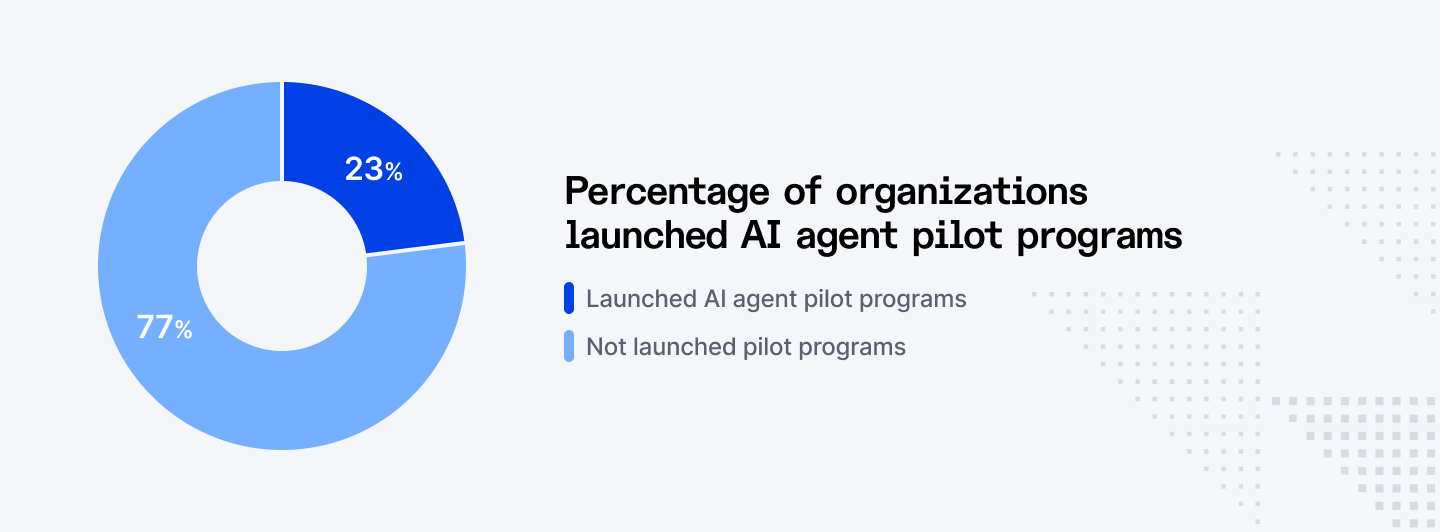
- Only 2% of enterprises report deploying AI agents at full scale, highlighting how rare end-to-end adoption still is.
- 12% of organizations operate AI agents at partial scale, typically within specific functions or workflows rather than across the enterprise.
- The majority of deployed AI agents currently operate at low or intermediate levels of autonomy, functioning as task-level or semi-autonomous systems rather than independent decision-makers.
- Within the next 12 months, enterprises expect only 15% of business processes to reach semi-autonomous or fully autonomous operation.
- By 2028, enterprises expect 25% of processes to operate at higher autonomy levels, suggesting cautious, staged expansion.
- AI agents are most commonly deployed alongside human supervision, with human-in-the-loop models dominating early adoption.
- Enterprises increasingly view AI agents as collaborators embedded within workflows rather than standalone tools or replacements.
Up next: See how ready different countries really are for AI and who’s falling behind in 2026.
Productivity Impact and Enterprise Value Creation
AI agents are being adopted with clear expectations around efficiency, output, and economic impact. While most deployments are still early, available data already shows measurable productivity gains and projected enterprise value when agents are embedded into workflows.
- Enterprises deploying AI agents expect an average 30% productivity improvement, driven by automation of complex, multi-step workflows.
- AI agents are projected to generate up to $450 billion in economic value by 2028 through combined revenue uplift and cost savings across surveyed economies.
- Organizations using enterprise AI report employees saving 40 to 60 minutes per day on routine and knowledge-intensive tasks.
- Adoption of AI agents working alongside human employees is expected to grow by 327% over the next two years, signaling rapid scaling of agent-driven work.
- Only 15% of enterprise business processes are expected to operate at semi-autonomous or fully autonomous levels within the next 12 months, limiting near-term impact.
- That share is projected to increase to 25% by 2028, indicating a gradual expansion of agent autonomy over time.
- Over the past year, enterprise AI usage intensity has increased sharply, with API-based reasoning token consumption per organization rising by 320× year over year in large-scale deployments.
- Enterprises with deeper AI integration show usage concentration gaps, with frontier firms using advanced AI capabilities at 2× the rate per seat compared to median enterprises.
Investment, Budget Allocation, and Enterprise Spend
Enterprise investment in AI agents has increased rapidly as organizations shift from experimentation toward operational deployment. AI has overtaken traditional digital transformation as a top strategic priority, with budgets increasingly allocated to agent platforms, infrastructure, and integration. However, investment outcomes remain uneven, revealing a sharp divide between enterprises that convert spending into production systems and those that remain stuck at pilot or evaluation stages.
- More than 90% of enterprise leaders plan to maintain or increase AI investment, making AI the highest-ranked strategic priority, yet 95% of organizations report that current AI spending has not produced measurable business returns.
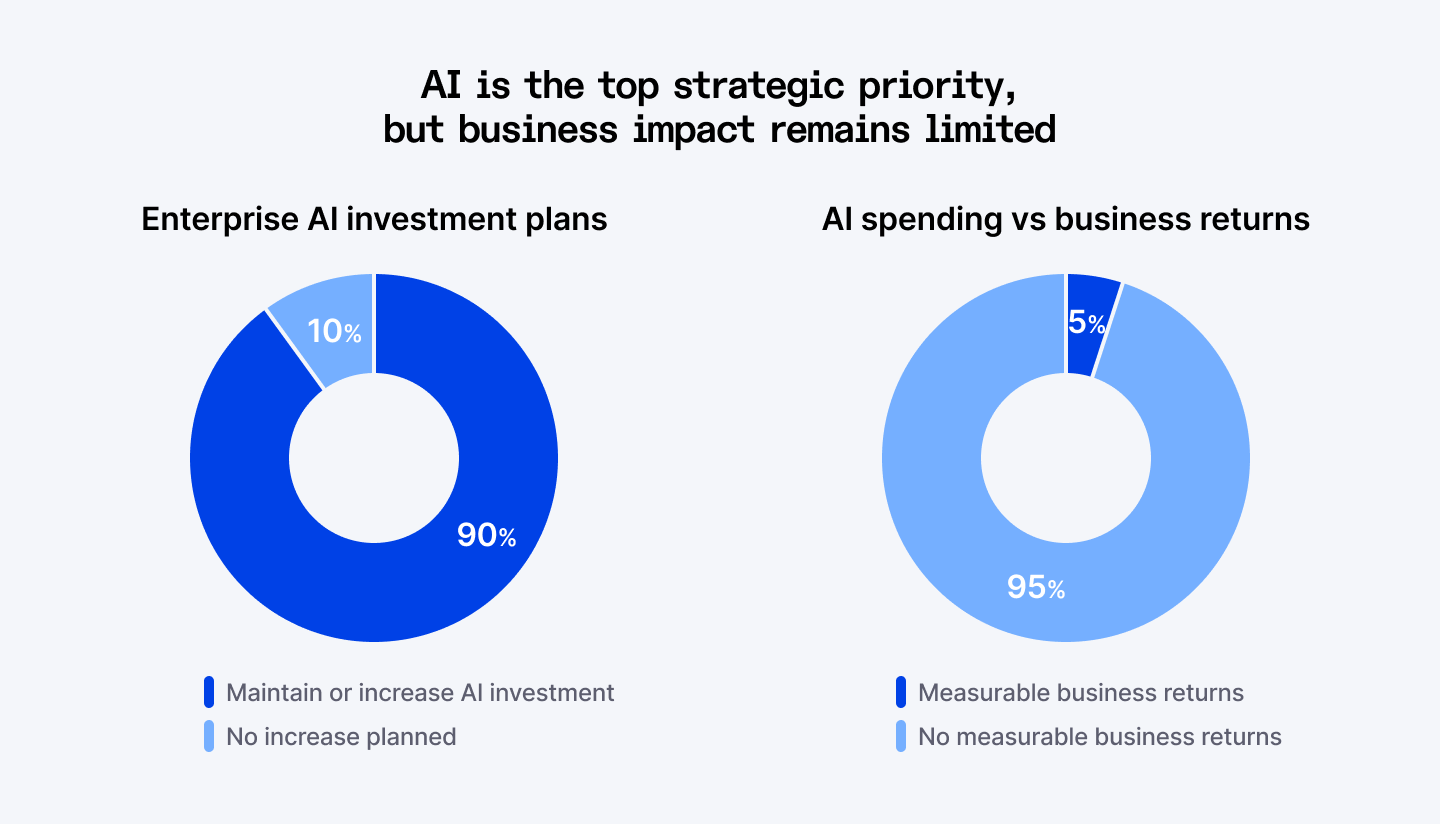
- Enterprise investment in generative and agentic AI is estimated at $30–40 billion, but only 5% of organizations have translated that spending into production-grade deployments with material P&L impact.
- While 60% of enterprises have evaluated enterprise-grade AI or agentic systems, adoption drops sharply across stages, with only 20% progressing to pilots and just 5% reaching full production.
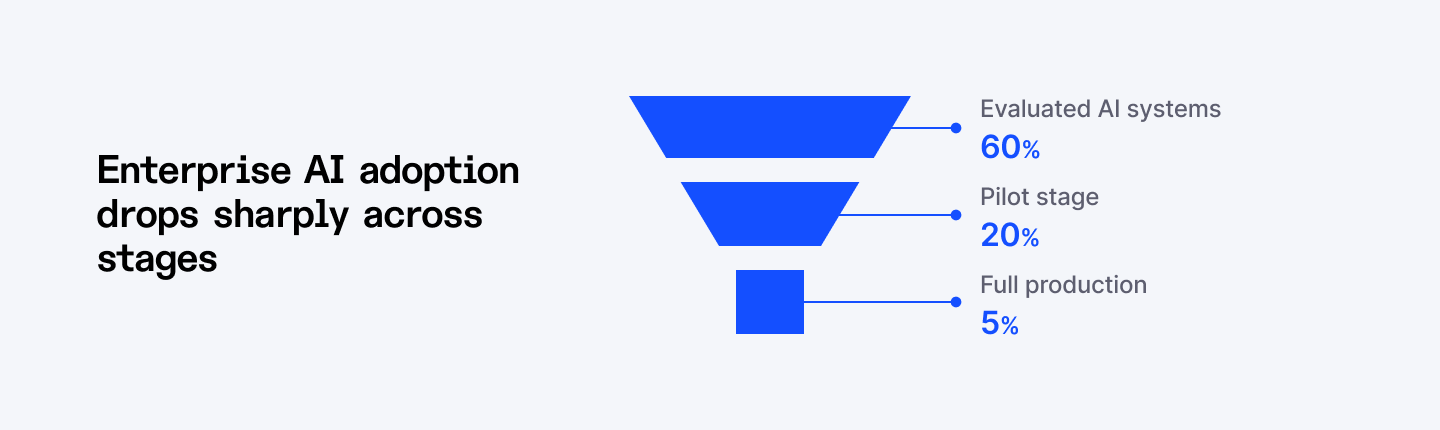
- Large enterprises lead in pilot volume but lag in scale, creating an execution gap where experimentation is high but sustained deployment remains limited.
- Organizations that engage external vendors, platforms, or system integrators show 2× higher success rates in scaling AI deployments compared to organizations relying solely on internal builds.
Trust, Governance, and Risk Readiness
As AI agents gain higher levels of autonomy, trust and governance have emerged as critical bottlenecks in enterprise adoption. While organizations express a strong interest in agentic systems, concerns around accountability, data control, and operational risk continue to slow large-scale deployment. The data shows that declining trust, limited readiness, and weak governance infrastructure are major reasons why many enterprises remain stuck at pilot stages.
- Only 27% of organizations report trusting fully autonomous AI agents, down from 43% twelve months earlier, indicating declining confidence as deployments move closer to real-world impact.
- Fewer than 50% of organizations say they have a clear understanding of AI agent capabilities, limiting their ability to assess risk and deployment boundaries.
- More than 80% of enterprises report lacking mature AI infrastructure, including monitoring, auditability, and control mechanisms required to govern agentic systems at scale.
- Less than 20% of organizations report high levels of data readiness, increasing the risk of agent failure, hallucination, or unintended actions in production environments.
- Although ethical risks such as data privacy, algorithmic bias, and explainability are widely acknowledged, fewer than 33% of organizations report having implemented concrete mitigation measures.
- Organizations that successfully deploy AI agents typically restrict autonomy during early stages, with the majority relying on human-in-the-loop models before expanding agent authority over time.
Workforce Impact, Skills, and Organizational Readiness
AI agent adoption is reshaping how work is distributed between humans and machines, but enterprise readiness has not kept pace with ambition.
While leaders expect significant productivity gains, many organizations lack the skills, data foundations, and internal alignment required to scale agentic systems responsibly. The data shows rising workforce anxiety alongside limited preparedness for long-term organizational change.
- 61% of organizations report increasing employee anxiety about the impact of AI agents on job security and future roles.
- More than 50% of leaders believe AI agents will displace more jobs than they create, despite limited large-scale workforce restructuring to date.
- Fewer than 20% of organizations report high levels of data readiness, constraining the ability of AI agents to operate reliably in production environments.
- Over 80% of enterprises lack mature AI infrastructure, including the tooling required to support agent learning, monitoring, and escalation.
- Only 50% of organizations say they have sufficient knowledge of AI agent capabilities, limiting effective training, oversight, and role design.
- Enterprises that successfully deploy AI agents report stronger cross-functional alignment between technology, operations, and risk teams than those stalled at pilot stages.
Read next: Discover where AI growth is accelerating worldwide and what it means for businesses this year.
Industry and Functional Adoption Patterns
AI agent adoption is not uniform across industries or business functions. Early deployment is concentrated in areas where workflows are digital, repetitive, and measurable, while more complex or regulated functions move cautiously. The data shows clear clustering around customer-facing and IT-driven use cases, with slower penetration into core operational and strategic domains.
- AI agents are most widely deployed in customer service, IT operations, and sales, which together account for the highest share of early enterprise use cases.
- Nearly 40% of organizations report deploying generative AI tools in production, but far fewer have extended these deployments into fully agentic, multi-step systems.
- Only 2 of 9 major industry sectors show signs of meaningful structural transformation from AI adoption, while the remaining sectors remain largely in pilot or limited-use phases.

- Technology and media sectors lead enterprise AI adoption, while capital- and labor-intensive industries lag due to integration complexity and legacy systems.
- 60% of enterprises evaluate enterprise-grade AI or agentic platforms, yet only 5% reach full production, indicating industry-wide friction between evaluation and scale.
- Back-office functions with high automation potential receive significantly less AI agent deployment than front-office functions, despite stronger projected ROI.
Geographic Readiness and Global Adoption Gaps
Enterprise adoption of AI agents varies widely by region, shaped by differences in regulation, infrastructure, talent availability, and national AI strategies. While some countries are actively preparing for large-scale agentic AI deployment, others remain in early readiness stages. The data shows that global adoption is advancing unevenly, with clear leaders emerging and significant gaps persisting across markets.
- Adoption of AI agents working alongside human employees is expected to increase by 327% globally over the next two years, but readiness levels differ sharply by country.
- Only 16 countries were assessed as part of global AI agent readiness evaluations, highlighting how adoption leadership is concentrated in a limited number of markets.
- Countries with advanced digital infrastructure and mature AI regulation frameworks show higher enterprise readiness scores than those still developing AI governance models.
- Less than 20% of organizations globally report high data readiness, creating a shared constraint across both advanced and emerging markets.
- More than 80% of enterprises worldwide lack the mature AI infrastructure required to safely scale agentic systems across business operations.
- Regions with lighter-touch or enabling regulatory approaches show faster enterprise experimentation with AI agents than regions relying primarily on restrictive or reactive frameworks.
Barriers to Scale and Why AI Agent Pilots Stall
Despite strong executive interest and rising investment, most AI agent initiatives fail to move beyond pilots. The data shows that stalled adoption is rarely caused by model capability alone. Instead, scaling breaks down due to learning gaps, integration friction, weak data foundations, and misalignment between AI systems and real business workflows.
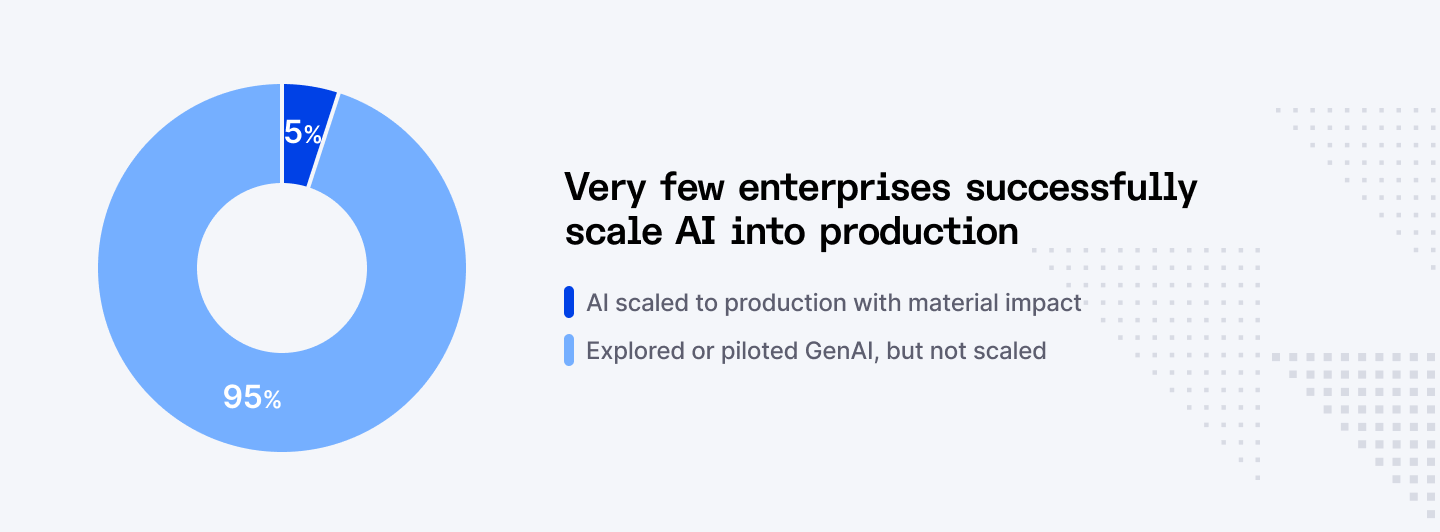
- 95% of organizations report that their AI initiatives have produced little to no measurable business return, despite widespread pilot activity.
- While over 80% of organizations have explored or piloted generative AI tools, only 5% of enterprises have successfully scaled AI systems into production with a material impact.
- 60% of enterprises evaluate enterprise-grade or custom AI systems, but adoption collapses across stages, with only 20% reaching pilot and 5% reaching production.
- Across industries, only 2 out of 9 major sectors show evidence of meaningful structural change from AI adoption, while the remaining sectors remain stuck in experimentation.
- Fewer than 20% of organizations report high data readiness, limiting the ability of AI agents to learn from feedback, adapt to context, or operate reliably over time.
- Enterprises relying solely on internal AI builds are half as likely to scale successfully compared to those working with external vendors or system integrators.
AI Agent Autonomy Levels and Human-in-the-Loop Deployment
Enterprise adoption of AI agents is closely tied to how much autonomy organizations are willing to grant. Most enterprises are deliberately limiting agent independence, preferring supervised or semi-autonomous systems over fully autonomous deployment.
The data shows that while agent capabilities are advancing quickly, enterprises remain cautious about expanding authority without proven reliability and governance.
- Only 15% of enterprise business processes are expected to operate at semi-autonomous or fully autonomous levels within the next 12 months.
- That figure is projected to rise to 25% by 2028, indicating gradual expansion rather than rapid autonomy jumps.
- Just 27% of organizations report trusting fully autonomous AI agents, down from 43% one year earlier.
- The majority of deployed AI agents currently operate at low or intermediate autonomy levels, performing task execution under human supervision.
- Enterprises most commonly adopt human-in-the-loop models, expanding agent autonomy only after reliability is demonstrated through controlled use.
- Organizations that scale AI agents successfully tend to align autonomy levels with task risk, granting limited authority in early deployments.
Don’t miss: Learn how AI is being used inside modern applications, backed by real adoption data.
Final Words: What AI Agent Enterprise Adoption Statistics Show
AI agent adoption in the enterprise is moving fast, but not evenly. The data makes one thing clear: interest and investment are no longer the bottlenecks. The real constraints are execution, readiness, and trust. While most organizations are experimenting with agents and planning broader rollouts, only a small fraction has crossed the gap from pilots to production.
The statistics show a widening divide between leaders and laggards. A handful of enterprises are redesigning workflows, investing in data and governance, and treating AI agents as long-term infrastructure.
Most others remain stuck with testing tools without the organizational changes needed to scale. Until issues around data readiness, integration, workforce alignment, and governance are addressed, AI agents will continue to deliver promise on paper faster than impact in practice.
➡︎ 82% plan AI agents, but infrastructure and trust issues keep 86% from deploying. Index.dev connects you with senior developers experienced in AI agent architecture, multi-step workflows, and production deployment. Start hiring now!
➡︎ Enjoyed this read? Explore our in-depth guides on the skills AI can't automate and find out whether AI agents will replace software developers. Check out the top AI skills to learn to command a higher salary and discover the 10 must-have AI roles for the future of work. For data-driven insights, dive into 50+ AI in job interview stats, AI growth statistics by country, and developer productivity stats with AI coding tools. Finally, understand the bigger picture with 50+ key AI agent statistics and adoption trends.
FAQs
1. If interest in AI agents is so high, why are most enterprises still stuck in pilots?
Because intent is outpacing readiness. While 82% of organizations plan to adopt AI agents within one to three years, only 14% have deployed them at partial or full scale, and just 2% operate agents at full enterprise scale. The gap is driven by data readiness, governance, and integration limits rather than a lack of demand.
2. How fast is AI agent adoption actually growing inside enterprises?
Adoption of AI agents working alongside human employees is expected to increase by 327% over the next two years. However, this growth is concentrated in low- to mid-autonomy use cases, not fully autonomous systems.
3. Are enterprises trusting AI agents more as they mature?
No. Trust has declined. Only 27% of organizations report trusting fully autonomous AI agents, down from 43% one year earlier, as real-world risks and governance concerns become clearer during deployment.
4. What level of autonomy are enterprises comfortable with right now?
Very limited. Only 15% of business processes are expected to operate at semi-autonomous or fully autonomous levels in the next 12 months, rising gradually to 25% by 2028. Most agents remain human-supervised.
5. Do AI agents actually improve productivity, or is that still theoretical?
Productivity gains are measurable but uneven. Enterprises adopting AI agents report expected productivity improvements of around 30%, and employees using enterprise AI tools report saving 40–60 minutes per day on routine and knowledge-intensive tasks.
6. Why do so many AI investments fail to show ROI?
Because scale is rare. Despite $30–40 billion in enterprise investment in generative and agentic AI, 95% of organizations report little to no measurable return. Only 5% of AI initiatives reach production with a material business impact.
7. What is the biggest technical blocker to scaling AI agents?
Data and infrastructure. Fewer than 20% of organizations report high data readiness, and over 80% lack mature AI infrastructure, including monitoring, auditability, and control systems required for agentic deployment.
8. Are some industries clearly ahead in AI agent adoption?
Yes, but narrowly. Only 2 out of 9 major industry sectors show signs of meaningful structural transformation from AI adoption. Customer service, IT operations, and sales lead adoption, while most sectors remain in experimentation phases.
9. Does working with vendors actually improve success rates?
Yes. Organizations that partner with external vendors or system integrators are 2× more likely to successfully scale AI systems compared to enterprises relying solely on internal builds.
10. What separates enterprises that scale AI agents from those that don’t?
Execution discipline. Scaled adopters redesign workflows, limit early autonomy, invest in governance, and align agents to business outcomes. Everyone else tends to stop at pilots, which explains why 60% evaluate AI systems but only 5% reach production.
Data Sources
- https://www.weforum.org/reports/ai-agents-in-action-foundations-for-evaluation-and-governance
- https://www.capgemini.com/insights/research-library/the-state-of-ai-in-2025/
- https://nanda.ai/research/state-of-ai-in-business-2025
- https://www.salesforce.com/resources/research-reports/global-ai-readiness-index/
- https://openai.com/research/the-state-of-enterprise-ai-2025
- https://www.turing.com/resources/state-of-ai-adoption-2025
- https://www.oecd.org/digital/ai/adoption-by-smes.htm
- https://www.weforum.org/publications/global-ai-adoption-in-the-g7/
- https://www.mckinsey.com/capabilities/quantumblack/our-insights/the-state-of-ai-in-2025