AI in Application Development Statistics reveal a clear gap between how fast teams want to ship software and how slow traditional workflows still are.
Many developers struggle with long coding cycles, slow reviews, and constant context switching.
AI tools reduce these problems by speeding up coding, improving accuracy, and helping teams work smarter.
In fact, developers use AI to write cleaner code, learn faster, fix errors, and search documentation with less effort.
We collected all AI in Application Development Statistics from trusted and verified research reports, developer surveys, and market studies. You can find every source URL at the end of this article for full transparency.
Join Index.dev to access high-paying remote projects and sharpen your app development skills using the latest AI technology.
Key findings: AI in application development (2026)
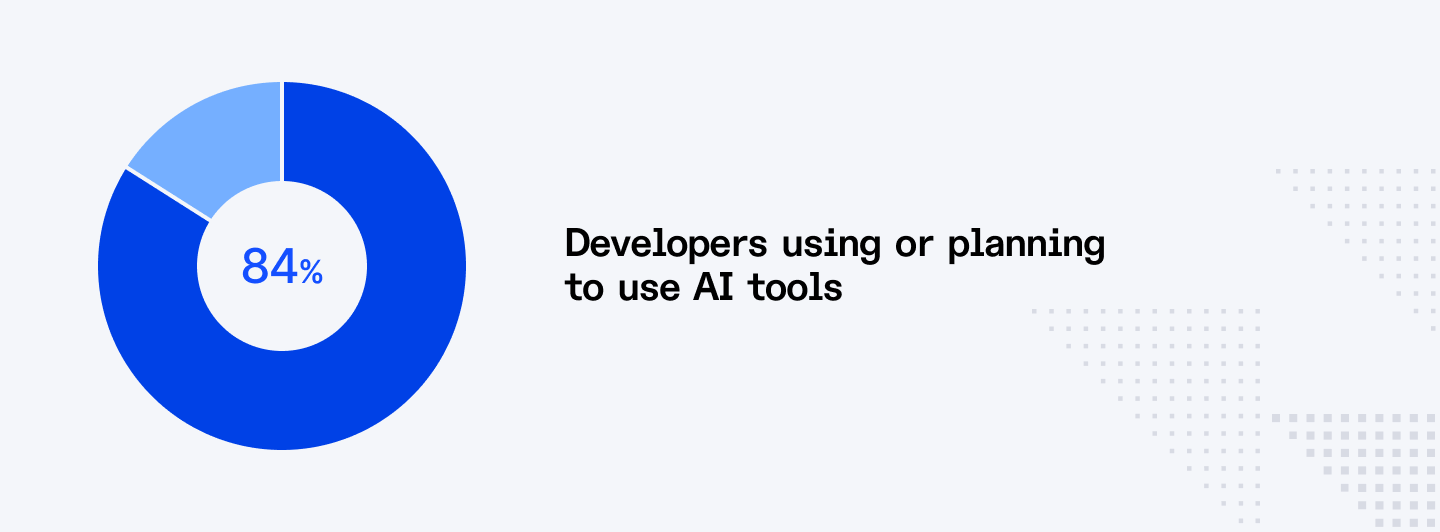
- 84% of developers use or plan to use AI, showing strong adoption across development teams.
- 51% use AI tools daily, making AI a normal part of coding work.
- AI improves coding speed by up to 55%, helping teams finish tasks faster.
- Documentation search time drops by 62% with AI, reducing daily workflow friction.
- 85% see better code quality with GitHub Copilot, especially in readability and structure.
- 46% distrust AI accuracy, showing developers still rely on human checks.
- 68% face reliability issues, including incorrect or incomplete outputs.
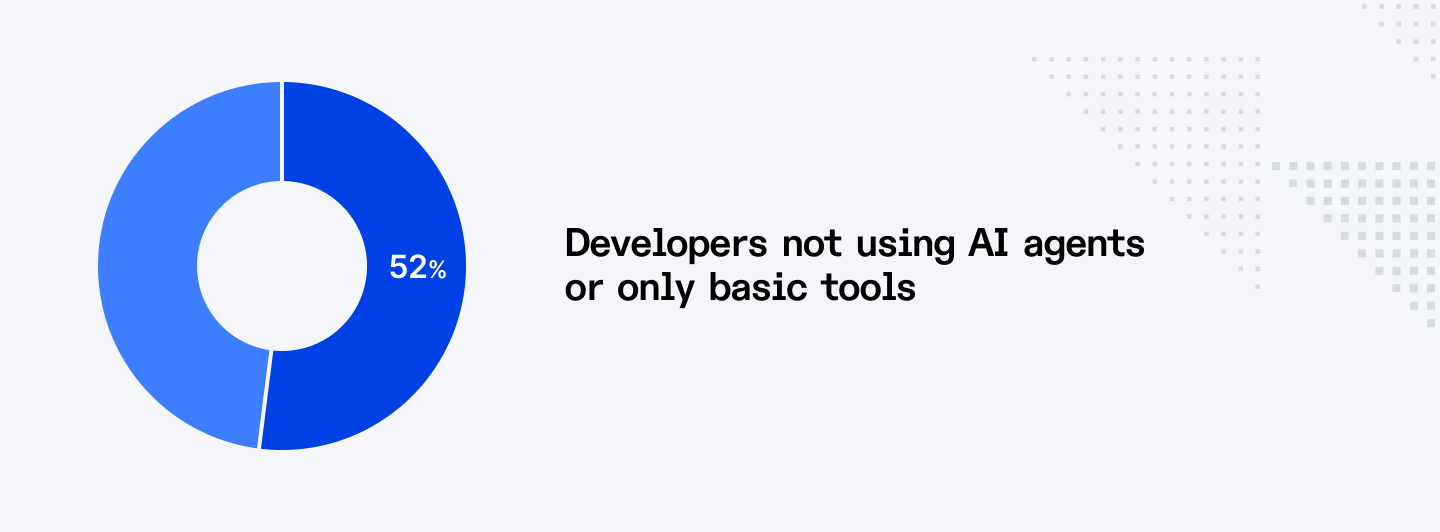
- 52% do not use AI agents, showing agents are still early in adoption.
- AI boosts productivity by 39%, helping developers focus on higher-value tasks.
- The AI market will reach USD 3.49 trillion by 2033, confirming rapid long-term growth.
AI adoption in application development
Readers will learn how widely developers depend on AI tools and how fast adoption is growing. The data highlights daily usage, tool preferences, and company-level adoption trends. This category matters because it shows how AI is becoming a normal part of the modern development workflow.
- 84% of developers already use or plan to use AI tools, which shows that AI is becoming a standard part of the development process.
- 51% use AI tools every day, which means AI is now built into their coding routine.
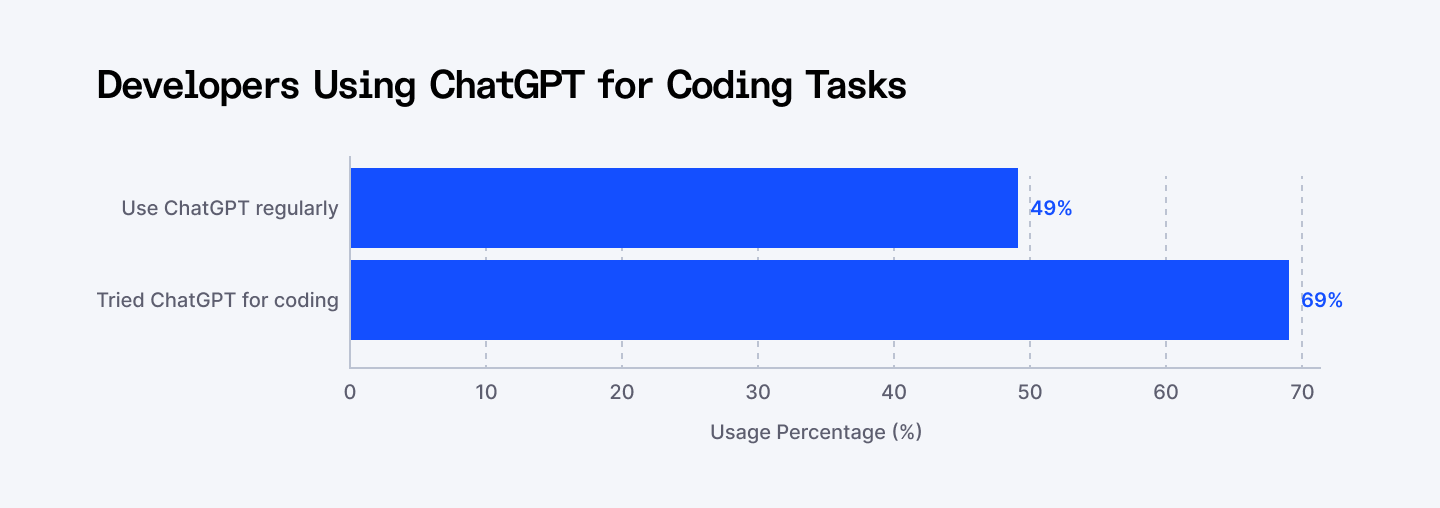
- 69% have tried ChatGPT for coding tasks, and 49% use it regularly because it helps with problem-solving and provides fast answers.
- 40% have tried GitHub Copilot, and 26% use it often because it helps them code.
- 19% of companies already use generative AI to write code or create documentation.
- 24% are in the testing phase, which shows steady movement toward adoption.
Use of AI agents in development
This part explores how developers and companies approach AI agents, including adoption levels, early testing, and real business use cases. The insights help readers understand why agents are still in early stages and which industries are moving faster toward agent-driven automation.
- 52% of developers do not use AI agents or use only basic AI tools, showing that advanced agents are still new.
- 38% have no plans to adopt AI agents, indicating slow acceptance for agent-driven workflows.
- 23% of companies have started expanding the use of AI agents in at least one function.
- 39% are experimenting with agent systems to understand how they can help in real projects.
- In the UK retail sector, 90% of decision-makers are actively exploring AI agents.
- One third already use agents in real work, which shows strong industry confidence.
- 55% use agents for customer support tasks, such as chatbots.
- 49% use agents to improve operations and reduce manual work.
Read next: Discover the 5 best AI agents for coding and see how developers speed up workflows.
AI supports learning and developer skills
Here, readers will see how AI helps developers learn new languages, understand complex code, and build skills faster. The data explains how much time AI saves and why developers consider it a strong learning assistant in their daily work.
- 60% to 71% of developers say AI helps them learn new languages and understand complex code faster.
- 23 to 29% find AI extremely helpful because it explains code in simple steps.
- 47% use the saved time to focus on higher-level work, such as planning, design, and team collaboration.
Productivity impact of AI tools
This focuses on how AI improves speed and efficiency in development. The insights include faster coding, quicker code reviews, reduced search time, and overall productivity gains. Readers can see why performance improvement is the biggest reason teams adopt AI.
- 52% say AI increases their productivity and helps them finish work faster.
- Developers who use AI write code up to 55% faster than those who do not use AI.
- GitHub Copilot Chat helps complete code reviews 15% faster by pointing out common errors.
- AI reduces the time spent searching technical documentation by 62%.
- AI improves solution accuracy by 56% by analyzing past project knowledge.
- AI-powered tools increase overall developer productivity by 39%.
- Time spent on routine coding tasks drops by 43% when using AI assistance.
Discover the AI tools that truly make a difference in coding productivity.
Code quality and security improvements with AI
This part highlights how AI improves code quality and strengthens security practices. Readers will find confidence metrics, country-level improvements, and expectations for future security benefits. These insights show why AI is valued for improving code standards.
- 85% feel more confident in their code quality when using GitHub Copilot or Copilot Chat.
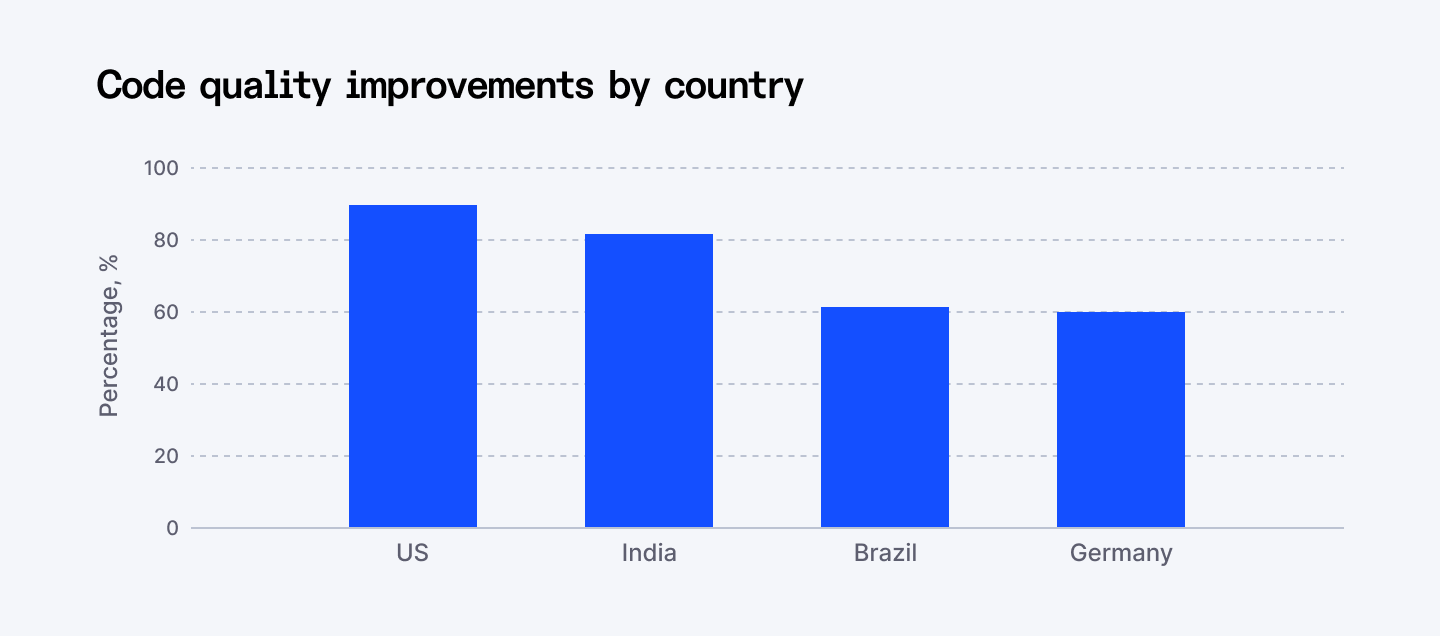
- Developers in the US (90%) and India (81%) report strong gains in code quality. Developers in Brazil (61%) and Germany (60%) also see clear improvements.
- 99 to 100% believe AI will help improve code security in the future.
- 41% of Indian developers expect AI to bring significant security improvements.
Trust and accuracy concerns about AI
The data here highlights gaps in trust, accuracy issues, and privacy worries developers face. Readers will understand why many developers still double-check AI output and why trust remains a major challenge despite high adoption.
- 46% distrust AI accuracy because it often makes small but important mistakes.
- 33% trust AI output but still check it manually.
- Only 3% trust AI results fully without heavy checking.
- Experienced developers show the lowest trust (2.6%) because they spot errors more easily, highlighting the need for human review.
- 87% of all users worry about AI accuracy.
- 81% worry about security and privacy when using AI tools.
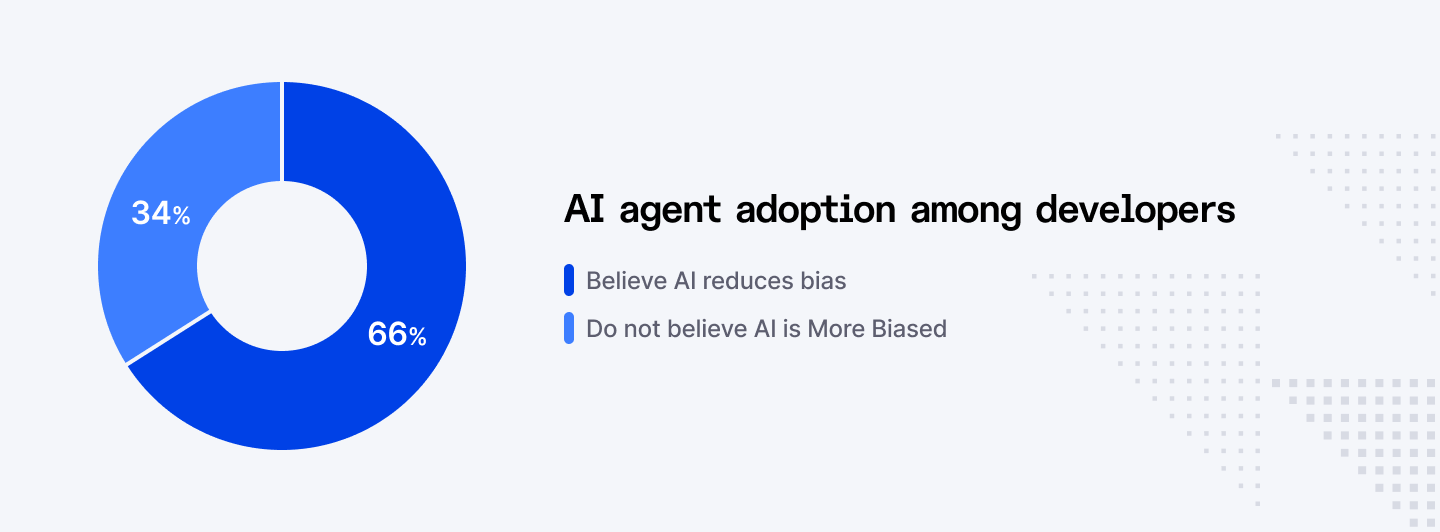
- 68% have experienced issues such as inaccurate answers, unreliable code, or performance problems.
- 54% worry about AI agent output being inconsistent, and 45% worry about privacy risks linked to agent workflows.
Human checks and risk control in development
This category explains why developers keep humans in control, especially for tasks with high risk such as deployment and project planning. The insights show the limits of AI and why teams rely on manual review to maintain software quality.
- 68% of C-suite executives believe developers must continue to review AI output to maintain software quality.
- The share of developers who think AI struggles with complex tasks dropped from 35% to 29%, but many still avoid using AI for high-risk work.
- 76% do not use AI for deployment or monitoring because mistakes can break live systems.
- 69% avoid using AI for project planning because they need an accurate understanding and judgment.
Key developer problems with AI tools
Readers will see the most common issues developers face when using AI, including incorrect outputs, debugging overhead, and performance problems. This helps set realistic expectations for teams planning to adopt AI in their workflows.
- 66% deal with AI outputs that look correct at first but contain hidden mistakes.
- 45% say debugging AI-generated code takes more time than writing the code manually.
- 68% face performance, accuracy, or reliability problems when using AI tools.
Company rules for AI usage
This part covers how organizations manage AI tools, including usage policies, permissions, and restrictions. The insights show how company rules shape developer behavior and influence the pace of AI adoption.
- 30 to 40% say their companies encourage the use of AI for development tasks.
- 29 to 49% say their companies allow AI tools but do not actively promote them.
- 17 to 27% use AI only at work because of company policies, not personal preference.
- About 80% of companies either allow third-party AI tools or have no strict rules. Only 11% fully ban third-party cloud-based AI tools.
Barriers that slow AI adoption
This outlines the main factors that limit AI adoption, such as immature technology, readiness gaps, and concerns about accuracy and security. Readers gain a clear view of what organizations must address before scaling AI.
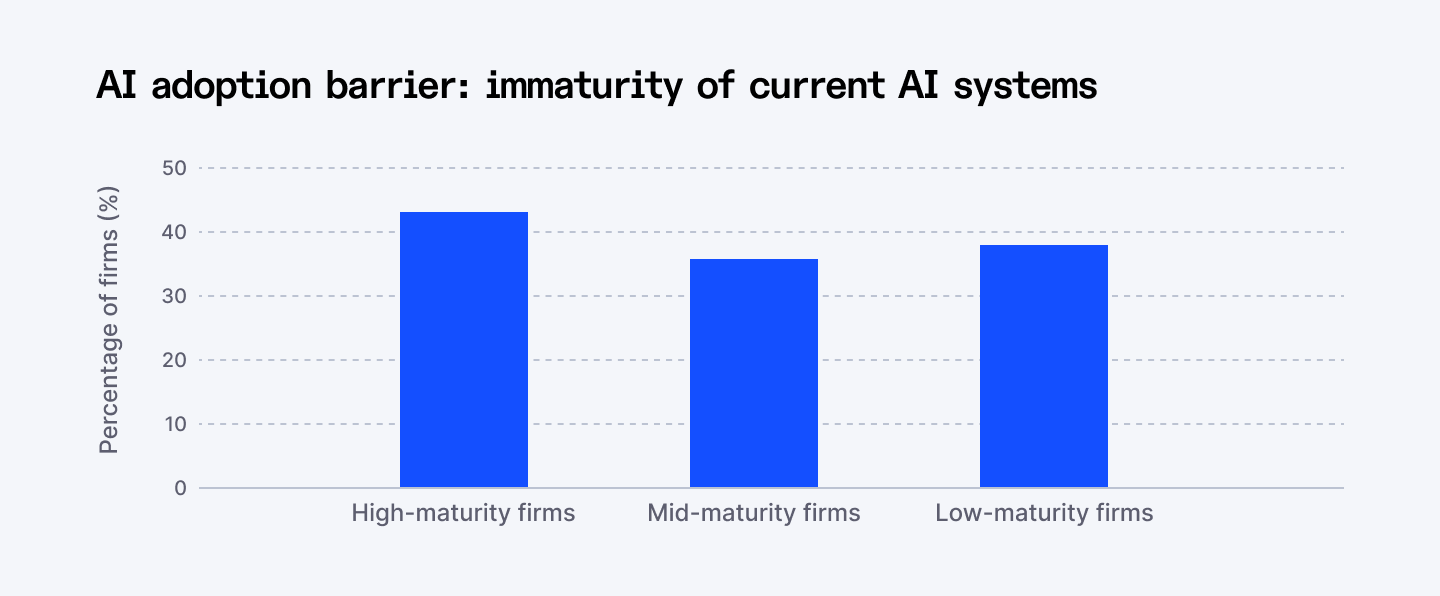
- The main barrier for all companies is the immaturity of current AI systems. This challenge affects 43% of high-maturity firms, 36% of mid-maturity firms, and 38% of low-maturity firms.
- Half of the companies with no AI maturity face serious adoption problems.
- 30% of low or no-maturity companies do not plan to adopt GenAI within the next three years.
Market growth for AI in development
Readers will find forecasts and market-size predictions that highlight how rapidly AI is expanding in the software development industry. This helps show the long-term impact of AI and why it will shape future development practices.
- The global AI market will grow to USD 3.49 trillion by 2033, showing massive long-term demand.
- AI will grow at a strong 31.5% CAGR from 2025 to 2033, making it one of the fastest-growing tech areas.
- The generative AI market for software development will grow from USD 53.4 billion in 2024 to USD 66.77 billion in 2025.
- By 2028, 75% of enterprise software engineers will use AI coding assistants as a standard tool.
How companies use AI in real workflows
This provides examples of how teams use AI beyond coding, such as data analysis, idea generation, and content creation. The insights show how AI improves everyday operations across different business areas.
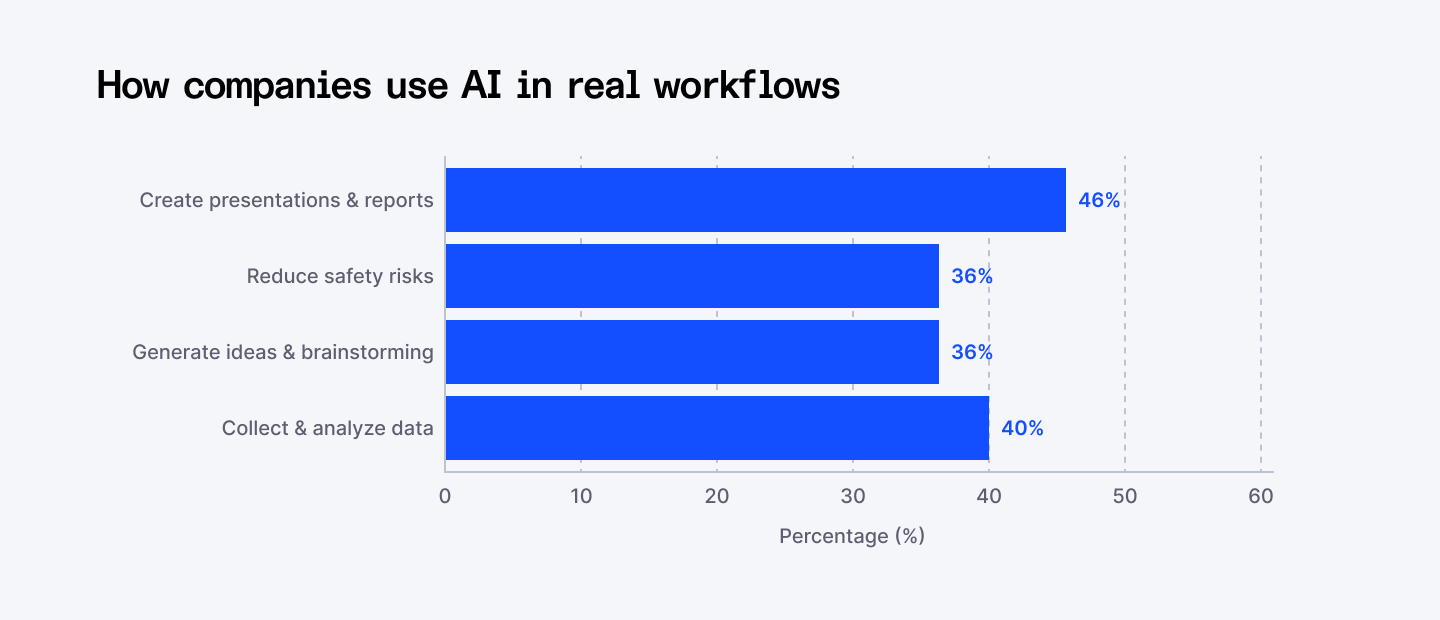
- 40% use AI to collect and analyze data from many sources.
- 38% use AI to generate ideas and speed up brainstorming.
- 38% use AI to reduce safety risks and support safe operations.
- 46% use AI to create business presentations, reports, and communication content inside the company.
Next up: See how AI is boosting developer efficiency and workflow.
Developer habits and AI usage trends
Here, readers will see how developer behavior is changing because of AI. The data covers how often developers experiment with tools, what tasks they automate, and how habits are shifting across teams.
- 97% have used AI coding tools at least once, showing nearly universal exposure.
- 18% work on building AI integrations inside software projects, showing strong developer interest in AI skills.
- Developers increasingly use AI for routine tasks, code exploration, and quick explanations.
Industry examples of AI agent adoption
This category shares real-world industry cases where AI agents are being used. Readers will see which sectors are leading adoption and which roles agents are starting to take on in customer support, operations, and other workflows.
- 90% of UK retail leaders are exploring AI agents as part of their future strategy.
- 51% expect AI agents to handle most customer support tasks within five years.
Final words
The data shows that AI is no longer an add-on in development. It now acts as a practical tool that improves speed, learning, and day-to-day work for most developers. But the numbers also make one thing clear: AI cannot replace human judgment yet. Developers still face issues with accuracy, unclear outputs, and security risks, which means teams must use AI with control and review.
As the market grows and more organizations adopt AI, the focus will shift toward building safer systems, setting strong usage policies, and training developers to work with AI tools the right way. Teams that understand both the benefits and limits of AI will be best positioned to build reliable applications and stay ahead in a fast-moving development landscape.
➡︎ Level up your career with Index.dev. Work on high-paying app development projects, collaborate with global teams, and make AI-powered coding part of your workflow.
➡︎ Want to explore more insights on AI talent, strategy, and hiring? Dive into our related guides on global AI talent pools, building an AI-first tech stack, hiring developers faster with AI, emerging AI roles, and how top companies solved remote AI hiring challenges.
FAQs
How many developers use AI in application development?
84% of developers use or plan to use AI in application development, and 51% already use AI tools every day. This shows that AI has become a standard part of the development workflow. Developers rely on AI for coding help, debugging support, documentation search, and faster problem-solving. Daily usage also proves that AI is now embedded in modern development practices.
Do AI tools improve developer productivity?
AI-assisted developers code up to 55% faster, which confirms that AI tools clearly improve productivity in application development. They also complete code reviews 15% faster and reduce documentation search time by 62%. These gains help developers finish tasks sooner and spend more time on planning, design, and complex work that needs human thinking and decision-making.
Are developers confident in the accuracy of AI tools?
46% of developers distrust the accuracy of AI tools, while only 3% highly trust them. This low trust level shows that developers still need to check AI outputs manually.
Many AI-generated answers contain small errors that can break code or cause logic issues. Experienced developers are the most cautious, which proves that AI cannot replace human review for critical tasks.
What problems do developers face when using AI tools?
66% of developers face AI outputs that look correct but contain errors, which is the biggest problem with AI-generated code. Another 45% say debugging AI code takes more time than writing the code themselves. Developers also experience issues with accuracy, performance, and reliability.
Are companies using AI agents for development work?
52% of developers do not use AI agents, indicating that agent adoption remains low in application development. Another 38% have no plans to adopt agents soon.
However, some industries lead the shift. In the UK retail sector, 90% of leaders are exploring agent use for customer support, operations, and marketing tasks, even though technical development use cases are still in their early stages.
Do AI tools improve code quality and security?
85% of developers feel that AI tools improve code quality, confirming strong benefits for development teams. Developers in the US, India, Brazil, and Germany report clear improvements in readability, structure, and consistency with tools like GitHub Copilot.
Almost all developers expect AI to improve code security by catching errors and unsafe patterns, even though human review remains necessary.
What slows down AI adoption in development teams?
The immaturity of AI technology slows adoption for 43% to 50% of companies across different maturity levels. Many teams feel AI tools are not reliable enough for complex or high-risk tasks, and concerns about accuracy, data privacy, and security remain high.
About 30% of low-maturity companies do not plan to adopt GenAI over the next 3 years, indicating slow readiness.
How fast is the AI market growing for software development?
The AI market for software development will reach USD 3.49 trillion by 2033, growing at a strong 31.5% CAGR. Generative AI alone will rise from USD 53.4 billion in 2024 to USD 66.77 billion in 2025. This rapid growth shows how quickly businesses are adopting AI for coding, automation, and enterprise development.
Data Sources
- https://survey.stackoverflow.co/2025/ai#sentiment-and-usage-ai-sel-prof
- https://www.grandviewresearch.com/horizon/outlook/artificial-intelligence-market-size/global
- https://github.blog/news-insights/research/research-quantifying-github-copilots-impact-on-code-quality/
- https://kpmg.com/kpmg-us/content/dam/kpmg/pdf/2023/KPMG-GenAI-and-SDLC.pdf
- https://www.leapwork.com/resources/ai-and-software-quality-report?utm_source=chatgpt.com
- https://blog.tbrc.info/2025/02/generative-artificial-intelligence-in-software-development-market/
- https://www.bcg.com/press/16july2024-genai-investment-high-maturity-companies-projecting-three-times-higher-roi
- https://www.gartner.com/en/newsroom/press-releases/2024-04-11-gartner-says-75-percent-of-enterprise-software-engineers-will-use-ai-code-assistants-by-2028
- https://www.forbes.com/advisor/business/software/ai-in-business/
- https://github.blog/news-insights/research/survey-ai-wave-grows/
- https://www.jetbrains.com/lp/devecosystem-2024/
- https://www.researchgate.net/publication/378962192_The_Impact_of_Artificial_Intelligence_on_Programmer_Productivity
- https://www.mckinsey.com/capabilities/quantumblack/our-insights/the-state-of-ai
- https://retailtechinnovationhub.com/home/2025/8/18/ai-technology-adoption-surges-as-majority-of-uk-retailers-now-have-chief-ai-officers-to-drive-strategy