In this listicle roundup, we break down the most important AI job growth statistics that show how fast AI is reshaping skills, roles, and industries worldwide.
These updated AI job growth insights help you understand where the workforce is heading and which opportunities are growing the fastest. We collect data from trusted online sources, and all source URLs are included at the end of the article for transparency.
Hire proven AI, ML, and data engineers globally—fast, compliant, and ready to deliver.
Key Takeaways
- Growth of 176% and 151% in AI specialist roles shows how quickly major economies like India and the UK are expanding their AI talent demand.
- 39% of skills will become outdated by 2030, proving how fast workers must adapt to AI-driven changes.
- 77% of employers plan to upskill their staff so teams can work more effectively with AI tools.
- 86% of businesses expect AI to transform operations by 2030, making AI the strongest driver of workplace change.
- 7x growth in demand for AI fluency shows that AI literacy is the fastest-growing skill requirement.
- 56% wage premium for AI-skilled workers shows the rising value of machine learning and prompt engineering skills.
- 1 in 4 workers is exposed to generative AI, highlighting major workforce shifts and uneven automation risk.
- 60–70% automation potential in current work activities shows why productivity gains are accelerating across industries.
- 72% of companies now use AI in at least one function, signalling rapid and widespread enterprise adoption.
- 300 million jobs may be exposed to automation, showing the global scale of workforce transition ahead.
Global AI Job Growth and Workforce Transformation
AI is reshaping global job markets at a rapid pace, and this category shows how quickly AI roles and AI-influenced careers are expanding. The data highlights significant growth in AI specialist roles, strong hiring momentum across all industries, including virtual assistants, and widespread confidence that AI will transform businesses by 2030. Readers can see how AI is opening new sectors, increasing demand for AI fluency, and reshaping long-term employment patterns.
- AI and Machine Learning Specialists show strong growth, with net increases of +176% and +151% in major economies such as India and the UK.
- The number of AI-related roles and AI-skilled professionals has more than doubled across almost all industries from 2016 to 2024.
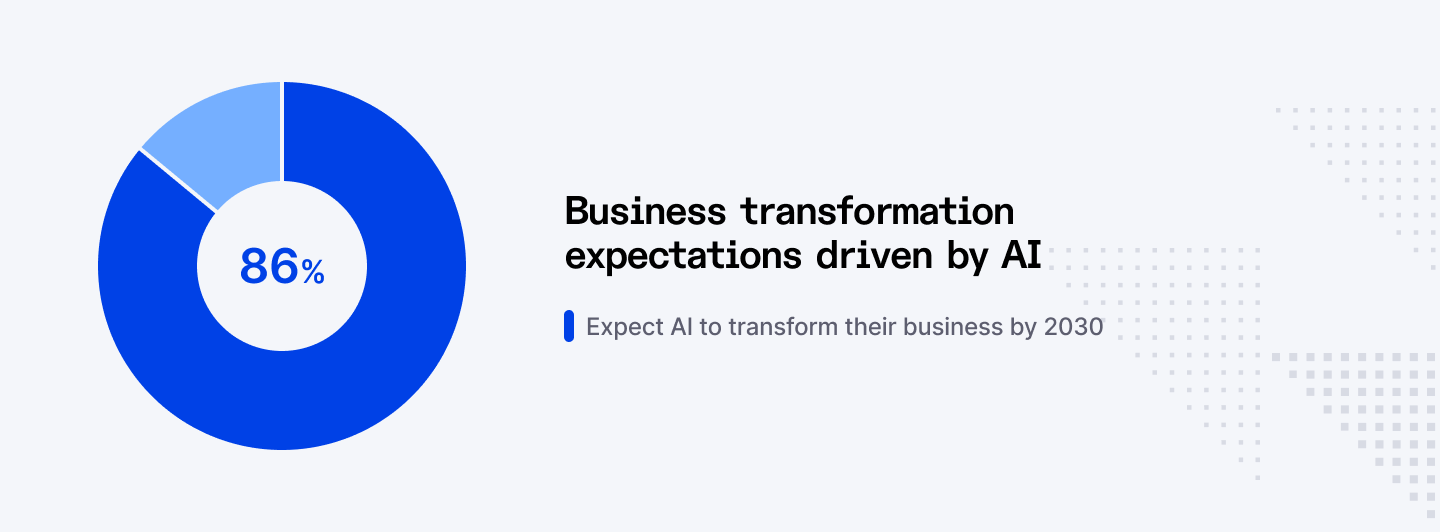
- 86% of respondents expect AI to transform their business by 2030, and the same 86% of employers identify AI and information-processing technologies as the leading transformation drivers for managing and interpreting vast amounts of company data.
- 100% of industries are expanding their use of AI, including sectors like mining and construction.
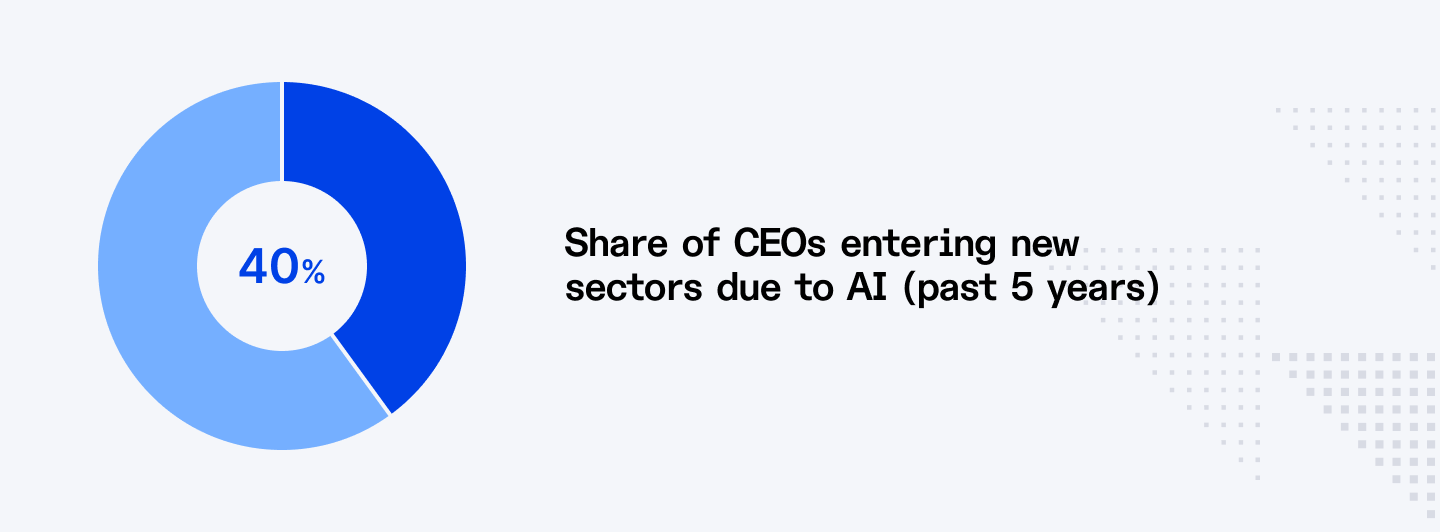
- Almost 40% of CEOs say their companies entered new sectors over the past five years due to AI-related opportunities.
- Demand for AI fluency has grown sevenfold in two years, faster than any other skill in US job postings.
- Employment of data scientists is projected to grow 34% from 2024 to 2034.
- One-third of US jobs created in the last 25 years did not exist before, and more than 60% of employment performed in 2018 did not exist in 1940.
The share of job postings mentioning AI terms has reached its highest point in years, as shown in the Indeed AI Tracker below. This chart illustrates how quickly employers are adding AI-related requirements across roles in the United States.
Read next: Discover which countries are leading AI growth, and why it matters for jobs and hiring.
Skill Shifts, Upskilling Pressure, and Changing Job Requirements
Skill requirements are shifting quickly as AI becomes part of daily work. Readers will understand how many current skills are becoming outdated, how fast job requirements are changing in AI-exposed roles, and why AI-specific abilities now carry strong wage premiums. The data also shows that employers are moving towards skills-based hiring rather than relying on formal degrees for AI-related positions. These insights help readers see why continuous learning and AI capability will play a central role in future career growth.
- Workers can expect 39% of their current skill sets to become outdated or transformed between 2025 and 2030.
- 77% of employers plan to reskill or upskill their workforce to enable teams to work more effectively with AI tools.
- 69% of respondents plan to recruit talent skilled in AI tool design and enhancement.
- Skills demanded by employers are changing 66% faster in AI-exposed occupations than in the least exposed roles, up from 25% the previous year.
- In 2024, 8.8% of ICT job adverts required AI skills, the highest share across all industries.
- AI skill demand in the information and communication sector has grown from 1.4% in 2012 to 9.5% in 2024.
Top Job Titles Requiring AI Skills
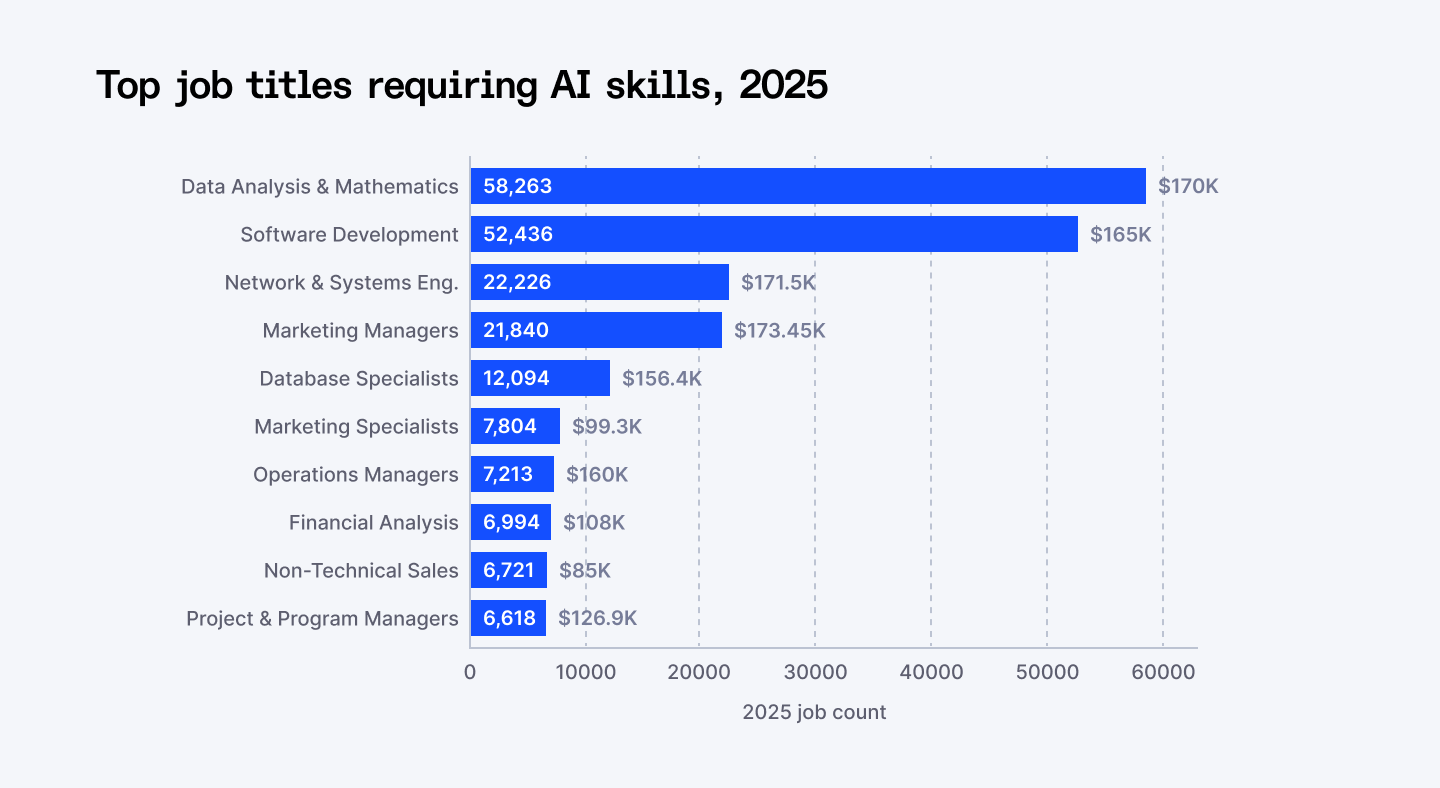
- Data analysis and mathematics leads AI job demand with 58,263 roles and a median pay of $170,000, showing that AI growth is strongest in data driven roles where companies need advanced modeling, forecasting, and decision support.
- Software development remains one of the largest AI powered job categories with 52,436 roles and a $165,000 median salary, proving that AI adoption is expanding core engineering teams, not replacing them.
- Non technical roles are also part of AI job growth, with marketing managers earning $173,450 while marketing specialists still account for 7,804 AI related roles, showing that AI skills now drive demand beyond pure tech jobs into business and growth teams.
| Job Title | 2025 Median Pay | 2025 Count |
| Data Analysis and Mathematics | $170,000 | 58,263 |
| Software Development | $165,000 | 52,436 |
| Network and Systems Engineering | $171,500 | 22,226 |
| Marketing Managers | $173,450 | 21,840 |
| Database Specialists | $156,400 | 12,094 |
| Marketing Specialists | $99,315 | 7,804 |
| Operations Managers | $160,000 | 7,213 |
| Financial Analysis | $108,000 | 6,994 |
| Non-Technical Sales | $85,000 | 6,721 |
| Project and Program Managers | $126,998 | 6,618 |
Wage Changes and Rising Value of AI Skills
AI capabilities deliver significant wage advantages, and this category shows how employers reward specialised AI skills. Readers will see the specific wage changes attached to machine learning, NLP, TensorFlow, data science, and prompt engineering. The data also shows how job growth patterns differ between AI-exposed and low-exposure occupations. These insights underscore why workers who invest in AI skills can achieve higher earning power and greater career resilience as AI reshapes labour-market demands.
- Workers with AI skills such as prompt engineering now earn a 56% wage premium, up from 25% last year.
- Machine learning skills add 40% to hourly earnings; TensorFlow adds 38%; deep learning adds 27%; natural language processing adds 19%; and data science adds 17%.
- Job numbers are growing more slowly in AI-exposed occupations, with 38% growth over the past five years, compared with 65% in less-exposed roles.
- Workers with AI skills such as prompt engineering now earn a 56% wage premium, up from 25% last year.
- Job numbers are growing more slowly in AI-exposed occupations, with 38% growth over the past five years, compared with 65% in less-exposed roles.
Revenue Growth per Employee by AI Exposure Level (2018–2024)
- Employees in the most AI exposed roles saw 27.0 percent revenue growth per employee, which is more than 3 times higher than the least exposed group.
- Revenue growth rises steadily with AI exposure, from 8.5 percent to 15.7 percent before jumping to 27.0 percent, proving that even partial AI adoption improves productivity and pushes companies to expand AI skilled teams.
| AI Exposure Level | Revenue Growth per Employee |
| Least exposed quartile | 8.50% |
| Second least exposed quartile | 14.30% |
| Second most exposed quartile | 15.70% |
| Most exposed quartile | 27.00% |
Wage Growth per Employee by AI Exposure Level (2018–2024)
- Employees in the most AI exposed roles saw 16.7% wage growth, which is more than double the 7.9% wage growth in the least exposed roles.
- Wage growth rises at every higher level of AI exposure, moving from 7.9% to 12.6% and reaching 16.7%. This steady increase explains why demand for AI skilled jobs continues to grow.
| AI Exposure Level | Wage Growth per Employee |
| Least exposed quartile | 7.90% |
| Second least exposed quartile | 8.20% |
| Second most exposed quartile | 12.60% |
| Most exposed quartile | 16.70% |
Wage for Workers with AI Skills (By Sector, 2024)
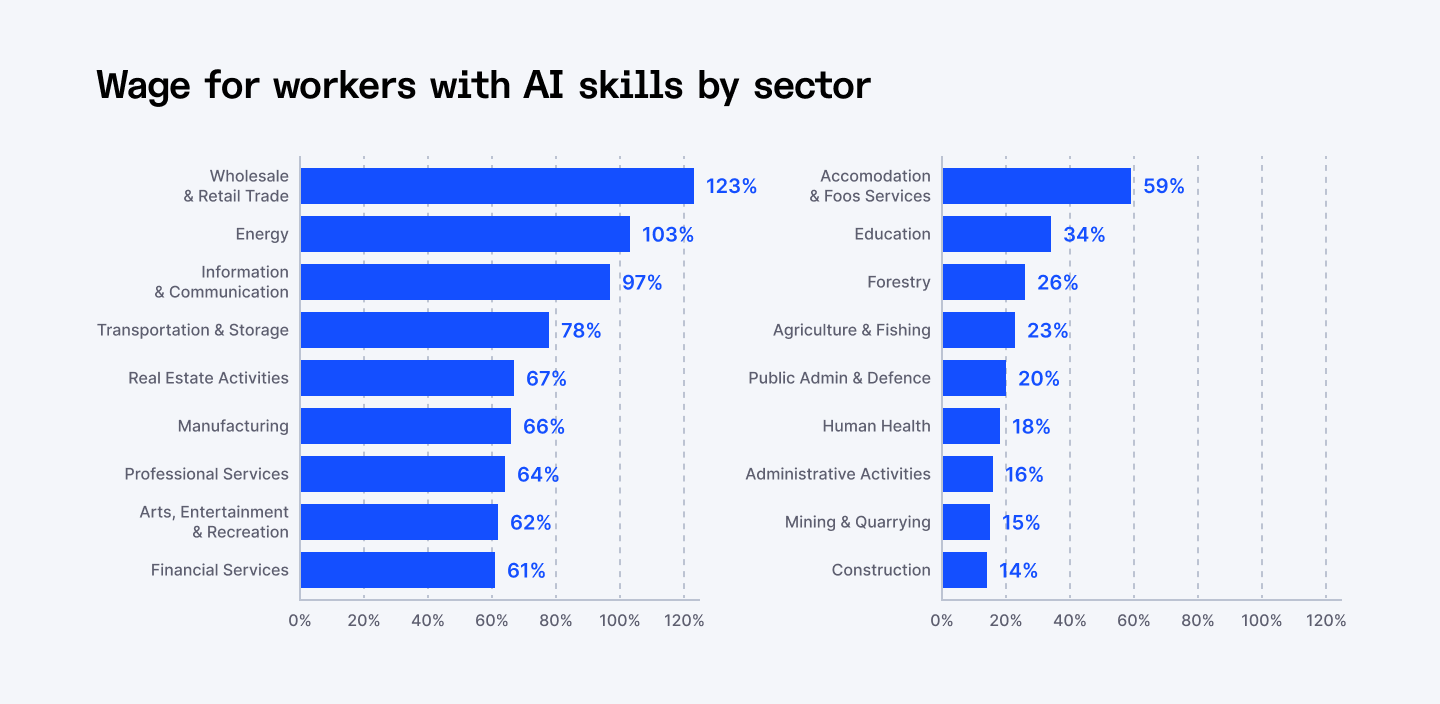
- AI skilled workers saw wage rises of 123% in wholesale and retail trade, 103% in energy, and 97% in information and communication, making these the top three industries driving AI job growth in 2024.
| Sector | Wage rise (2024) |
| Wholesale and Retail Trade | 123% |
| Energy | 103% |
| Information and Communication | 97% |
| Transportation and Storage | 78% |
| Real Estate Activities | 67% |
| Manufacturing | 66% |
| Professional Services | 64% |
| Arts, Entertainment and Recreation | 62% |
| Financial Services | 61% |
| Accommodation and Food Service Activities | 59% |
| Education | 34% |
| Forestry | 26% |
| Agriculture and Fishing | 23% |
| Public Admin and Defense | 20% |
| Human Health | 18% |
| Administrative Activities | 16% |
| Mining and Quarrying | 15% |
| Construction | 14% |
AI Exposure, Automation Risk, and Workforce Vulnerability
AI exposure is not evenly distributed across the workforce, and this section explains how automation risk varies by gender, education, occupation type, and global income levels. Readers will understand which groups are most exposed to generative AI, how many jobs may be affected, and why targeted support will be essential during AI-driven transition periods. The data highlights where labour markets are most at risk, how inequality may widen, and which workers require urgent reskilling or protection as automation accelerates
- According to ILO research, 1 in 4 workers is exposed to generative AI, and 3.3% of global employment is in the highest exposure category.
- The risk of automation affects 4.7% of women in high-exposure roles, compared with 2.4% of men.
- In high-income countries, 9.6% of female jobs and 3.5% of male jobs fall into high-exposure categories.
- 12% of male workers and 6% of female workers are in occupations with high automation risk.
- Automation risk affects only 2% of university-educated workers, but rises to 12% for those with upper secondary education and 22% for those with lower levels of education.
- Economist analysis across 900 occupations estimates that two-thirds of US occupations have some degree of automation exposure.
- New AI systems could expose the equivalent of 300 million full-time jobs to automation.
Decline in Employer Degree Requirements for AI-Exposed Jobs (2019 vs 2024)
| Job Category | 2019 Degree Requirement | 2024 Degree Requirement |
| Least Exposed 50% | 16% | 11% |
| Augmented (AI-supported) | 66% | 59% |
| Automated (AI-automated) | 53% | 44% |
AI Exposure and Worker Characteristics (2022 Data)
| Occupation Group | Average AI Exposure | % Tertiary Educated | % Male | % Prime Age | % Native Born |
| 5 most exposed occupations | |||||
| Science, engineering professionals | 0.84 | 87% | 69% | 67% | 86% |
| Chief executives | 0.85 | 72% | 68% | 62% | 89% |
| Managers | 0.86 | 76% | 59% | 73% | 91% |
| Business professionals | 0.87 | 82% | 45% | 69% | 89% |
| IT technology professionals | 0.88 | 79% | 81% | 70% | 84% |
| 5 least exposed occupations | |||||
| Cleaners, helpers | 0.25 | 9% | 18% | 56% | 66% |
| Agricultural, forestry, and fishery labourers | 0.34 | 8% | 65% | 42% | 89% |
| Food preparation assistants | 0.39 | 7% | 31% | 47% | 71% |
| Labourers | 0.42 | 8% | 72% | 54% | 79% |
| Refuse workers, other elementary workers | 0.43 | 10% | 72% | 49% | 83% |
| Average across all country-occupations | 0.65 | 37% | 57% | 60% | 86% |
Productivity Gains, Business Efficiency, and Economic Value
AI is driving measurable improvements in productivity, profitability, and operational efficiency. This category quantifies the impact of generative AI across business functions, showing where the greatest economic value is created. Readers will see how AI influences output, automates work, reduces costs, and expands revenue potential across industries such as banking and customer service. These insights help explain why organisations are aggressively investing in AI to accelerate performance gains.
Key Stats:
- More than 56% of leaders say generative AI improved employee time efficiency, while 32% report higher revenue and 34% report increased profitability.
- About 75% of the value that generative AI can deliver is concentrated in customer operations, marketing and sales, software engineering, and R&D.
- Generative AI and related technologies can automate 60% to 70% of employees’ current work activities.
- Generative AI could raise annual labour productivity by 0.1% to 0.6% through 2040.
- Applying generative AI to customer care could increase productivity equal to 30% to 45% of current function costs.
- Generative AI could add 2.8% to 4.7% to annual banking revenues, equal to $200B to $340B.
- Economists estimate that generative AI will raise labour productivity in developed markets by 15% when fully adopted.
Most Common Generative AI Use Cases by Function (2024)
| GenAI Use Case (2024) | % of Respondents Using It |
| Marketing strategy content support (drafting, generating ideas, presenting content) | 27% |
| Knowledge management | 19% |
| Personalization (creative content generation at scale) | 19% |
| Design development | 14% |
| Code creation (assistants, translation, debugging, test development) | 13% |
| Automation of sales follow-up interactions | 13% |
| Integration of GenAI into human customer service workflows | 12% |
| Sales lead identification and prioritization | 11% |
| Accelerated simulation/testing phases (R&D, customer research, interviews) | 11% |
| Scientific literature and research review | 11% |
Up next: See how generative AI is already changing software development in practical ways.
Corporate AI Adoption and Workforce Impact
Businesses are rapidly integrating AI into their operations, and employers and workers are already experiencing noticeable changes. This category highlights leader expectations, job impact outlooks, early efficiency gains, and shifts in workforce sentiment. Readers will understand how organisations perceive AI’s role in shaping job structures, improving performance, and influencing employee experience. These insights reflect the speed at which AI is transforming everyday work environments.
Key Stats:
- When asked whether AI is already impacting jobs, 67% of senior HR executives said yes.
- 89% of leaders expect AI to impact jobs next year, with 45% expecting half or more roles to be affected, 44% expecting fewer than half, and 11% expecting no impact.
- 61% of leaders say AI has made their company more efficient, while 39% believe it is too early to measure the effect.
- 78% say AI has made their workforce more innovative, while 17% report no significant change yet.
- 4 in 5 workers say AI improved their performance, and 3 in 5 say it increased their enjoyment at work.
- Around 20% of organisations are fully committed to AI in compensation management, while about 50% are cautiously optimistic.
Share of Organizations Using AI in at Least One Function (2017–2024)
- The share of organizations using AI in at least one function increased from 50% in 2022 to 55% in 2023, then jumped sharply to 72% in 2024.
| Year | % Using AI |
| 2017 | 20% |
| 2018 | 47% |
| 2019 | 58% |
| 2020 | 50% |
| 2021 | 55% |
| 2022 | 50% |
| 2023 | 55% |
| 2024 | 72% |
Organizational AI Use by Regions (2023 vs. 2024)
- North America reached 82% AI usage in 2024, up from 61% in 2023, making it the fastest large region for AI adoption.
| Region | AI Use in 2024 (%) | AI Use in 2023 (%) |
| All geographies | 78% | 55% |
| Asia-Pacific | 72% | 58% |
| Europe | 80% | 57% |
| North America | 82% | 61% |
| Greater China (incl. Hong Kong, Taiwan, Macau) | 75% | 48% |
| Developing markets (India, Central/South America, MENA) | 77% | 49% |
Automation Trends, Job Displacement, and Worker Transitions
Automation driven by AI is changing labour demand and accelerating worker transitions across the economy. This category quantifies the number of work hours that may be automated, which roles are declining, how many workers must shift careers, and how many have already faced displacement. These insights highlight the scale of upcoming workforce disruption and point to the importance of reskilling and adaptation strategies for long-term economic stability.
- Without generative AI, automation would account for 21.5% of US work hours by 2030; with generative AI, this rises to 29.5%.
- Demand could fall by 1.6M clerks, 830k retail salespersons, 710k administrative assistants, and 630k cashiers because these roles rely heavily on repetitive tasks.
- Around 11.8M workers in shrinking occupations may need to move into different lines of work by 2030.
- About 13.7% of workers say robots have already replaced their jobs.
- By 2030, activities representing up to 30% of current US work hours could be automated due to generative AI.
Are Organizations Replacing Workers With Automation/AI?
| Response | Percentage |
| No, and we don’t plan to in the future | 52% |
| No, but we are considering this in the future | 20% |
| Yes, we are doing this now | 18% |
| Unsure | 10% |
Sentiment Toward Leveraging AI/Machine Learning by Use Case
| Use Case | Totally on Board | Cautiously Optimistic | Undecided | Against It |
| Market pricing | 20% | 51% | 21% | 8% |
| Recommending pay increases | 19% | 46% | 24% | 10% |
| Legislative compliance | 21% | 45% | 24% | 10% |
| Policy documentation, education, or communications | 22% | 46% | 21% | 11% |
AI Investment, Market Expansion, and Technology Momentum
AI investment and technological development continue to accelerate across global markets. This category highlights major spending forecasts, advances in AI compute capacity, rapid growth in AI-related technologies, and the expected expansion of intelligent connected devices. Readers will see how quickly AI infrastructure and model research are evolving worldwide.
- Deloitte forecasts that global investment in sovereign AI compute will reach $100B by 2026.
- Countries outside the US and China are expected to double their domestic AI compute capacity by 2030.
- By 2028, around 15 billion linked products will behave like digital consumers.
- Interest in NLP has increased by 195%, generative models by 900%, and Transformers by 325%.
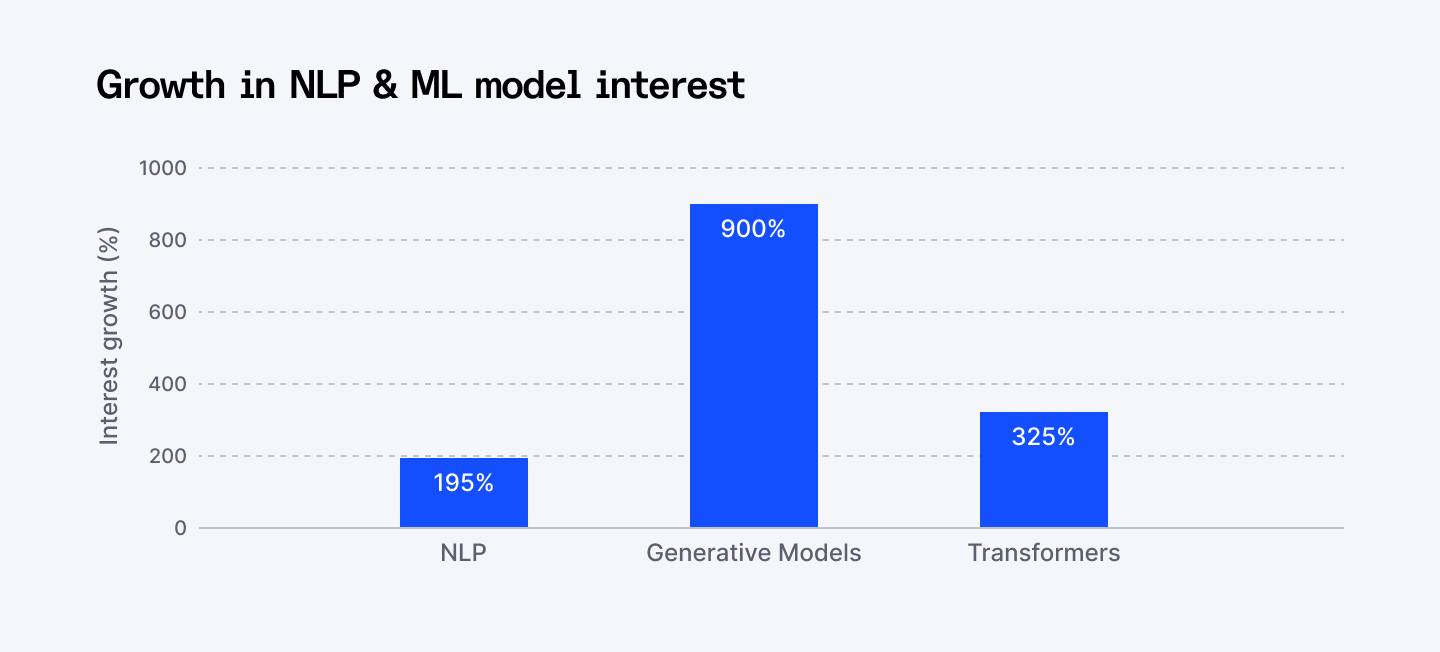
- Interest in deep learning grew by 19%, reinforcement learning by 15%, PyTorch by 25%, and MLOps by 14%.
Read next: Learn how AI is influencing job interviews, hiring decisions, and candidate evaluation.
Final words
AI is reshaping the global workforce faster than any previous technological shift, and these statistics help reveal where opportunities and challenges are emerging. As AI adoption accelerates, workers, teams, and organisations can use this data to plan smarter upskilling strategies, identify high-growth career paths, and anticipate future talent needs.
What’s next is a job market where AI fluency becomes essential, productivity tools become more intelligent, and roles continue to evolve. Use these insights to stay prepared, stay competitive, and navigate the future of work with confidence.
➡︎ Need AI-ready developers fast? Index.dev connects you with pre-vetted remote engineers who already have the machine learning, Python, and data science skills. Skip the 6-month ramp-up and hire talent that's built for 2026's AI-first workplace.
➡︎ Want to explore more insights on ATS tools, AI hiring, and global tech recruitment? Check out related articles such as the Paradox AI recruitment chatbot review, AI startup tech stack for 2026, remote AI hiring challenges, mitigating risks when hiring offshore talent, top countries for AI developer ROI, choosing the right AI transformation partners, and evaluating developers for AI/ML expertise. These guides offer deeper frameworks, tool comparisons, and data-driven insights to help you hire smarter and scale engineering teams globally.
FAQs
How fast are AI careers growing globally?
176% and 151% growth in AI and Machine Learning Specialist roles in India and the UK shows how quickly AI careers are scaling in major economies. AI-related roles have also more than doubled across industries from 2016 to 2024. Together, these numbers show rapid global expansion and strong long-term demand for AI talent.
How quickly are skill requirements changing because of AI?
39% of today’s skills will become outdated or transformed by 2030, and skill demands are changing 66% faster in AI-exposed roles. With 77% of employers planning to upskill workers, AI is reshaping every major occupation. These figures highlight the urgency of continuous learning to stay employable in an AI-driven workforce.
How much more do workers with AI skills earn?
A 56% wage premium is earned by workers with AI skills, showing their strong value in the job market. Machine learning: 40%; TensorFlow: 38%; deep learning: 27%; NLP: 19%; data science: 17%. These premiums confirm that AI capability is one of the fastest paths to higher earnings and career security.
How many workers are exposed to AI-driven automation?
1 in 4 workers is exposed to generative AI, while 3.3% of global employment is in high-exposure roles. Automation risk is uneven, with women at 4.7% exposure versus 2.4% for men. Education also matters, ranging from 2% risk for university graduates to 22% for lower-educated workers.
How much work can AI automate across the economy?
60–70% of current work tasks can be automated using generative AI and related technologies. Productivity gains are also large, including 30–45% improvements in customer care and 2.8–4.7% revenue growth in banking. These figures show why companies are accelerating AI adoption to reduce costs and increase output.
How widely are organisations using AI today?
72% of organisations use AI in at least one function, up from 55% last year. Adoption is strong across regions, with North America at 82%, Europe at 80%, and Asia-Pacific at 72%. These adoption rates reflect AI’s growing influence on efficiency, decision-making, and workforce performance across industries.
How many workers may need to switch careers due to AI?
11.8 million workers may need to shift into new roles by 2030 as demand drops for clerks, retail workers, administrative assistants, and cashiers. With 300 million jobs globally at risk of automation, workforce transitions will be widespread, making reskilling essential for long-term job stability.
How much investment is flowing into AI infrastructure?
$100 billion investment in sovereign AI compute is expected by 2026, with countries outside the US and China set to double their AI capacity by 2030. Interest in key AI technologies is rising rapidly, including a 900% increase in research on generative models. These numbers show how fast global AI readiness is accelerating.
Data Source
- https://reports.weforum.org/docs/WEF_Future_of_Jobs_Report_2025.pdf
- https://www.pwc.com/gx/en/issues/artificial-intelligence/job-barometer/2025/report.pdf
- https://www.pwc.com/gx/en/issues/c-suite-insights/ceo-survey.html
- https://www.oecd.org/content/dam/oecd/en/publications/reports/2024/10/who-will-be-the-workers-most-affected-by-ai_fb7fcccd/14dc6f89-en.pdf
- https://www.mckinsey.com/capabilities/tech-and-ai/our-insights/the-economic-potential-of-generative-ai-the-next-productivity-frontier
- https://www.mckinsey.com/mgi/our-research/generative-ai-and-the-future-of-work-in-america
- https://www.ilo.org/meetings-and-events/artificial-intelligence-ai-and-non-discrimination-world-work
- https://www.deloitte.com/global/en/about/press-room/2026-tmt-predictions.html
- https://www.cnbc.com/2025/11/14/ai-to-impact-89percent-of-jobs-next-year-cnbc-survey-finds.html
- https://www.goldmansachs.com/insights/articles/how-will-ai-affect-the-global-workforce
- https://www.mckinsey.com/featured-insights/employment-and-growth/technology-jobs-and-the-future-of-work
- https://www.goldmansachs.com/insights/articles/generative-ai-could-raise-global-gdp-by-7-percent
- https://www.researchgate.net/figure/More-than-60-of-jobs-done-in-the-United-States-in-2018-had-not-yet-been-invented-in_fig6_360965560
- https://www.mckinsey.com/mgi/our-research/agents-robots-and-us-skill-partnerships-in-the-age-of-ai
- https://www.oecd.org/en/topics/sub-issues/ai-and-work.html
- https://www.goldmansachs.com/insights/articles/generative-ai-could-raise-global-gdp-by-7-percent
- https://www.bls.gov/ooh/math/data-scientists.htm
- https://www.ox.ac.uk/news/2023-10-24-artificial-intelligence-skills-can-increase-salaries-much-40
- https://www.payscale.com/featured-content/cbpr
- https://www.pwc.com/gx/en/issues/artificial-intelligence/job-barometer/aijb-2025-united-states-analysis.pdf
- https://pwc.turtl.co/story/ai-jobs-barometer-industry/page/6/3
- https://newsletter.techworld-with-milan.com/p/gartners-top-10-strategic-technology
- https://journals.sagepub.com/doi/full/10.1177/23780231221131377
- https://www.ilo.org/publications/generative-ai-and-jobs-refined-global-index-occupational-exposure
- https://hai.stanford.edu/assets/files/hai_ai_index_report_2025.pdf
- https://www.payscale.com/compensation-trends/ai-skills-are-in-demand-and-employers-are-paying-big-bucks-for-them