The AI Readiness Index measures how well countries are prepared to use and manage artificial intelligence. It studies three key areas: government policies, technology sector strength, and data and infrastructure systems.
The index helps identify which countries have strong national AI plans, how advanced their technology and data systems are, and where they need more progress. It also shows how developing nations are working to improve their AI governance and readiness.
All data in this article is collected from reliable and verified international sources. The source URLs are listed at the end of the article for reference.
Key statistics: Global AI readiness highlights
- The United States leads globally with a score of 87.03, followed by Singapore (84.25), South Korea (79.98), France (79.36), and the United Kingdom (78.88).
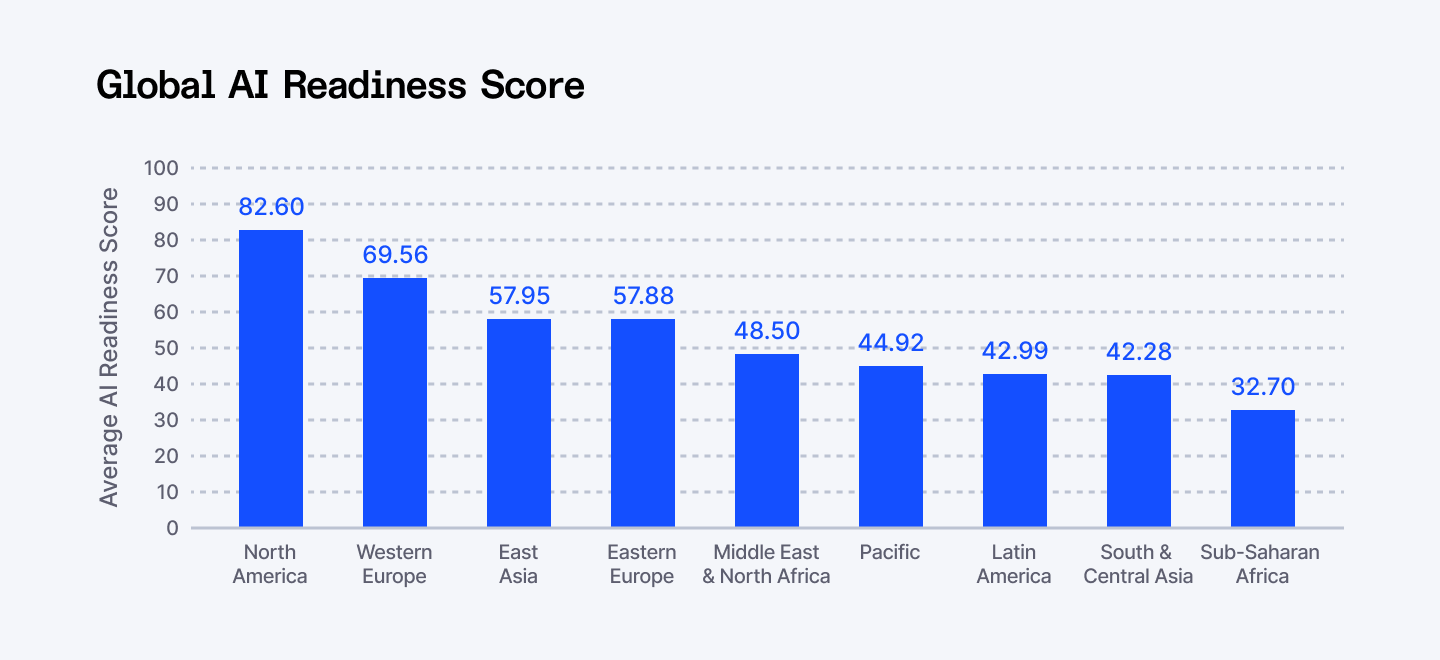
- North America ranks first with an average score of 82.60, showing strong innovation, governance, and data systems.
- Western Europe follows with an average of 69.56, led by France, performing best in data and infrastructure.
- East Asia ranks third with an average of 57.95, led by Singapore and South Korea, both scoring above 79.
- 12 new national AI strategies were launched in 2024, three times more than in 2023, most from developing countries like Ethiopia, Ghana, and Nigeria.
- U.S. AI private investment reached $109.1 billion, 12 times China’s ($9.3B) and 24 times the U.K.’s ($4.5B).
- 78% of companies globally now use AI, up from 55% in 2023, showing fast business adoption.
- China is testing autonomous vehicles in 16 cities, the highest number worldwide.
- Ukraine, Costa Rica, Moldova, and Uzbekistan scored a perfect 100 in Vision, showing strong AI policy and planning among developing nations.
Read next: Discover the 5 best AI agents for coding and see how developers speed up workflows.
Which countries lead the world in AI readiness?
The top five countries in the 2024 AI Readiness Index are the United States (87.03), Singapore (84.25), South Korea (79.98), France (79.36), and the United Kingdom (78.88). These nations show strong performance across government strategy, technology maturity, and data infrastructure.
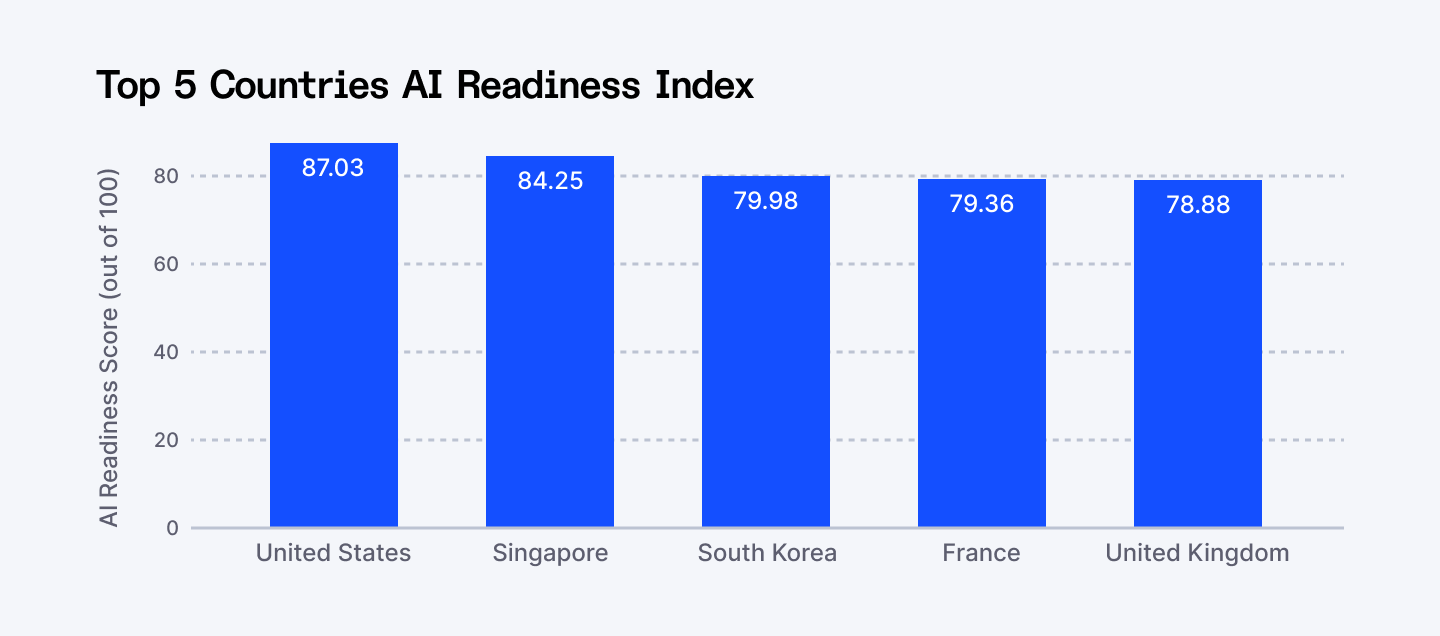
The United States continues to lead in Innovation Capacity and Tech-Sector Maturity, reflecting its strong private investment and innovation base. However, its lead over other top countries is narrowing, with only 2.93 points more in the Government pillar and 0.71 points in Data and Infrastructure.
In 2023, Singapore ranked first, followed by Denmark and the United States, showing how leadership in AI readiness continues to shift among advanced digital economies.
How does North America perform in AI readiness?
North America ranks first globally in AI readiness with an average score of 82.60, far above the global average of 47.59. The region’s performance is driven by the United States (87.03) and Canada (78.18), which both appear in the global top 10.
The United States shows strong results in Governance and Ethics (91.14), Innovation Capacity (92.48), and Technology Maturity (83.8), supported by advanced research, private investment, and policy planning. Canada performs best in Governance and Ethics (94.14) and Data Availability (93.15), proving its focus on responsible AI use and data transparency.
Both countries demonstrate how structured national AI policies and a mature technology ecosystem can help maintain long-term leadership in global AI readiness.
Why does Western Europe remain a strong AI region?
Western Europe ranks second in the global AI Readiness Index with an average score of 69.56. The region remains a consistent high performer due to strong governance, innovation frameworks, and advanced data infrastructure.
France (79.36) leads the region, followed by the United Kingdom (78.88), Netherlands (77.23), Germany (76.90), and Finland (76.48). These five countries all appear in the global top 10, showing the region’s overall maturity in AI policy and research.
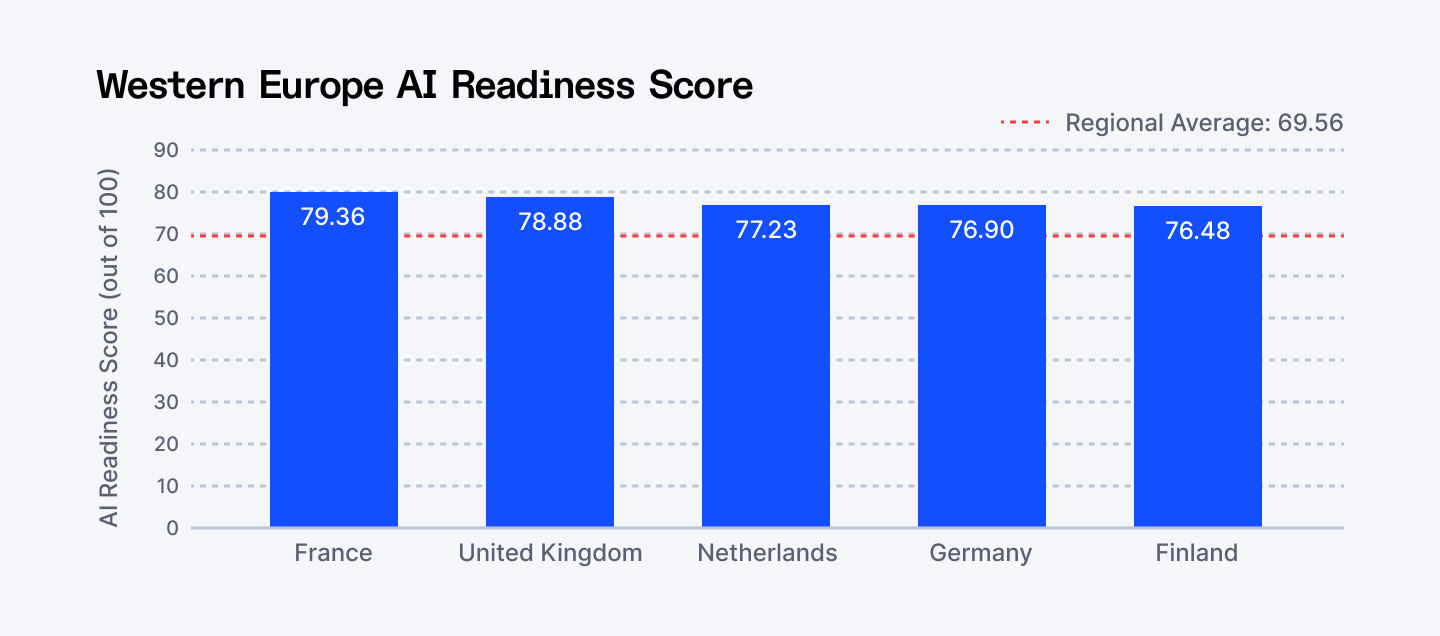
Western Europe performs best in the Data and Infrastructure pillar, averaging 81.91, which is 21 points higher than the global average. This strength reflects the region’s investment in data access, high-speed connectivity, and open data frameworks that support innovation and AI adoption.
What drives East Asia’s high AI readiness scores?
East Asia ranks third in the global AI Readiness Index with an average score of 57.95. The region performs well above the global average across all three pillars of government capability, technology sector strength, and data infrastructure.
Singapore (84.25) and South Korea (79.98) lead the region and are among the global top five. Singapore has invested over $740 million to boost its AI capabilities and support national AI strategies, strengthening its position as a regional AI leader.
East Asia’s strongest results appear in the Government pillar, with an average score of 84.71, showing the region’s strong AI vision, policy support, and strategic planning. The Data and Infrastructure pillar also performs well at 69.72, reflecting strong digital systems and connectivity.
However, the Technology Sector pillar, with an average of 44.61, still needs further growth to match the region’s strengths in governance and data readiness.
How does Eastern Europe compare in AI development?
Eastern Europe ranks fourth in the global AI Readiness Index with an average score of 57.88, which is over ten points higher than the global average of 47.59. The region shows balanced progress across all three pillars. Estonia (72.62) leads the region and is the only Eastern European country to appear in the global top 25.
The region performs especially well in the Data and Infrastructure pillar, with an average score of 72.10, making it the third-best region worldwide in this area. The Technology Sector pillar, however, remains a challenge with a lower regional score of 39.03.
This shows that while Eastern Europe is strong in policy and digital systems, it still needs more innovation and private-sector growth to improve its overall AI capacity.
Next up: Learn what works (and what doesn’t) when using AI to hire developers — real use cases, pitfalls, and practical tips.
How is the Middle East and North Africa (MENA) advancing in AI readiness?
The Middle East and North Africa (MENA) region ranks fifth in the global AI Readiness Index with an average score of 48.50. The region shows strong progress in AI adoption but also a wide performance gap among countries.
The United Arab Emirates (75.66) leads the region, entering the global top 15, followed by Israel (74.52) and Saudi Arabia (72.36). These countries have invested heavily in AI research, smart governance, and national AI strategies. However, there is a large difference of 61 points between the highest performer, the UAE, and the lowest, Yemen.
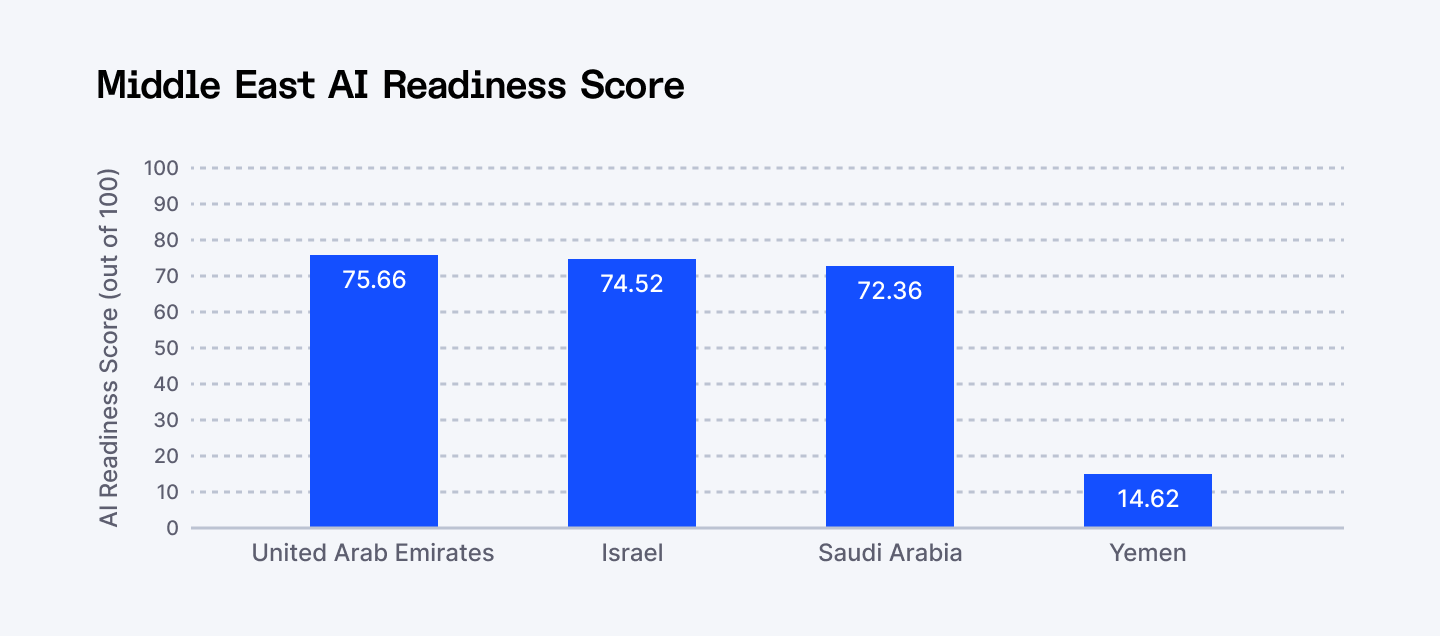
MENA performs slightly above the global average in Technology Sector (39.34) and Data and Infrastructure (59.94) but scores lower in the Government pillar (47.77). The region continues to improve its data systems and innovation base while focusing on stronger AI governance and regulation.
How do Pacific nations rank in AI readiness?
The Pacific region ranks sixth in the global AI Readiness Index with an average score of 44.92. While it performs slightly below the global average, a few countries show strong progress.
Australia (76.44) leads the region and holds a position in the global top 10, followed by New Zealand (63.98). The next-best performer, Fiji (44.21), ranks 92nd globally, showing a large gap between developed and smaller island nations.
The region performs best in the Data and Infrastructure pillar with an average score of 58.81, reflecting solid digital networks and data frameworks. However, it scores lower in Government (40.63) and Technology Sector (35.32), pointing to the need for stronger policy frameworks and innovation ecosystems
Which countries lead in Latin America’s AI progress?
Latin America and the Caribbean rank seventh in the global AI Readiness Index with an average score of 42.99. The region is making steady progress, driven by a few top-performing countries. Brazil (65.89) leads the region, followed by Chile (63.19) and Uruguay (62.21). These three are the only Latin American countries to appear in the global top 50.
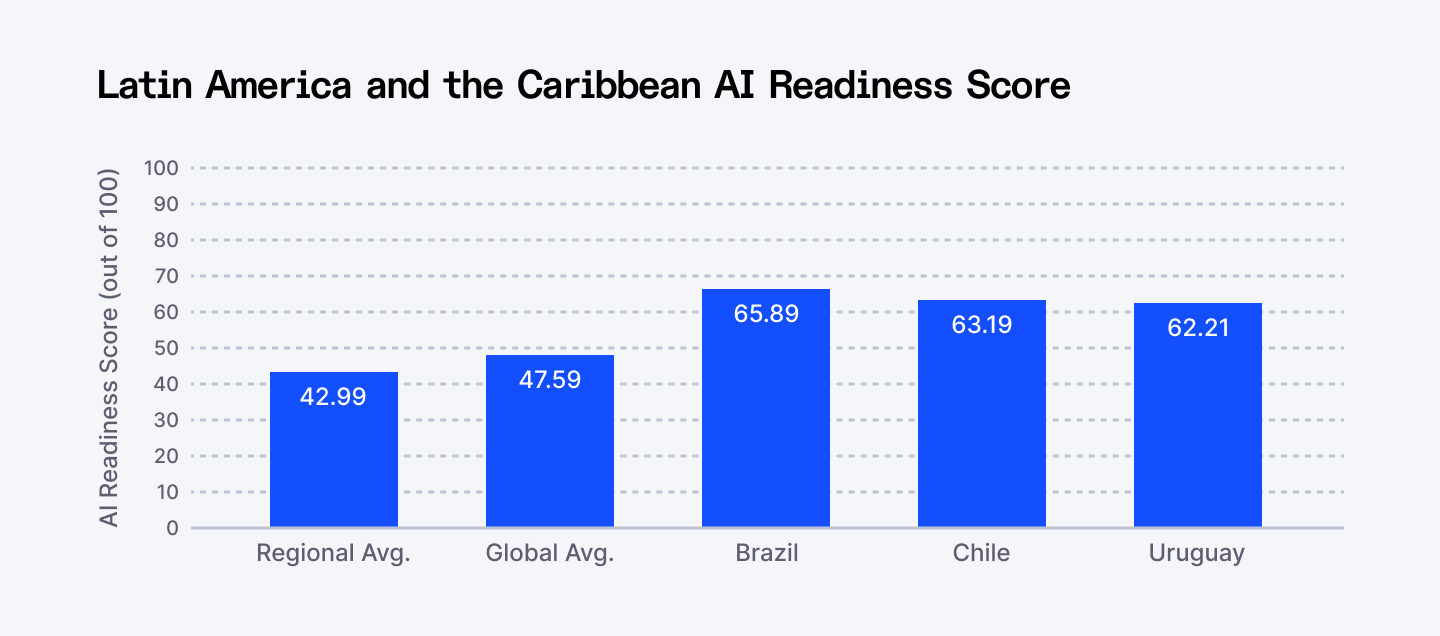
Brazil performs strongly in the Government pillar (74.51) and Data and Infrastructure (78.38), supported by high Data Availability (84.53) and Representativeness (94.6).
Chile leads in Governance and Ethics (83.84), showing strong policy and transparency standards, while Uruguay earns a perfect score of 100 in Vision, supported by clear national AI goals. The Technology Sector remains the weakest area, with Brazil’s top score only 44.78, highlighting the region’s need for more innovation and startup growth.
What defines AI readiness in South and Central Asia?
South and Central Asia rank eighth in the global AI Readiness Index with an average score of 42.28. The region shows growing awareness and policy efforts toward AI but continues to face large gaps in infrastructure and governance.
India (62.81) leads the region, ranking 46th globally, followed by Türkiye (60.63) and Uzbekistan (53.45). While these countries have formal AI strategies, the region still trails behind the global average in several key areas.
The biggest weaknesses appear in Governance and Ethics (47.9) and Data and Infrastructure (52.3), where many countries lack open data access and reliable digital systems. Data Representativeness scores are 17 points below the global average, showing the need for stronger inclusion and data quality.
Despite these gaps, several South and Central Asian countries are developing new AI policies and training programs, aiming to improve readiness in the coming years.
How is Sub-Saharan Africa progressing in AI readiness?
Sub-Saharan Africa ranks ninth in the global AI Readiness Index with an average score of 32.70, the lowest among all regions. However, several countries in the region are showing clear progress in AI planning and policy.
Mauritius (53.94), South Africa (52.91), and Rwanda (51.25) lead the region. The score difference between the top and bottom performers is 35.36 points, showing a smaller gap compared to other regions.
The region’s best results appear in the Data and Infrastructure pillar, with an average of 42.06, while the Government (32.05) and Technology Sector (23.98) pillars show the most room for growth.
A major milestone this year is Ethiopia’s launch of a national AI strategy, making it the second low-income country, after Rwanda, to release a formal AI plan. This signals growing interest and investment in AI across developing African economies.
Which developing countries made the most improvement in 2024?
In 2024, 12 new national AI strategies were published or announced — three times more than in 2023. This rise shows that more developing nations are now taking active steps to plan and manage AI adoption.
Most new strategies came from low- and lower-middle-income countries, including Ethiopia, Ghana, Nigeria, Sri Lanka, Uzbekistan, and Zambia. These countries had their plans in progress during 2023 and officially launched or finalized them this year.
Other developing nations such as Ukraine, Costa Rica, Moldova, and Uzbekistan also performed well in readiness indicators. All four scored 100 in Vision, far above the global average of 42.55. They also outperformed global averages in Governance and Ethics and Data Availability, showing strong progress in responsible AI planning and data systems.
This growing participation of developing economies marks a key step toward global inclusion in AI governance.
How does global AI investment and perception shape AI readiness?
Global AI investment and public trust play a major role in shaping AI readiness. Countries with stronger funding and innovation systems show faster progress in AI development and use.
In 2024, the United States led global private AI investment with $109.1 billion, which is 12 times higher than China’s $9.3 billion and 24 times higher than the United Kingdom’s $4.5 billion. Generative AI attracted $33.9 billion worldwide, marking an 18.7% rise from the previous year.
Business adoption of AI is also rising fast, 78% of organizations used AI in 2024, up from 55% in 2023.
Public perception of AI varies by region. In China (83%), Indonesia (80%), and Thailand (77%), most people view AI as more helpful than harmful. In contrast, optimism is much lower in Canada (40%), the United States (39%), and the Netherlands (36%). Still, attitudes are improving in several countries, including Germany, France, and the United States, where public trust in AI has grown since 2022.
These figures show that investment and social acceptance together drive a country’s overall AI readiness and future growth potential.
Continue reading: Get clear, simple answers to the 5 biggest AI hiring questions companies ask when building AI teams.
How is China performing beyond readiness scores?
China is currently testing autonomous vehicles in 16 cities, the most of any country worldwide. It is also one of the top producers of advanced AI models, creating 15 major models in 2024, compared to 40 produced in the United States and 3 in Europe.
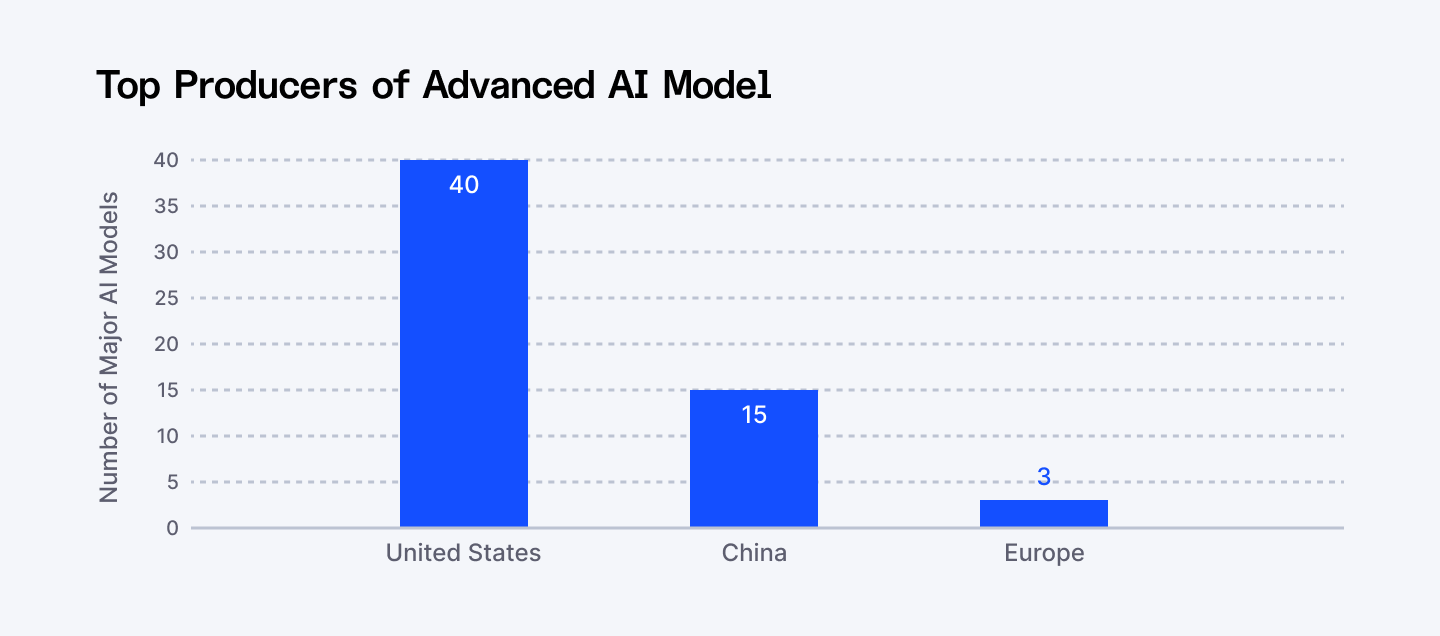
These figures show that even though China does not lead in AI readiness rankings, it performs strongly in real-world implementation and innovation. The country continues to invest heavily in AI research, infrastructure, and industrial applications. Its efforts to apply AI in transport, manufacturing, and public services reflect strong national planning and execution.
China’s focus on scaling AI across sectors, along with active testing and production, highlights its growing influence in global AI development and technology leadership.
Summary: Regional AI Readiness Overview
The table below gives a clear view of how different regions performed in the last year AI Readiness Index. It lists each region’s rank, average score, leading country, and main area of strength. The data highlights both global leaders and emerging regions that are building stronger AI strategies and infrastructure.
Region | Rank | Average Score | Top Country | Key Strength |
North America | 1 | 82.60 | United States | Innovation and strong governance |
Western Europe | 2 | 69.56 | France | Data and infrastructure quality |
East Asia | 3 | 57.95 | Singapore | Government strategy and policy strength |
Eastern Europe | 4 | 57.88 | Estonia | Data readiness and digital infrastructure |
Middle East and North Africa (MENA) | 5 | 48.50 | United Arab Emirates | Data access and innovation capacity |
Pacific | 6 | 44.92 | Australia | Infrastructure and connectivity |
Latin America | 7 | 42.99 | Brazil | Data availability and policy clarity |
South and Central Asia | 8 | 42.28 | India | National AI strategy and policy focus |
Sub-Saharan Africa | 9 | 32.70 | Mauritius | Emerging AI policies and planning progress |
Final words
The AI Readiness Index shows how countries are progressing toward building strong and responsible AI systems. High-income regions such as North America and Western Europe continue to lead due to advanced innovation, governance, and data infrastructure. However, many developing countries are quickly catching up by launching new AI strategies and improving national policies.
The global results also show that data quality, technology maturity, and infrastructure remain key challenges for several regions. At the same time, growing investment and positive public awareness are helping more countries adopt AI responsibly.
Overall, the index reflects a world moving toward inclusive and balanced AI growth, where both advanced and emerging economies are contributing to the next stage of global innovation.
➡︎ Looking to build an AI-ready tech team? Index.dev connects you with vetted AI engineers worldwide — fast hiring, lower risk, and global talent.
➡︎ Want to explore more insights on AI talent, strategy, and hiring? Dive into our related guides on global AI talent pools, building an AI-first tech stack, hiring developers faster with AI, emerging AI roles, and how top companies solved remote AI hiring challenges.
Data sources
- https://hai-production.s3.amazonaws.com/files/hai_ai_index_report_2025.pdf
- https://oxfordinsights.com/wp-content/uploads/2024/12/2024-Government-AI-Readiness-Index-2.pdf
- https://www.imf.org/external/datamapper/AI_PI@AIPI/ADVEC/EME/LIC/EURO/EU
- https://www.cnbc.com/2024/02/19/singapores-ai-ambitions-get-a-boost-with-740-million-investment-plan.html