If you’re investing in AI recruitment tools, you need hard numbers to win budget approval. Which means that you must:
Calculate ROI, frame your pitch for finance teams, and drive faster hires with measurable benchmarks.
In this guide, we’ll weave in industry benchmarks, trusted research, and practical tips so that you can move from “maybe” to “let’s do it” in 30 minutes.
Let’s get started.
Start building your AI solution with our elite development team today to accelerate your launch and scale faster.
Uncover Your True Hiring Costs
Before you can show savings, you must understand what you’re really spending today. Hidden costs lurk in every open role, every phone screen, and every mis-hire.
While you're waiting for the perfect candidate, your existing team burns out covering extra work, projects get delayed, and revenue opportunities slip away. Understanding the ROI of AI in recruitment starts with recognising these hidden expenses.

Vacancy Drain on Productivity
When a senior engineer position remains open, projects stall and your top performers pick up the slack. Research by the Society for Human Resource Management (SHRM) shows an unfilled technical role can cost companies $450-$900 per day in lost productivity. Over a 45-day average time to hire, you’re looking at $20,250-$40,500 per vacancy.
Now that you see what vacancies are costing you, let’s break down the time and money spent on hiring itself.
Recruiter and Interviewer Time
- Recruiter hours:
Average of 40 hours per hire, at a fully-loaded cost of ~$80/hour = $3,200.
- Interview panel:
Five stakeholders × 1 hour each × average salary rate ($120/hour) = $600 per candidate.
- Screening rounds:
If you review 100 resumes for each hire, and it takes 2 minutes per resume, that’s 200 minutes (3.3 hours) × $80/hr = $267.
Financial Impact of Vacancies
High cost per hire for technical roles can reach £10,000-£20,000 per position, once you tally sourcing, advertising, and agency fees. In contrast, a vacant senior engineering position can cost companies £400 to £800 per day in productivity.
Poor Hires Are a Strategic Risk
Bad matches can cost up to 30% of first-year salary. For a £120K engineer, that’s £36,000 lost, before you even recruit again.
These figures add up fast and they aren’t reflected in your P&L today. Understanding these inputs sets the stage for quantifying how AI can transform your bottom line, employee morale, and give you a competitive edge.
Examine the fairness of AI-powered interviews.
Why AI Makes a Measurable Difference
You hear businesses discussing AI in recruitment; but what do the numbers show? Leading brands share concrete results when they lean into AI for talent acquisition.
These powerful AI recruitment case studies demonstrate tangible outcomes:
Hilton:
Hilton reduced their hiring time by 86% after utilising AI-driven screening and matching. What took weeks to accomplish previously now occurs within days.
IBM:
IBM experienced a 30% reduction in overall recruitment expense through employing AI to automate first-round candidate screening and faster identification of best-fit candidates.
Unilever:
Unilever enhanced new-hire retention by 16% through improved candidate matching algorithms. Improved quality of hire directly translated to lower turnover cost.
These outcomes are evidence of a radical change in the way that visionary businesses acquire talent. The ROI of AI in recruitment makes sense when you see these quantifiable enhancements firsthand.
The ROI Framework: Inputs That Matter to Finance
Making a business case for AI talent acquisition tools means talking in finance speak. CFOs don't want to hear about recruitment jargon; they want to hear about quantifiable differences in costs, revenue, and productivity. This framework will allow you to work out the ROI of AI in recruitment in your context.
Smaller teams without a full-time finance chief often bring in a fractional CFO for business process consultation, mapping hiring spend to the same cost, revenue, and productivity levers a board expects to see.
Here’s what organizations have seen so far, so you know our assumptions are grounded in real-world results:
Half of all companies that have invested in AI for HR report at least 15 % ROI to date, and the top quartile are seeing more than 55 %.
Input Variables (Your Current State)
Metric | Typical Value |
| Average engineer salary | £120,000 |
| Average interview hours per hire | 40 hours |
| Cost of an unfilled role per month | £10,000 |
| Annual hiring volume | 50 engineers |
| Current time to hire | 45 days |
| Recruiter fully loaded cost | £80,000 annually |
AI Platform Impact (Industry Benchmarks)
- Decrease in time to hire: 40-60%
- Increase in interview efficiency: 50%
- Decrease in cost per hire: 30%
- Increase in retention: 10-15%
Calculated Outputs
Cost Savings
- Time saving to hire saves £222,000 per year (50 jobs × 18 days quicker × £246/day)
- More efficient interviewing saves £80,000 per year (1,000 hours × £80/hour interviewer rate)
- Reduced cost per hire saves £180,000 per year (50 jobs × £3,600 reduction)
Revenue Impact
- Achievement of roles is accelerated to bring in £500,000 extra revenue (50 roles × 18 days quicker × £555/day productivity)
- Total Yearly Gain: £982,000 Cost of AI Platform: £120,000 per year Net ROI: 718%
- The arithmetic is simple: ROI = [(Cost Savings + Revenue Gains) – Cost of AI Platform] / Cost of AI Platform
Soft-Benefit Value
- 10% better retention on 50 hires = 5 avoided replacements
- 5 × (30% of £120,000) = £14,400 saved in turnover costs
Establishing Your Business Case: 4-Step Process
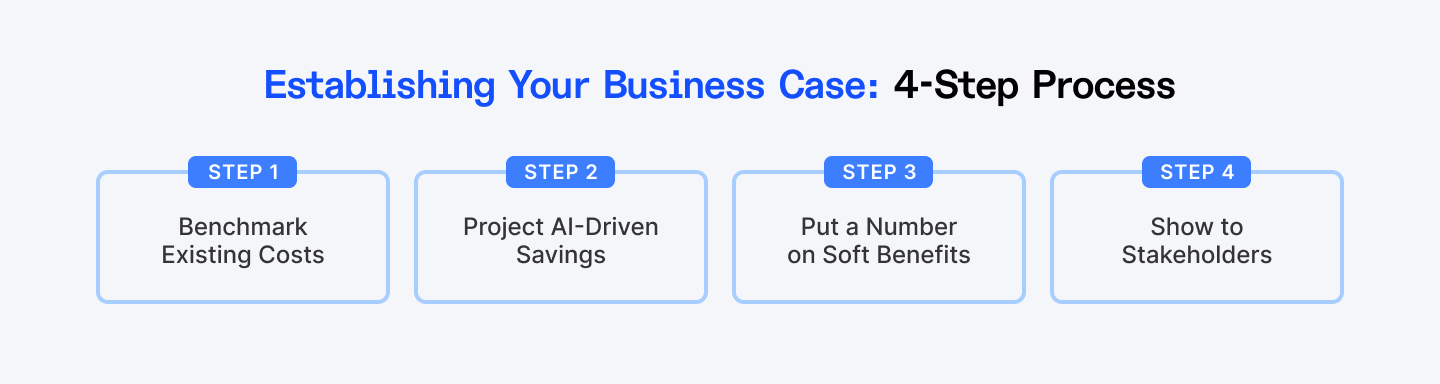
Step 1: Benchmark Existing Costs
Start by compiling your real-world hiring statistics. Don't guess, use hard data from your previous 20 hires. Measure time to hire, interview time, recruiter time, and hiring manager time.
Factor in the hidden costs, such as the productivity effect of open positions and the time current employees spend doing additional work. Set up a basic spreadsheet with role, hiring time, total interview hours, recruiter hours, hiring manager hours, and estimated productivity loss columns. This is your "before" snapshot.
Step 2: Project AI-Driven Savings
Use conservative industry standards to apply to your baseline numbers. If IBM managed 30% cost savings, model what 20% would look like for your organisation. Present ranges instead of point estimates to demonstrate to your CFO that you have thought through risks and aren't overstating the ROI of AI in recruitment.
Step 3: Put a Number on Soft Benefits
Don't overlook more intangible benefits. Improved candidate matching decreases turnover, saving the expense of replacement and maintaining institutional knowledge. Assign numbers to these benefits. If enhanced matching raises retention by 10%, estimate the savings from not replacing an employee. These gains in the quality of hire bring long-term value.
Step 4: Tailor Your Presentation
Your presentation must deal with various audiences:
- For CFOs:
Lead with numbers. Lead with net ROI (%), payback period (months), and cash flow effect. Discuss budget issues early on and how the platform pays for itself.
- For Talent Leaders:
Highlight recruiter bandwidth freed and enhances hiring results.
- For Engineering VPs:
Highlight quicker team growth and less interview load on current engineers. Illustrate how AI screening equates to engineers interviewing pre-screened candidates only.
Discover the hidden biases in AI hiring tools (and how to spot them).
Why Generic Methods Miss the Mark
Most AI hiring vendors provide generic statements of efficiency gain without specific financial models. They'll explain that their platform "speeds up hiring," but won't demonstrate how much money you will save.
Index.dev does things differently. We provide boardroom-ready ROI of AI in recruitment projections that use your specific data and industry benchmarks. Instead of asking you to trust our claims, we show you exactly how the numbers work for your organisation.
While competitors showcase features, Index.dev demonstrates financial impact. While they provide case studies, we provide calculators using your actual hiring data.
Real Results from Index.dev Clients
These results aren't hypothetical; they're happening right now at companies like yours. Index.dev has helped organisations across industries transform their hiring outcomes with measurable results through proven AI recruitment case studies:
Fintech Startup (Series B) | Enterprise Software Company | Healthcare Tech Scale-up | E-commerce Platform | |
| Challenge | Struggled to hire 12 engineers in 6 months, losing £144,000 in productivity from unfilled roles | High interview burden on the engineering team (300+ hours monthly), affecting product development | 35% new-hire turnover in the first year, costing £200,000 in replacement expenses | Competing for talent in a saturated market, losing candidates to faster-moving competitors |
| Index.dev Solution | AI-powered candidate matching and automated screening pipeline | Pre-screening algorithms to identify the top 15% of candidates before human interviews | Predictive matching algorithms analysing cultural fit and role compatibility | Automated candidate engagement and streamlined interview scheduling |
| Results | Cut hiring time from 52 days to 23 days, filled all positions in 3 months, saved £76,000 in recruitment costs | Reduced engineering interview time by 65%, improved candidate quality of hire scores by 40% | Improved retention to 89%, reduced replacement costs by £140,000 annually | Increased offer acceptance rate from 60% to 85%, reduced hiring time by 45% |
| ROI | 340% in the first year | £384,000 annual savings from reclaimed engineering productivity | 420% return on platform investment | £256,000 saved in extended recruitment cycles and lost productivity |
Taking the Investment Decision
The ROI of AI in recruitment becomes indisputable when you view the figures rationally. Businesses that put this decision off aren't only missing out, they are losing ground on competitors who already have these advantages.
Your finance team requires solid forecasts, not hope. Your engineering team requires outcomes that liberate their time for creating products. Your talent team requires software that works, not more complexity.
Index.dev's platform brings measurable gains in cost per hire, time to hire, and quality of hire. Our clients realise an average ROI of 400% within one year, with several experiencing payback in less than six months.
The investment will generally repay itself in terms of just five better hires. From there, each hire brings only pure savings and efficiency improvements. When you consider that most growing companies hire 20-50 engineers annually, the cumulative impact becomes substantial.
Your Next Steps
The data is clear:
AI recruitment tools deliver measurable ROI for organisations that implement them strategically.
Index.dev can show you exactly what your ROI of AI in recruitment would look like using your actual data to create a personalised financial analysis.
This isn't a generic product demo; it's a customised financial analysis that shows your exact return on investment. You'll see how much money you'd save, how much time you'd reclaim, and how much faster you could scale your engineering team.
The process takes 30 minutes and gives you concrete numbers you can present to your CFO with confidence. The framework is proven, the benefits are measurable, and the time to act is now.
You owe it to your teams, and your P&L, to explore how AI can transform hiring into a competitive advantage.
Build your AI recruitment solution with our elite developers today to cut hiring costs, speed up results, and prove ROI fast.