Artificial intelligence (AI) has rapidly evolved from an experimental technology used in limited research laboratories to a pivotal driver of organizational competitiveness and transformation. What started as a niche use of predictive analytics and automation has now become critical to strategic decision-making, product innovation, and operational efficiency throughout the global corporate landscape. As we approach 2026-2027, organizations are no longer discussing "if" AI matters; instead, they are planning how quickly and deeply they can incorporate AI throughout their digital ecosystems. This means that corporate AI adoption numbers in 2026 are more than simply a progress metric; they are also a roadmap for future competitiveness.
In this blog, we'll dissect the most recent data from worldwide surveys and research, delve into insights from the global AI adoption report, identify important AI transformation KPIs, and project how businesses will employ AI by 2027. With adoption rates increasing and disruptive AI technologies such as generative models and MLOps becoming mainstream, now is a critical time for businesses eager to expand AI at the enterprise level.
Looking to hire AI-savvy developers? Index.dev connects you with top remote talent ready to accelerate your AI adoption.
Enterprise AI Adoption: Current Landscape (2026)
What Does "AI Adoption" Mean for Global Enterprises?
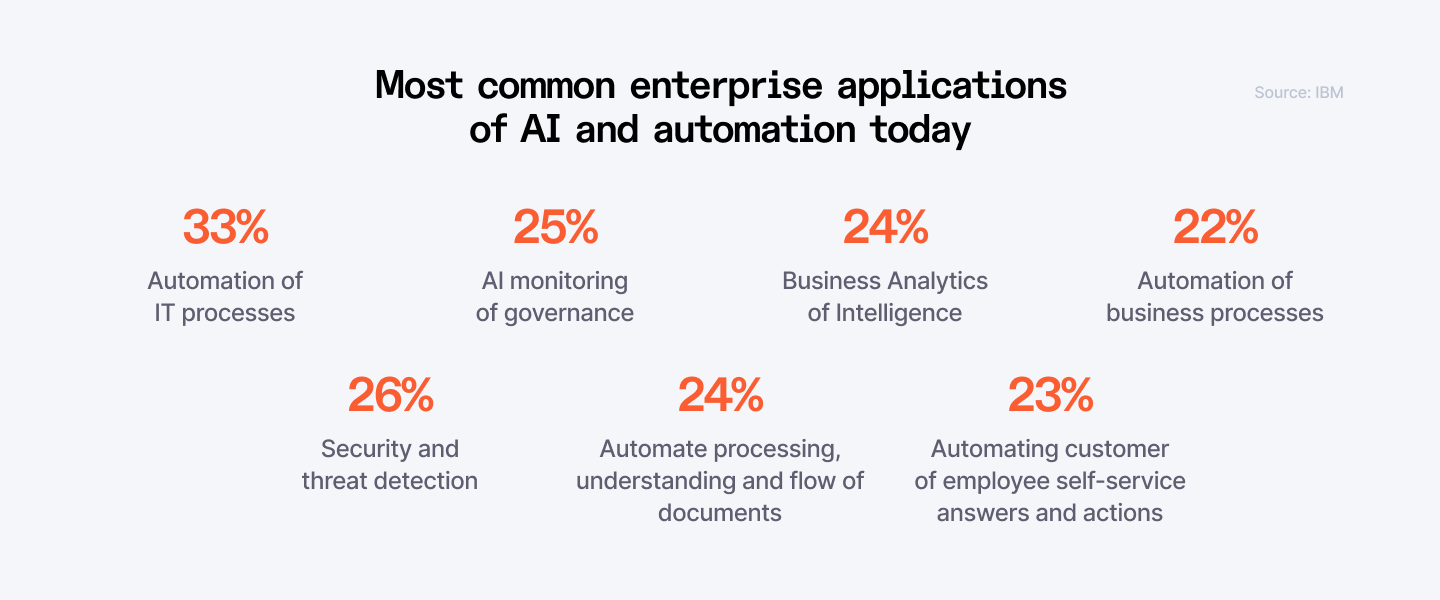
In today's business environment, AI adoption extends beyond training a few machine learning models for study. Instead, it ranges from pilot projects that prove feasibility to huge production deployments in which AI systems work consistently in mission-critical settings. True adoption entails integration into workflows, demonstrable business results, and repeatable procedures – going beyond testing to daily business operations. Some firms promote horizontal adoption (widespread usage across departments such as HR, finance, and customer service), while others prioritize vertical adoption (AI suited for domain-specific activities such as medical diagnostics or supply chain forecasting).
Key Adoption Stats (2026)
Enterprise AI use continues to rise through 2026, demonstrating increased confidence and investment. According to recent research, over 78% of organizations worldwide currently employ AI in at least one business function, up from 55% only a few years ago, indicating that AI is entering the mainstream industry.
Large corporations are ahead of the curve: many firms with 5,000 or more people report considerably greater adoption rates than smaller companies, which often lag owing to resource restrictions and integration difficulties. Regional trends indicate high acceptance in Asia and North America, with certain EMEA and LATAM regions catching up as internet infrastructure improves.
Drivers of Adoption
Several factors contribute to the acceleration of general AI adoption:
- Competitive pressure and market disruption: Businesses fear falling behind if they do not use AI to develop and optimize.
- Data maturity and cloud infrastructure readiness: With rich data assets and scalable cloud platforms, corporate AI implementation is more viable than ever.
- Available AI platforms: Advancements in LLMs, MLOps, generative AI, and analytics tools are decreasing implementation hurdles and enabling businesses to create more meaningful solutions.
Barriers to Adoption
Despite the excitement, adoption doesn't come without challenges:
- Skill gaps and talent shortages: A lack of AI professionals continues to impede deployment and growth.
- Concerns about ROI and measurement: Businesses struggle to quantify real results, which might slow investment.
- Governance, compliance, and ethical AI challenges: Data privacy, transparency, and governance concerns often hamper adoption strategies.
As 2026 is here, organizations that address these impediments proactively will be better positioned to turn AI adoption into enterprise-wide change and competitive advantage.
Curious how AI agents are transforming enterprises? Discover the latest stats and real-world insights.
Anatomy of a Global AI Adoption Report
A recent global AI adoption study looks beyond surface-level use metrics and instead focuses on how deeply AI is integrated into company processes. Analysts generally monitor deployment rates to differentiate between firms experimenting with AI and those running models in full production at scale. Another important consideration is investment levels, which include AI budgets, cloud infrastructure investments, and long-term platform commitments. Finally, studies are increasingly comparing business results to expectations, assessing whether AI programs deliver on projected increases in productivity, revenue, and efficiency.
Benchmarking within the industry is another important aspect. AI is commonly utilized in the financial services industry to identify fraud and estimate risk. Diagnostics, patient analytics, and medication development are key areas of concentration in healthcare and life sciences. Retail and CPG use AI for demand forecasting and customization, while manufacturing and logistics depend on predictive maintenance and supply chain optimization. The public sector and education are increasingly using AI for service delivery and policy formulation.
These reports have a direct impact on company strategy. They are used by leaders for strategic planning and budgeting, guiding vendor and platform selection, and driving executive alignment and artificial intelligence governance frameworks. As a consequence, global AI adoption statistics are often used to make decisions rather than just providing industry snapshots.
Key Transformation Metrics for Enterprise AI Success
Measuring success in corporate AI programs needs more than just monitoring installations; it necessitates a systematic perspective of AI transformation indicators like adoption, performance, risk, and organizational preparedness. Adoption indicators often include the percentage of processes automated, the proportion of teams actively utilizing AI tools, and deployment velocity, which measures how rapidly AI models go from pilot to production.
Beyond use, organizations prioritize performance and impact measures such as revenue growth due to AI, cost savings from operational efficiency, and time-to-value, which is an important sign of AI maturity. Faster time-to-value frequently indicates robust data pipelines and MLOps procedures.
Quality and risk measures, such as model accuracy, fairness, and dependability, are just as critical as ethical AI compliance standards and security or privacy audit results. On the organizational level, executives monitor talent development, internal AI certifications, cross-functional cooperation, and overall AI maturity scores.
Top-performing organizations often combine these signals into executive KPI dashboards, allowing for comparison against peers and continual improvement – a characteristic of scalable, responsible AI transformation.
Enterprise AI Usage Forecast: 2026-2027
The AI corporate adoption projection for 2026-2027 predicts a significant transition from testing to large-scale operationalization. By the end of 2027, researchers expect 85-90% of big worldwide organizations will use AI in numerous fundamental business processes, up from around three-quarters in 2025. At the same time, total corporate AI expenditure is likely to increase at a CAGR of 20-25%, driven by investments in generative AI platforms, data infrastructure, and AI governance tools.
Adoption trends will continue to change based on organization size. Large organizations are expected to expand their use of AI across operations, finance, engineering, and customer experience, while SMEs will increasingly use AI via embedded tools in SaaS platforms rather than developing models in-house.
By 2027, numerous promising AI use cases are predicted to have matured. These include self-driving decision systems for pricing and risk assessment, predictive analytics integrated directly into workflows, conversational AI for knowledge work, and AI-supported software engineering that shortens development and testing cycles.
Certain sectors are poised for very fast development. Healthcare will witness an increase in diagnostics and tailored medication, financial services in forecasting and fraud protection, supply chains in real-time optimization, and consumer engagement in hyper-personalised interactions.
Alongside clinical AI tools, healthcare practices are increasingly pairing technology with remote medical assistants to manage the administrative workload, from real-time documentation to patient scheduling, that still requires trained human oversight.
Major technological advancements underpin these trends, including more competent foundational models, a rising open-source AI ecosystem, enhanced MLOps and model lifecycle tools, and hybrid cloud-edge AI deployments that bring intelligence closer to real-world operations.
See which AI acquisitions are shaking up the market and what it means for the industry in 2026.
Best Practices for AI Adoption Success in 2026-2027
As corporate AI adoption grows, firms that thrive will adhere to a consistent set of best practices centered on people, processes, and platforms. First, executives must establish an AI-ready culture by getting visible executive support, aligning AI projects with corporate goals, and investing in structured change management and skill development programs.
To choose efforts that provide demonstrable benefit without unnecessary complexity, companies should begin with high-impact use cases and use an impact × feasibility matrix. This enables teams to avoid halted pilots and concentrate on scalable victories. Equally vital is the capacity to consistently measure value. High-performing firms establish KPIs from the start and utilize dashboards to link AI results directly to revenue growth, cost savings, and risk avoidance.
Strong governance and ethical standards are also required. This includes model risk management processes, open data and model documentation, and frequent audits to ensure fairness, security, and compliance. Finally, companies must invest in scalable infrastructure, such as secure data lakes, orchestration layers, and MLOps platforms that enable continual improvement.
Together, these guidelines will allow businesses to go beyond adoption to long-term, responsible AI-driven change in 2026-2027 and beyond.
Risks and Ethical Considerations
As enterprise AI usage rises, organizations must face an increasing number of risks and ethical issues. Bias and fairness are still major problems, especially when AI systems affect employment, financing, pricing, and healthcare choices. Without varied training data and ongoing monitoring, workplace AI models may inadvertently exacerbate existing inequities.
Data privacy and cross-border data governance are both crucial as businesses increasingly operate in regions with different legal constraints. Compliance with standards such as GDPR and upcoming AI legislation complicates global AI installations.
Furthermore, organizations confront an increasing need for model explainability and transparency, particularly in regulated sectors where decision traceability is required. Regulatory and compliance issues will increase from 2026 to 2027 as countries implement stronger AI accountability laws. Addressing these issues early is critical for long-term and responsible corporate AI transformation.
Future Outlook for 2028 and Beyond
Looking beyond the present forecasts, AI is predicted to become the de facto corporate operating standard by 2028, similar to cloud computing today. Rather than being standalone tools, AI will be deeply integrated into business processes, decision systems, and digital products. Enterprises will increasingly employ autonomous AI systems that can manage processes, optimize operations, and support governance with minimum human participation.
The next phase of AI advancement will be determined by integration with cutting-edge technology. Advances in IoT will allow real-time AI at the edge, AR/VR will improve intelligent interfaces, and early quantum computing advances may open up completely new classes of AI optimization issues. Together, these changes will reshape how businesses scale intelligence.
Explore the newest AI model releases and how they’re set to change business strategies.
Conclusion
The global corporate AI environment is approaching a decisive period. The business AI adoption statistics for 2026, developing AI transformation metrics, and the AI enterprise use prediction all indicate fast expansion, deeper integration, and increasing strategic relevance. AI is no longer an experimental capacity; it is becoming a critical corporate asset.
Enterprise executives have a clear mandate: carefully evaluate results, balance opportunity with governance and risk, and strategically invest in people, platforms, and processes. Organizations that see AI as a long-term transformation rather than a short-term technological update will be best positioned to compete, innovate, and lead in the next years' AI-driven global economy.
➡︎ Looking to scale AI adoption? Index.dev connects you with elite AI engineers who've built production systems at scale. From MLOps to generative AI—find talent that turns your 2027 roadmap into reality.
➡︎ Want to go deeper into where AI is really headed? Explore more Index.dev insights on AI literacy and what it means in 2026, how AI is reshaping application and cloud development, and which industries are closest to a real AI tipping point. You can also dig into practical perspectives on why forward-deployed engineers matter, plus hands-on model comparisons that break down DeepSeek versus ChatGPT, how it stacks up against Claude, and which open-source Chinese LLMs are gaining serious traction.