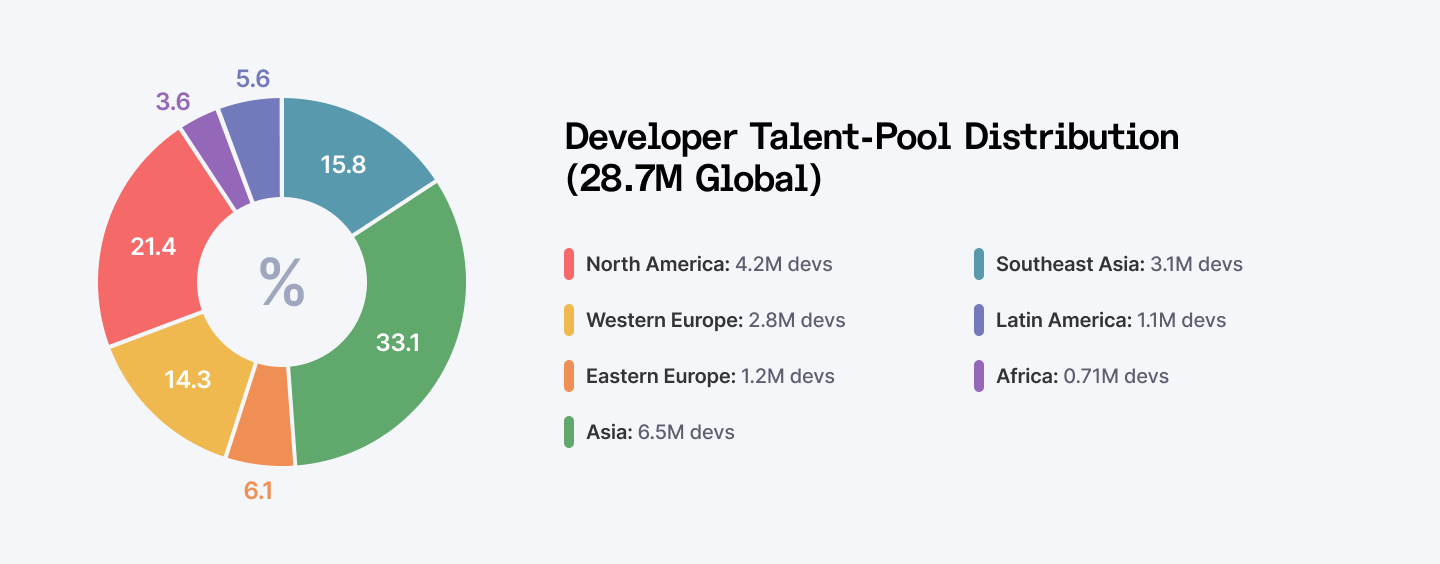
the global market spans $25/hr in Asia to $140/hr in North America. Web developers average $45-75/hr, software engineers command $60-120/hr, and AI specialists charge $100-200/hr. Senior developers consistently earn 2-3x more than juniors across all regions.
But the 2026 landscape has shifted in ways the 2025 benchmarks do not capture. AI agent developers now command $180-300/hr as a distinct category. EOR compliance costs add 15-25% to cross-border engagements that published rates do not include. And the "cheap offshore" narrative is fading as senior talent in Poland, Argentina, and Vietnam prices closer to Western mid-level rates.
This guide breaks down rates across 75 countries with the exact numbers you need to budget your project or price your services competitively in 2026. We cover every developer type, seniority band, region, and the hidden cost layers that most rate guides skip.
Need freelance developers fast? Get matched with human-vetted engineers from LATAM and CEE in 48 hours. Transparent rates. No upfront risk.
5 Key Takeaways
- $101.50/hr global baseline for freelance developers worldwide. North American rates ($80-140/hr) anchor the top, while Southeast Asia ($20-33/hr) offers 70-80% savings at comparable mid-level quality.
- AI/ML engineers command 40-60% premiums over generalist developers. Senior AI specialists with production ML experience charge $150-250/hr, and AI agent developers (LangChain, MCP, multi-agent orchestration) are emerging as a $180-300/hr niche in 2026.
- Seniority matters more than geography. A senior developer in Eastern Europe ($60-90/hr) often outperforms a junior in North America ($40-60/hr) on total project cost, delivering in one-third the hours.
- Platform vs. direct hiring gap: 20-30%. Upwork and similar marketplaces reduce rates by 20-30% compared to direct relationships, but freelancers trade margin for steady deal flow. Index.dev offers transparent pricing with human-vetted engineers matched in 48 hours.
Hidden costs inflate cross-border budgets by 15-25%. EOR compliance fees, currency conversion, time-zone coordination overhead, and platform service charges are rarely included in published hourly rates, but they add up fast on distributed teams.
Average Hourly Rates by Developer Type (2026)
Get smart about what to pay, (or charge), for each developer specialty in 2026.
Web Developer Freelance Rates
Front-End Developers
Work with HTML, CSS, JavaScript, React, and more.
- Junior: $40-50/hr (1-2 years)
- Mid-level: $60-80/hr
- Senior: $80-120/hr
Curious about what determines these bands? See JavaScript developer rates by region.
Back-End Developers
Code in Python, PHP, Node.js, Java. Server-side know-how means higher rates.
- Mid-level: $70-100/hr
- Senior: $100-140/hr (competitive markets)
Full-Stack Developers
Handle both front- and back-end. Pay a premium for versatility.
- Average: $70-120/hr
- Top markets (SF, Zurich): $140-160/hr
Software Developer Hourly Rates
Entry-Level Software Developers
Fresh out of uni, 0-3 years' experience.
- Typical rate: $50-70/hr
Mid-Level Software Developers
3-7 years' strong delivery resume.
- Typical rate: $70-100/hr
Senior Software Developers
7+ years, handle system architecture, lead teams.
- Typical rate: $100-160/hr
AI Engineer and Machine Learning Specialist Rates
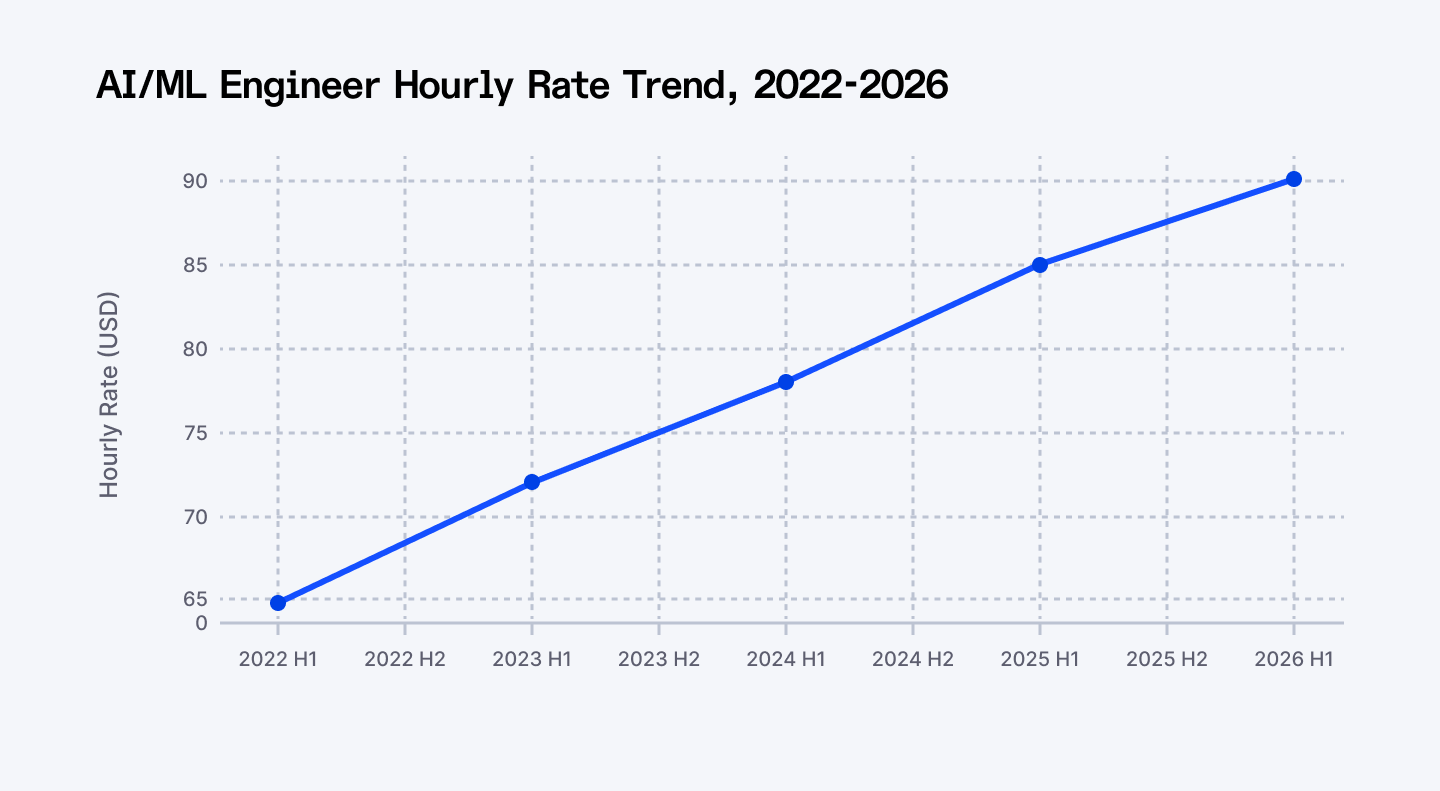
Premium tier: these specialists are rock stars for a reason. The specialized knowledge required for AI work means these developers consistently charge 40-60% more than general software developers.
Freelance AI engineers with basic machine learning experience start around $80-100/hr. However, the real value lies with mid to senior level AI specialists. Those with 3-5 years of production ML experience charge $120-180/hr, while senior AI engineers with deep expertise in NLP, computer vision, or custom model development command $150-250/hr.
The highest rates often go to AI consultants with Ph.D. qualifications and proven track records in specialized areas. These experts can charge $250-500/hr for strategic AI consulting and custom implementation work.
Projects requiring cutting-edge AI capabilities like large language model fine-tuning, custom neural network architectures, or production-grade ML systems justify these premium rates when you hire AI developers. Companies recognize that expertise at this level significantly reduces project risk and accelerates time to market.
| Specialization | Rate Range ($/hr) | Typical Premium vs. Baseline |
|---|---|---|
| AI/ML Engineer | $35-$160 | +40-60% |
| Cybersecurity | $40-$90 | +30-50% |
| Blockchain Dev | $54+ | +20-40% |
| DevOps Engineer | $45-$110 | +25-45% |
| Cloud Architect | $65-$130 | +35-55% |
The data above has been compiled from various sources like Upwork, Ruul, FreelancerMap, etc.
How Experience Level Changes Rates
Your experience = your price tag. Here's the breakdown:
Junior Developers (0-2 Years)
Junior developers typically earn the base rates for their region. In North America, that's $40-60/hr. In Western Europe, it's $35-55/hr. In Eastern Europe, you're looking at $25-40/hr, and in Asia, rates start at $20-35/hr.
Junior developers excel at maintenance tasks, bug fixes, simple feature implementation, and working under supervision on larger projects.
Mid-Level Developers (3-6 Years)
Mid-level developers see their rates increase by 50-80% compared to juniors. A mid-level developer in North America charges $70-100/hr, while their counterparts in Eastern Europe charge $40-65/hr.
These developers can handle complex features independently, make architectural decisions for modules, and mentor junior team members.
Senior Developers (7+ Years)
Senior developers command 2-3x the junior rate in their region. North American seniors charge $100-160/hr, Western European seniors get $80-120/hr, and even in cost-effective markets like Eastern Europe, senior talent charges $60-90/hr.
Here's the kicker: a senior might do in 20 hours what a junior takes 60 for. They're worth it because they design system architecture, prevent technical debt, lead development teams, and deliver projects with minimal supervision.
Higher rates? Cheaper project.
Tech leads and architects sit at the top of the scale. These developers with 10+ years of experience and proven leadership skills charge $120-200/hr globally, with rates reaching $250/hr in premium markets or for specialized expertise.
The math is straightforward. A junior developer might take 60 hours to complete what a senior does in 20 hours. The senior's higher hourly rate often results in lower total project costs because of their efficiency, fewer bugs, and better architectural decisions that prevent costly rewrites.
We've found this geographic flexibility particularly valuable for startups watching their burn rate. These cost spreads highlight how regional talent pools and local market structures influence freelance pricing. When planning your budget, consider not only the hourly rate but also what each experience level actually delivers. And if you're exploring the best countries to hire freelance developers, factor in talent quality, time zones, and long-term scalability, not just cost.
Note: The data below has been sourced and compiled from various sites such as Arc, Your Team In India, Techvify, Qubit Labs, etc. These ranges blend juniors' lower band with seniors' top band, so you can match your project scope to the appropriate bracket, as detailed in the table below.
| Country | Avg. Rate (USD/hr) | Junior (USD/hr) | Senior (USD/hr) | Top Skills |
|---|---|---|---|---|
| United States | 95-110 | 55-75 | 100-150 | AI/ML, Cloud, Cybersecurity |
| Canada | 85-100 | 50-70 | 90-130 | DevOps, Full-stack JS |
| United Kingdom | 75-95 | 45-65 | 80-120 | Python, React, Data Engineering |
| Germany | 70-85 | 40-55 | 75-110 | Java, DevOps, Cloud |
| Switzerland | 90-120 | 60-85 | 100-160 | Site Reliability, Blockchain |
| India | 30-50 | 15-25 | 40-70 | JavaScript, Java, Mobile Dev |
| Ukraine | 25-35 | 10-15 | 25-40 | .NET, QA, Python |
| Brazil | 30-55 | 20-35 | 40-75 | React, Node.js, IoT |
| South Africa | 25-45 | 15-30 | 35-55 | Web Dev, Angular, .NET |
| Philippines | 20-35 | 10-20 | 25-40 | QA Automation, Mobile, PHP |
Explore more with ourLATAM developer rates.
Top 10 Most Expensive and 10 Cheapest Countries
Compiling data across 75 countries, the spectrum of freelance rates highlights both premium markets and emerging lowcost hubs. Switzerland leads the pack, with an average of $90/hr, closely followed by the United Kingdom and Canada. On the other end, Mongolia's average of $9.65/hr showcases how far regional pricing disparities can stretch.
These rankings offer quick benchmarks if you're deciding between highcost, highexpertise markets and budgetfriendly alternatives. Remember that the cheapest rates often come with lower living costs and smaller talent pools, so balance your needs for speed, quality, and local market knowledge.
Please note that the following data is compiled from UpstackStudio; highest and lowest tiers shown.
| Rank | Country | Avg. Rate ($/hr) | Rank | Country | Avg. Rate ($/hr) |
|---|---|---|---|---|---|
| 1 | Switzerland | 90.00 | 66 | Morocco | 29.33 |
| 2 | UK | 96.75 | 67 | Nepal | 28.00 |
| 3 | Canada | 94.67 | 68 | Bangladesh | 26.83 |
| 4 | Australia | 93.25 | 69 | Tunisia | 25.50 |
| 5 | U.S. | 87.88 | 70 | Tajikistan | 25.00 |
| 6 | Japan | 83.25 | 71 | Laos | 23.75 |
| 7 | Germany | 79.56 | 72 | Myanmar | 22.60 |
| 8 | Netherlands | 78.83 | 73 | Moldova | 20.25 |
| 9 | Slovenia | 75.00 | 74 | Ghana | 19.67 |
| 10 | Ireland | 72.25 | 75 | Mongolia | 9.65 |
Several major trends are reshaping developer rates in 2026, and understanding them helps you make smarter hiring or pricing decisions.
AI Agent and LLM Developer Rates: The New Premium Tier (2026)
The 2025 rate guides covered AI/ML broadly, but 2026 has splintered this category. Companies now distinguish between traditional ML engineers (model training, feature engineering) and a newer class: AI agent developers who build autonomous multi-step systems using frameworks like LangChain, CrewAI, AutoGen, and Anthropic's Model Context Protocol (MCP).
Traditional ML engineers with 3-5 years of production experience still charge $120-180/hr. But AI agent developers, who architect systems where LLMs call tools, chain reasoning steps, and interact with external APIs, command $180-300/hr for senior-level work. The premium reflects both scarcity (fewer than 18 months of real-world agent production experience exists anywhere) and complexity (agent reliability, hallucination mitigation, and cost optimization are unsolved problems that require deep expertise).
Fine-tuning specialists, RAG engineers, and prompt engineers sit between these tiers at $130-200/hr. The highest rates go to engineers who can build complete AI product stacks: from data pipeline through model selection to production agent deployment with observability and guardrails.
| AI Specialization | Rate Range ($/hr) | Key Skills |
|---|---|---|
| ML Engineer (traditional) | $80-180 | TensorFlow, PyTorch, feature engineering, model training |
| RAG / Fine-Tuning Engineer | $130-200 | Vector DBs, embedding models, LoRA, RLHF |
| AI Agent Developer | $180-300 | LangChain, CrewAI, MCP, tool orchestration, guardrails |
| AI Consultant (PhD / Strategic) | $250-500 | Architecture review, custom model development, compliance |
If you are budgeting for AI talent in 2026, the question is no longer "do we need AI?" but "which layer of the AI stack do we need?" A $90/hr ML engineer can integrate pre-trained models. A $200/hr agent developer builds the autonomous systems that multiply your team's output. Match the rate to the architectural complexity of the work.
AI Tool Impact on Rates
AI coding assistants are more nuanced than predicted. While some analysts expected AI coding assistants to drive rates down, the reality is different. AI tools have made developers more productive, but hourly rates haven't decreased.
Instead, overall project costs have dropped because developers complete work faster. The exception is routine maintenance work, where rates have softened by 5-10% as AI handles simple tasks.
Premium Skills Command Bigger Premiums
AI/ML developers, cybersecurity specialists, and blockchain engineers earn 40-60% more than general software developers. This gap has widened in 2025 as companies compete for scarce specialized talent. If you have these skills, now is the time to price aggressively. If you're hiring, budget accordingly or consider hybrid approaches.
Remote Work Has Stabilized Geographic Arbitrage
The initial pandemic-era rush to hire globally has matured. Companies now understand the real costs of distributed teams, including communication overhead and time zone coordination. As a result, nearshore developers in similar time zones command 10-15% premiums over offshore talent at the same skill level.
Contract Flexibility is Worth More
Developers offering quick start times and flexible hour commitments are getting 15-20% rate premiums. Companies increasingly value developers who can scale up for a sprint and scale down afterward, rather than committing to fixed monthly retainers.
Platform vs. Direct Hiring Rates
Freelancers working through platforms like Upwork typically charge 20-30% less than those with direct client relationships. However, platform developers trade lower rates for consistent project flow and payment security. If you're building your freelance career, start on platforms to build a portfolio, then transition to direct clients for better rates.
European Rate Compression is Easing
For several years, rates in Western and Eastern Europe converged as Eastern European developers raised prices. That trend has slowed in 2025. Western European rates remain stable at $70-110/hr while Eastern European rates have plateaued at $45-70/hr, creating a sustainable 35-40% cost advantage.
Break it down further in our European developer hourly rates.
Factors Influencing Developer Rates
Why does a senior AI/ML engineer in the U.S. bill $140/hr, while a mid-level Java dev in Eastern Europe charges $40/hr? Break down:
- Cost of living & local economics (Nordics vs. CEE)
- Talent supply & demand (Global developer shortage vs. regional surpluses)
- Specialization premiums (AI/ML, cybersecurity add +40-60%)
Remote Work Impact on Rates
- Hybrid Roles: 5-10% rate reduction vs. fully remote.
- Time Zone Flexibility: Developers in UTC+2/UTC-5 zones charge 10-15% more for overlap with U.S./EU teams.
Why It Matters to You
Understanding these drivers helps you predict where rates will move next and where you can negotiate most effectively.
Actionable Takeaways
- Optimize Your Mix: Pair North American architects ($120/hr) with Eastern European teams ($30-$59/hr) to reduce overall spend by up to 35% while retaining senior oversight.
- Invest in Niche Skills: Lock in AI/ML and cybersecurity experts early. Platforms like Index.dev and Upwork report these roles fill 60% faster and deliver 30-50% higher ROI than generalists.
- Leverage Emerging Hubs: Latin American devs (Brazil, Argentina) bill $28-$55/hr with minimal time-zone friction, making them ideal for U.S./EU projects.
- Tier Your Contracts: Use junior talent ($20-$40/hr) for maintenance and testing, intermediate ($40-$70/hr) for feature builds, and seniors ($70-$160/hr) for architectural design and leadership; this maximizes value per dollar.
How to Negotiate Rates Without Losing Money or Talent
Negotiation. The part everyone dreads and everyone needs to master.
Whether you're hiring or pricing your own services, this conversation determines if you walk away with a fair deal, or get played. Here's how to keep your leverage without torching the relationship.
Hidden Costs Beyond the Hourly Rate
Published hourly rates tell only part of the story. When hiring freelance developers across borders, three cost layers sit on top of the advertised rate that most rate guides ignore.
Platform and Intermediary Fees
Freelance platforms charge service fees that inflate effective costs. Upwork takes 10% from freelancers (built into their rates) plus a 5% client fee. Toptal operates on a 60-100% markup model, meaning a developer paid $60/hr may cost the client $100-120/hr. Agency models in Eastern Europe and Latin America typically add 30-50% over the developer's take-home. Index.dev uses a transparent fixed-margin model with human-vetted engineers from LATAM and CEE, so you know exactly what the developer earns versus what you pay.
EOR and Compliance Overhead
Hiring full-time contractors through an Employer of Record adds 15-25% on top of base compensation. This covers local employment taxes, statutory benefits (health insurance, pension contributions, severance), and the EOR's management fee. In markets like Brazil (CLT labor law) or India (PF/ESI contributions), statutory costs alone add 20-30%. For short engagements under six months, freelance contracts avoid this layer entirely, which is one reason freelance rates appear higher per hour but often cost less per project.
Time-Zone Coordination Tax
Distributed teams lose 10-15% of productive time to async communication delays, meeting scheduling across zones, and context-switching during handoffs. Nearshore teams (Latin America for US clients, Eastern Europe for EU clients) minimize this overhead. The 10-15% rate premium for nearshore versus offshore talent typically pays for itself in faster iteration cycles and fewer miscommunication-driven rework hours.
Where Rates Are Heading: H2 2026 and Beyond
Three forces will shape freelance developer rates through the rest of 2026 and into 2027.
AI productivity gains compress project costs, not hourly rates. Developers using AI coding assistants (GitHub Copilot, Cursor, Claude Code) complete tasks 25-40% faster according to early productivity studies. But hourly rates have not dropped. Instead, total project budgets shrink because fewer hours are needed. Expect this pattern to continue: the same $100/hr senior developer now delivers $130-140 worth of output per hour. Clients who fixate on hourly rate reduction will lose to those who measure cost-per-outcome.
Specialized AI roles will keep diverging from generalist rates. The 40-60% AI/ML premium of 2025 is widening to 60-100%+ for agent developers and AI infrastructure engineers. As every software product adds AI features, demand for these specialists outpaces the training pipeline. Budget accordingly if your 2026-2027 roadmap includes AI agent features, RAG systems, or custom model deployments.
Latin America and Eastern Europe are no longer "cheap", they are "efficient." The cost arbitrage narrative is shifting. Senior developers in Poland, Ukraine, Argentina, and Brazil now charge $60-90/hr, comparable to mid-level rates in Western Europe. The value proposition is no longer "lower rates" but "same rates, better availability, and comparable time zones." Companies that still frame these regions as budget options will struggle to attract top-tier talent.
For Clients: Hire Top Freelance Developers
Index.dev is an AI-first engineering talent platform that connects companies with the top 1% of senior engineers from LATAM and CEE, around 30,000+ developers, each human-vetted through technical and live interviews from a pool of 2.5M+. Roughly a 1.2% acceptance rate, with matches in 48 hours.
Clients save 40-60% on engineering costs compared to US in-house rates. 97% of clients return for a second engagement, and repeat hires are matched 4-8x faster. Whether you need a single senior React developer or a full AI engineering squad, start here and get matched with human-vetted talent in 48 hours.
For Developers: Know Your Worth
Join Index.dev's network of 30,000+ human-vetted engineers from LATAM and CEE, the top 1% selected from 2.5 million professionals. Get matched with top-paying freelance projects from global companies. No bidding wars, just serious offers matched to your skills and rate expectations.