On an ordinary Tuesday of November the 18th, Google shipped something that didn't feel ordinary at all.
Antigravity—an agentic development platform powered by Gemini 3 Pro. It isn't a code completion tool with a nice UI. It's not a Cursor with extra features. It's genuinely different—an IDE built for agents, not autocomplete.
Antigravity is an AI tool that understands your entire task and handles multiple steps automatically. You tell it 'build a login form with database connection,' and it creates HTML, backend code, validation, tests, and fixes bugs—all without you writing line-by-line code.
Here's what this means for teams hiring and building in 2026.
Build with AI, focus on architecture. Find projects on Index.dev.
Understanding Antigravity
Here's what matters: An agent doesn't autocomplete your next line. It takes your task, breaks it into steps, executes those steps, runs tests, fixes what broke, and hands you a verified result. You oversee. You verify. You make calls. But you don't write the boilerplate.
Antigravity achieved 76.2% on SWE-bench Verified—a benchmark that measures whether an AI can actually resolve real GitHub issues in production codebases, not toy problems. That's 1% behind Claude Sonnet 4.5. On Terminal-Bench 2.0 (testing whether models can chain tool calls and handle multi-step workflows),
Gemini 3 Pro scored 54.2% versus GPT-5.1's 47.6%. Translation: Antigravity orchestrates complex tasks better than anything else in the market. The catch? Everything gets processed on Google's servers. If your code is legally mandatory to stay local, Antigravity isn't your tool. If you're building the next blockchain payment app, you're handing Google a copy first.
The Three-Surface Architecture That Makes This Work
The Architecture That Breaks the Autocomplete Pattern
Antigravity gives agents three command surfaces: the editor, the terminal, and a browser. Think about what that means.
Traditional AI coding tools live in the editor. Cursor suggests autocomplete. GitHub Copilot fills functions. They see code. They predict more code. Dead simple. Also, constrained.
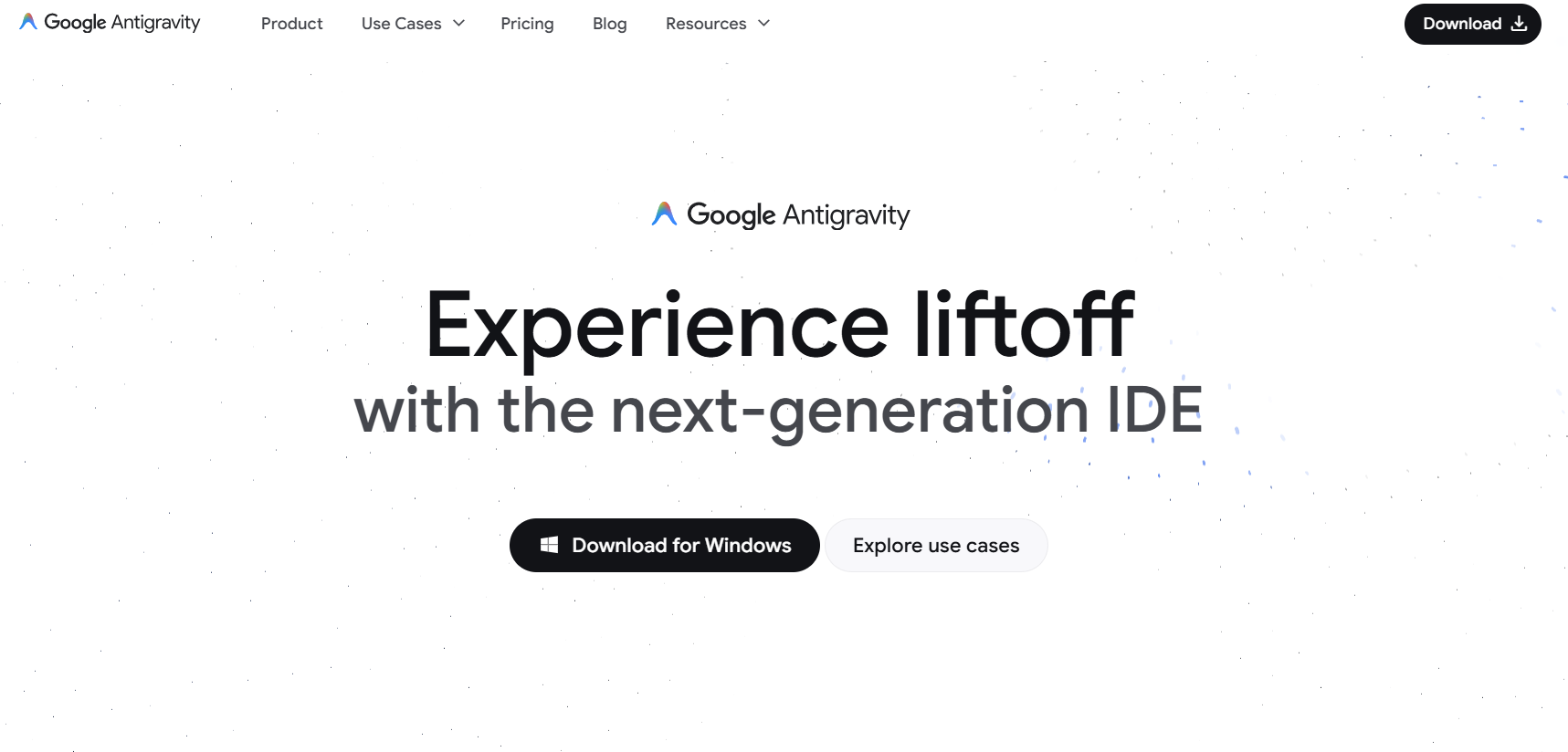
Editor + Terminal + Browser = Total Task Autonomy
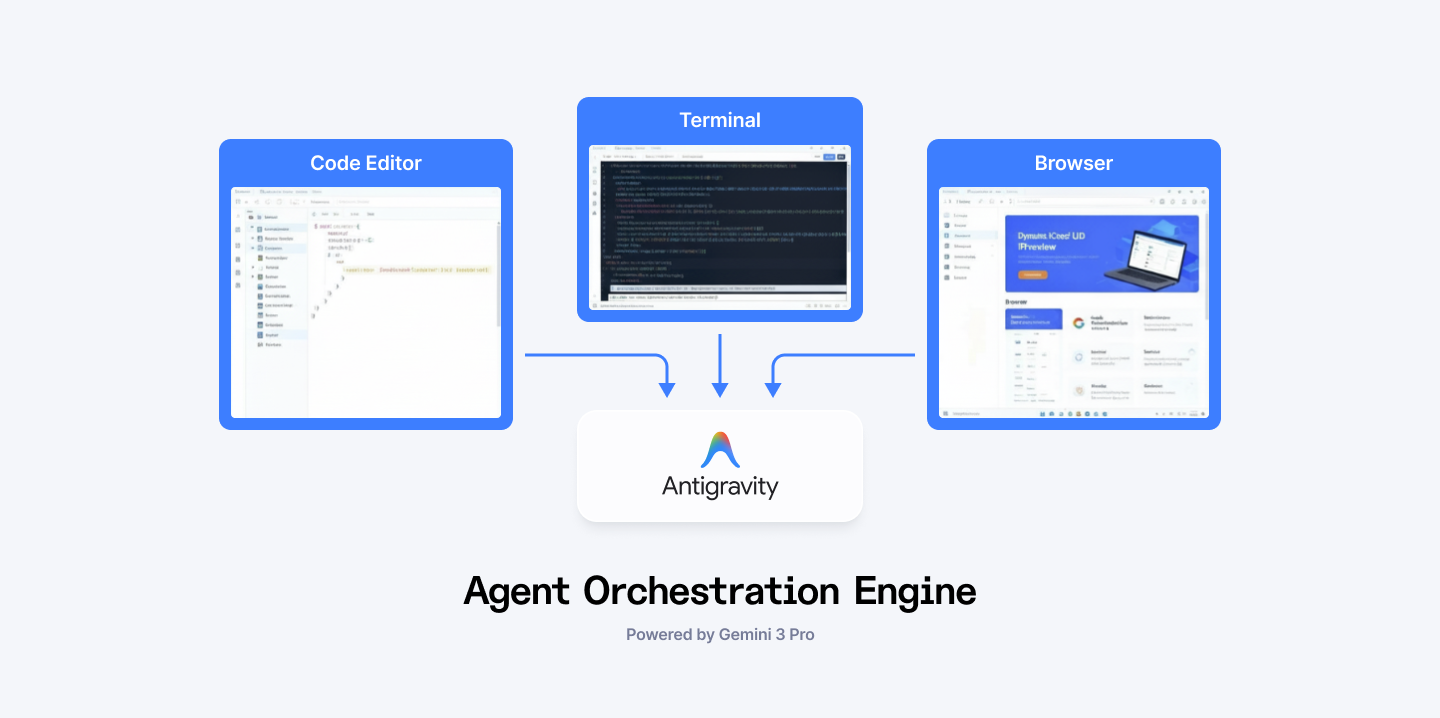
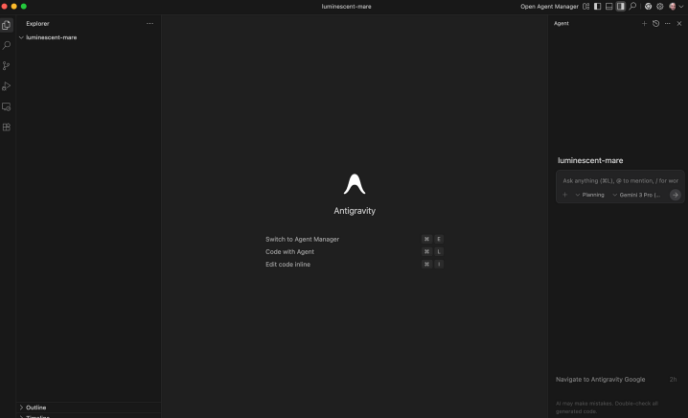
Antigravity's agents can see your editor, execute shell commands, and watch browser windows. So an agent scaffolds a Next.js app in the editor, spins up the dev server in the terminal, loads the app in a browser, runs E2E tests (end-to-end testing), notices the login button is misaligned, patches the CSS, verifies the fix, takes a screenshot, and hands it to you with a summary. All without asking permission between steps.
You oversee from what Google calls Manager View—a mission control console where you can spawn multiple agents simultaneously, each tracking its own task state, artifacts, and verification status. You're not babysitting them. You're reviewing the work.
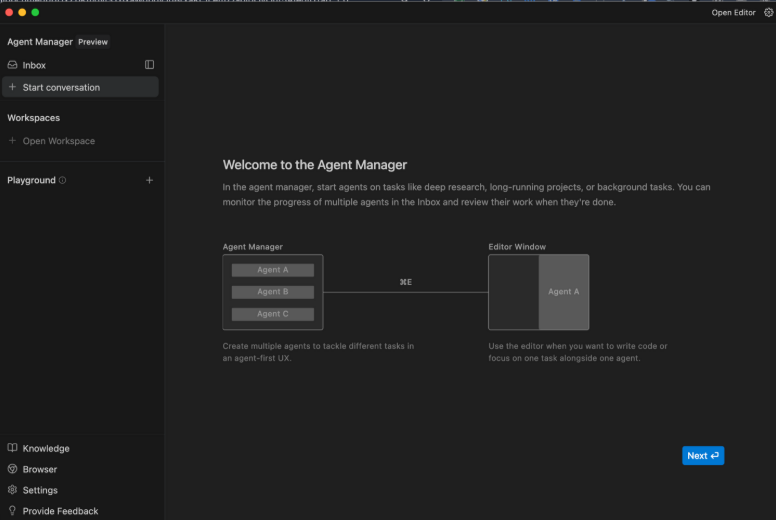
This async-first design solves something real. Chat-based tools trap you in modal conversation: you type a message, wait for output, type the next message. Loop forever. Antigravity lets agents grind through 30-minute tasks while you grab coffee, then you come back and decide whether to accept, modify, or restart their work.
That's not productivity theater. That's restructuring what a developer's actual workday looks like.
The Performance Gap: Speed That Matters
Antigravity completes a typical Next.js + Supabase feature in 42 seconds versus Cursor's 68 seconds. On codebase navigation across 100k+ line repositories, Antigravity resolves queries 40% faster than Cursor 2.0. Refactoring accuracy: Antigravity hits 94%, Cursor hits 78%.
These aren't marginal gains. They compound.
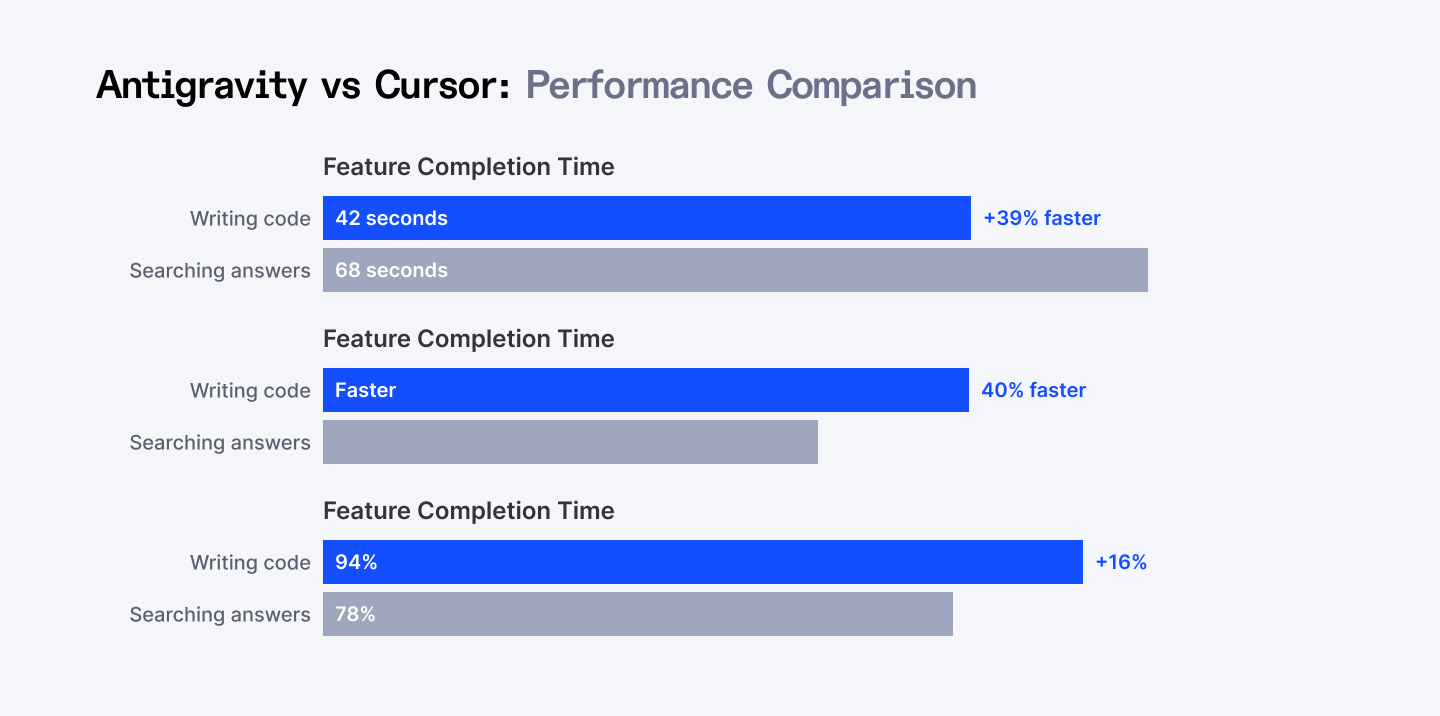
When you're spinning up features daily, 26 seconds faster per task adds up to hours per week. Scale that across a team of five engineers and you're talking about recovered productivity measured in weeks per quarter—without anyone working harder.
But speed is only half the story.
See how fast AI can turn ideas into real UI designs in our Google Stitch AI review.
Four Development Modes: Choose Your Workflow
Antigravity doesn't force one workflow on you. It launches with four distinct development modes:
1. Agent-Driven Development
The agent takes complete autonomy. You define the goal, the agent plans and executes without interruption. Best for greenfield scaffolding and clear-cut tasks.
2. Agent-Assisted Development (Recommended)
The sweet spot. The agent makes decisions, pauses for verification checkpoints, then continues. You provide tactical guidance without stopping the workflow. This is what most teams should start with.
3. Review-Driven Development
You retain strict control. The agent proposes everything; you approve each step. Ideal for critical paths (payment systems, auth) where human judgment is non-negotiable.
4. Custom Configuration
Mix modes task-by-task. Different tasks get different autonomy levels based on risk and complexity. It means a single team can use Antigravity differently depending on what they're building. Boilerplate scaffolding? Agent-driven. Payment refactoring? Review-driven. The tool adapts to your risk tolerance, not the other way around.
The Engine: Gemini 3 Pro With Options to Switch
Native Multi-Model Support, Not Lock-In
Antigravity ships with Gemini 3 Pro as the default, but agents can toggle between Claude Sonnet 4.5 and GPT-OSS 120B within the same session. No platform switching. No context loss. You don't choose a model once; you choose it per-task.
Gemini 3 Pro (the default) scored 76.2% on SWE-bench Verified and 54.2% on Terminal-Bench 2.0. Its multimodal capabilities mean it processes code, screenshots, live API responses, and natural language simultaneously. You can paste a screenshot of a Figma design and say "build this," and the agent comprehends both the image and your intent.
Deep Think Mode: Reasoning for Complex Tasks
Here's a capability Cursor doesn't have:
Deep Think, a reasoning mode that lets Gemini 3 Pro work through multi-step problems with extended deliberation. When you toggle Deep Think on, the model takes longer but produces more accurate outputs on hard problems—data migrations, complex schema refactors, tricky algorithmic code.
You toggle it off for quick fixes and utility functions to keep latency down. It's the reasoning equivalent of choosing between a calculator and a proof.
Context Window That Scales With Your Codebase
Gemini 3 Pro natively handles 1 million tokens. For context: that's roughly 700,000 words or an entire large monorepo. Antigravity can read your entire codebase without truncation, meaning it understands dependency trees, naming conventions, and architectural patterns at once.
Cursor's effective context caps are lower in practice. You hit the ceiling and need multiple iterations or manual pruning. Antigravity doesn't. It means first-attempt accuracy on large-scale refactors and semantic consistency across hundreds of files.
Read next: explore the data behind how AI tools are transforming developer workflows.
When to Use Antigravity (and When Not To)
Greenfield Projects: Where Antigravity Shines
On greenfield projects, Antigravity is genuinely spectacular. One early user showed Antigravity building a full-featured collaborative whiteboard app end-to-end—API, database schema, auth, testing, UI. No human coding. The agent orchestrated the whole thing. This is real capability, not marketing fiction.
The pattern is clear: when requirements are well-defined and boilerplate is thick, agents move fast. Scaffolding, routing, database initialization, basic CRUD endpoints—these are agent work, not human work.
Legacy Codebases: Where It Stumbles
Where it stutters: legacy codebases with custom patterns.
If your repo uses a homegrown validation library that didn't show up in Gemini 3's training data, the agent might assume a standard library and generate incompatible code.
You'll need to catch this, clarify it, and have the agent redo the work. Supervision is non-negotiable.
The practical pattern emerging: Use Antigravity for new features and architectural scaffolding. Use Cursor for surgical edits in critical paths (payment flows, auth) where you want tiny, safe diffs. Both tools increasingly live in the same workflow, not as competitors, but as fit-for-task instruments.
This hybrid approach requires judgment. It requires knowing which tool fits which job. It requires understanding your codebase well enough to predict where agents will struggle.
That's exactly the kind of thinking senior engineers bring to the table—and exactly what teams need to hire for in 2026. When you're evaluating developers for agentic workflows, you're not looking for speed typists. You're looking for architects.
Index.dev's vetting process surfaces developers who've already shipped complex systems and can reason about architectural trade-offs. That's the tier of talent that thrives when agents handle the grunt work.
Trust Through Artifacts: The Transparency Layer
Why Traditional AI Agents Fail Trust Tests
The black-box problem with AI agents is real. Show developers raw tool logs and you drown them in noise. Show only the final code diff, and they can't audit how the agent made decisions.
Antigravity surfaces Artifacts—structured deliverables that include implementation plans, task lists, screenshots, browser recordings, and annotated code diffs. You read the plan, leave feedback like you're commenting on a Google Doc, and the agent incorporates it live without discarding the current run.
How Artifacts Change Enterprise Adoption
The artifact also captures screenshots and recordings of what the agent actually did—visual proof of work. For compliance-heavy industries (fintech, healthcare, regulated security), this moves agentic workflows from experimental to auditable.
A regulator doesn't care that an AI wrote the code. A regulator cares that you can explain every decision and prove the code was verified. Artifacts give you both.
Google Docs-Style Feedback, Not Chat
Here's the micro-innovation that matters: Instead of restarting conversations, you comment on artifacts.
You highlight a section of the implementation plan and type "Let's use Zod instead of Yup for validation"—same as leaving feedback in a shared doc. The agent reads your comment and adjusts the current run without nuking context.
This async feedback loop is why Antigravity doesn't feel like shouting into a void. You're collaborating with the agent, not commanding it.
Knowledge Base Learning: Agents That Remember Your Patterns
Antigravity treats learning as a core primitive, with agents maintaining a persistent Knowledge Base. Every task completion feeds into this knowledge system. The agent learns:
- Code patterns you commonly use and prefer
- Project standards (naming conventions, file structures, comment style)
- Technical decisions and why they were chosen
- Team preferences (React Query over Redux, async/await over Promises)
After the first few tasks, agents anticipate your style without you asking. You write "add loading state," and the agent knows exactly what that means in your codebase's context. You can view, edit, and manually add rules to the Knowledge Base, even share it across teams.
This is where Antigravity escapes the "dumb autocomplete that needs to be babysat" trap. It learns you.
The Windsurf Acquisition: Why This Pedigree Matters
$2.4 Billion for Talent, Not Just Software
In July 2025, Google acqui-hired Windsurf's leadership team—CEO Varun Mohan, co-founder Douglas Chen, and ~40 senior engineers—for $2.4 billion. Google licensed but didn't fully acquire Windsurf. Cognition AI (the team behind Devin) ended up with the product and user data. OpenAI didn't move.
This wasn't an accident.
Google extracted talent and IP, then shipped Antigravity four months later. These are people who've been thinking about autonomous coding for years. They got moved inside Google's infrastructure with unlimited resources. They shipped at startup velocity.
What that pedigree tells you: This isn't Google's repackaged LLM tacked onto VS Code. It's Windsurf's architecture and philosophy deployed at Google scale with Gemini 3 Pro as the engine. The thinking is mature. The execution is serious.
The Hiring Earthquake: What Teams Need Now
Here's where the industry signal gets loud.
Nearly 80% of organizations are already deploying AI agents, and 96% plan to expand use by 2026 . But demand for traditional software development roles in AI-related positions dropped 8 percentage points year-over-year, while demand for AI ethics expertise jumped 9 points and data analysis climbed 4.
The hiring shift isn't subtle.
Teams aren't asking "how do we hire more developers?" anymore. They're asking "how do we hire developers who can architect workflows for agents to execute?" That's a different skill set. A more senior skill set.
The Talent Shortage Got Worse, Not Better
The developer shortage hasn't eased—it's intensified. The IT sector faces a 40% worse talent shortage in 2026 than 2025. Agentic tools don't solve the shortage. They redistribute it. They absorb boilerplate and testing grunt work, freeing capacity for architecture and judgment.
But that requires engineers senior enough to know what good architecture looks like. You can't delegate task decomposition to an agent if you don't understand the task.
This is the brutal truth: Antigravity makes boilerplate disappear. It doesn't replace the engineer who thinks about systems. It makes that engineer more essential.
Where to Find Those Engineers
This is why platforms like Index.dev's focus on vetting senior developers aligns so cleanly with 2026 hiring realities. The bottleneck isn't finding people who can code. It's finding people who can reason about systems, guide agents, and make calls when autonomy isn't enough.
Index.dev US Hub connects you with that tier of talent—engineers who've already shipped real systems, who understand what good architecture looks like, who can work with agents rather than watching from the sidelines.
The hiring conversation has fundamentally changed. It's not "Can you write fast?" anymore. It's "Can you think about systems and guide autonomous builders?"
That's a different interview. That's different vetting.
Index.dev's vetting process surfaces exactly this—engineers who've already shipped complex systems, who understand architecture, who can work with agents instead of watching from the sidelines.
The Real Questions Nobody's Answering Yet
Antigravity ships during public preview with "generous" rate limits that power users will hit. Pricing tiers for production haven't been announced. If Google follows Gemini 3's enterprise licensing, costs could reshape your unit economics fast.
The data residency question matters too.
Code sent to Google's servers raises legitimate privacy concerns for enterprises with strict compliance requirements. Unlike tools that run local models, Antigravity is cloud-native. For regulated industries or IP-sensitive work, this could be disqualifying.
Enterprise governance is still forming.
Teams will need guardrails around what agents are allowed to do, what APIs they can access, and how to audit decisions. Antigravity's roadmap suggests this is coming. Not yet.
Download It, Watch Your Workflow Change, Then Decide
Antigravity is free during public preview. Download it. Spin up a greenfield project. Watch how your team's workflow reshapes when agents handle orchestration instead of humans writing boilerplate.
Run it alongside Cursor. Notice where each tool pulls its weight. Don't commit. Just learn.
The developer experience is about to shift more in the next 18 months than it did in the previous five years. Antigravity isn't the only agent IDE coming, but it's the first one that ships with this much capability, this much polish, and this much architectural clarity.
For teams building on Google Cloud or already committed to Gemini,
Antigravity deserves serious evaluation. For teams locked into GitHub or preferring local-first models, Cursor remains solid. The competitive landscape just got richer, and that's good for developers, teams, and users.
The next wave of software gets built by humans who know when to lead and when to delegate to machines that actually listen.
Want to know which AI tools actually boost output—and which ones don’t? Check this quick guide.
The Bottom Line: What Changes Now
The developer shortage isn't getting solved by Antigravity. It's getting redirected. Junior roles that existed to absorb routine coding work shrink. Senior roles that require judgment and taste become even more competitive. The shortage doesn't ease—it shifts upstream.
This is actually good news if you're hiring. It means the junior developers on your team who can think have a clear path: become the person who architects agent workflows. The ones who can't think at that level? Antigravity makes them objectively less valuable. Evolution in real time.
It's harsh. It's also how every technology transition works.Antigravity is free during public preview. Get it from antigravity.google/download.
Don't theorize about how agents change development. Experience it. Take a feature your team usually builds in two days. Have Antigravity attempt it with Agent-Assisted mode (the safe default). Compare the execution cost, the supervision burden, the output quality. Build a data point.
The teams that will dominate 2026 aren't waiting for perfection. They're learning on imperfect tools right now.
➡︎ If you need to staff up with people who can architect instead of just code, Index.dev specializes in matching you with developers who've proven they can think at that level. Trial-based hiring, 30-day risk-free. Because hiring isn't about finding faster typists anymore—it's about finding people who know when to let the machine type.
➡︎ Want to guide AI agents instead of writing boilerplate? Join Index.dev to work remotely on cutting-edge projects with tools like Antigravity.
➡︎ Want to explore more real-world AI performance insights and tools? Dive into our expert reviews — from Kombai for frontend development and ChatGPT vs Claude comparison, to top Chinese LLMs, vibe coding tools, and AI tools that strengthen developer workflow like deep research, and code documentation. Stay ahead of what’s shaping developer productivity in 2026.