In 2025, the venture capital world split into two economies. One where mega-funds control everything. Another where emerging managers fight for scraps.
Global venture funding hit $425 billion—a 30% year-on-year jump. Roughly 60% went to just 629 companies. More than one-third went to 68 companies that raised $500 million or more.
This article breaks down the 10 VC firms, where their money goes, and the patterns behind their biggest bets in AI, infrastructure, and growth-stage startups. You’ll see which funds back early traction, which demand proven scale, and why access to the right tier of capital matters more than ever.
Looking to scale fast? Hire vetted senior developers from Index.dev's network—48-hour placement available.
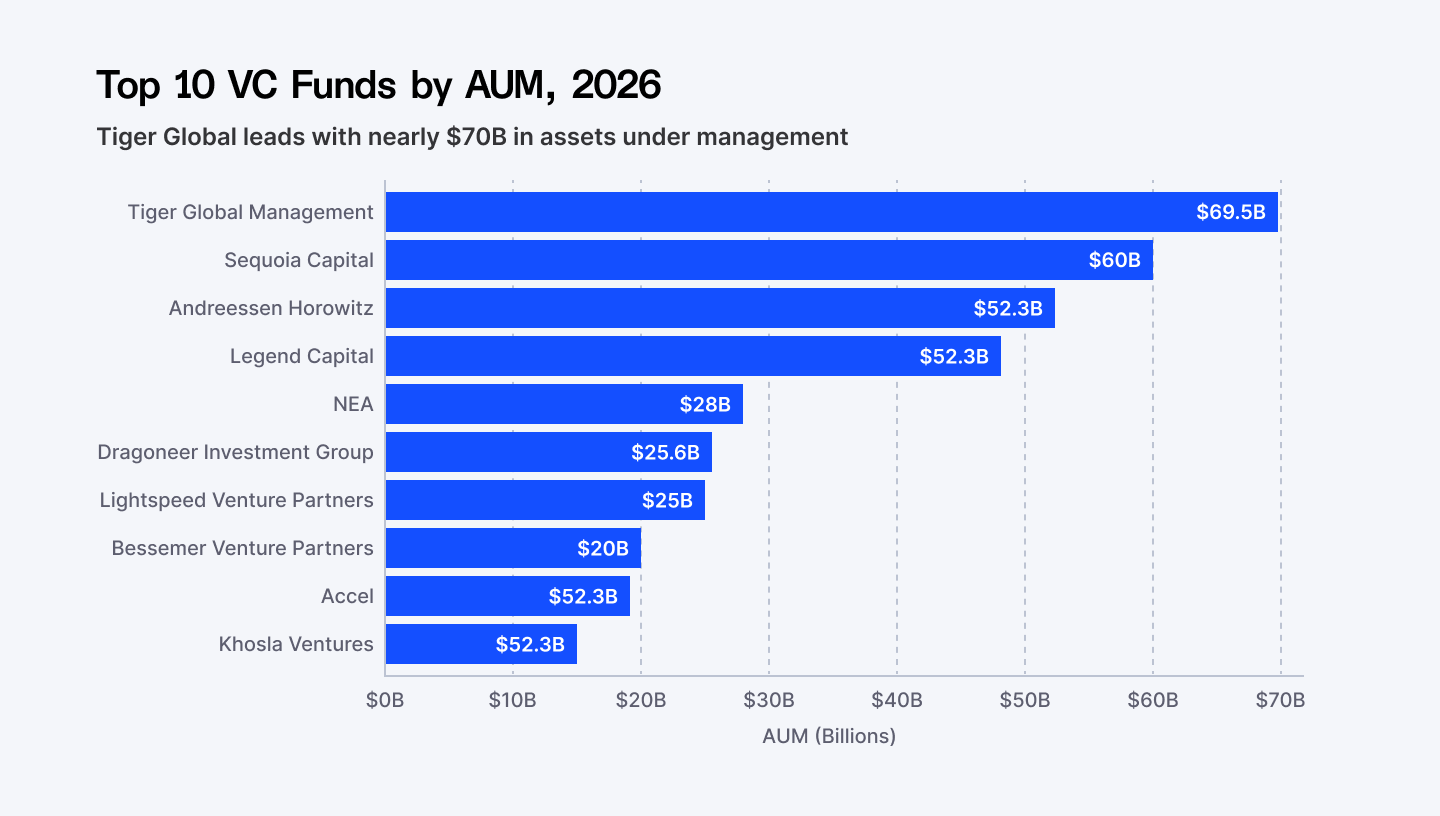
The Top 10 VC Funds Control $400B
Here's the hierarchy of venture capital in 2026:
Rank | Fund | AUM | Focus | 2025 Reality |
1 | $69.5B | Multi-stage, global | Pivot: $2-3B new fund instead of $6B target | |
2 | $60B | Multi-stage, category-defining | Maintained "gold standard" reputation | |
3 | $52.3B→$90B+ | AI, defense, infrastructure | Raised $15B in Jan 2026—largest in firm history | |
4 | $48.1B | Multi-stage, China/Asia focus | Sustaining Asia leadership | |
5 | $28B | Seed to growth | 50-year track record | |
6 | $25.6B | Growth/late-stage | Strategic bets in enterprise | |
7 | $25B | Multi-stage, growth | $9B raise in 2025 including $3.3B opportunity fund | |
8 | $20B | SaaS, enterprise, healthcare | Broad portfolio across stages | |
9 | $19.1B | Seed to growth | Etsy, Rovio, Atlassian pedigree | |
10 | $15B | Deep tech, climate, AI | Leading climate-focused rounds |
These 10 funds alone manage nearly half a trillion dollars. Three funds—Tiger, Sequoia, A16z—manage over $180 billion combined.
What These 10 Funds Actually Funded in 2025
Mega-funds don't just write checks blindly. They back specific companies in specific sectors. Here's what each fund actually bet on:
Andreessen Horowitz (A16z) – $15B raise in 2026
A16z participated in 165 post-seed funding rounds in 2025. Most notable:
- Cursor (AI code editor) – $105M at $2.5B valuation. ARR jumped from $4M to $100M in one year.
- Harvey (legal AI) – $160M at $8B valuation. 50% of Am Law 100 law firms now use it.
- Substack (creator platform) – $100M Series C. 5M paid subscriptions.
- Databricks (data infrastructure) – Major portfolio position.
- ElevenLabs (AI voice), Flock Safety (police tech), Safe Superintelligence (AI lab).
Pattern: A16z backs infrastructure + applied AI + narrative-driving companies.
Sequoia Capital – $60B AUM
Sequoia is now backing three competing AI giants simultaneously:
- Anthropic (Claude chatbot) – Just invested in $25B raise at $350B valuation. Anthropic owns 54% of enterprise coding tools ($4B market) and 40% of enterprise LLM spend.
- OpenAI – Early investor, still holding.
- xAI (Elon's AI company) – Recent investment.
Pattern: Sequoia bets on multiple horses in the same race. "Portfolio companies supporting each other."
Tiger Global – $69.5B AUM, downsizing to $2-3B new fund
Tiger made two mega-bets in 2021 that are now printing money:
- OpenAI – Invested when valued at <$16B. Now worth $150B+.
- Waymo (self-driving cars) – Invested at $39B. Now delivering 450,000 robotaxi rides per week.
- Databricks (data infrastructure) – Major position with 33% returns YTD.
Pattern: Tiger bets big on proven models at scale.
PIP 16 is up 33% so far this year because of these early AI bets.
Lightspeed Venture Partners – $25B AUM
Less publicized than A16z or Sequoia, but serious players in AI infrastructure and growth-stage companies.
Raised $9B in 2025 including a $3.3B opportunity fund specifically for follow-ons into winning portfolio companies.
Pattern: Specialized funds double down on winners.
And these funds are concentrating. A16z backs Cursor, which sells to companies using Substack, which integrates with Databricks. Sequoia backs three competing AIs at once. Tiger doubles down on OpenAI and Waymo.
That's not spreading risk. That's ecosystem lock-in.
⭢ See how the newest AI model launches are already changing how businesses build, ship, and compete.
Which Mega-Fund Should You Pitch?
The mega-fund you pitch to matters as much as your product. Because they're not all looking for the same thing.
Tiger Global
Tiger bets on proven models at scale.
Requirements:
- Minimum $10M+ ARR (they want mature revenue)
- Clear unit economics (they want to see you can stay profitable)
- Demonstrated growth proof (not "we could scale if we had capital")
- Preferably an exit path visible (acquisition or IPO ready)
Why? Tiger sized down from $6B to $2-3B funds. They're being picky. They want companies that are already working, just needing capital to scale.
Pitch Tiger if: You're mature, growing 40%+ annually, and just need fuel.
Don't pitch Tiger if: You're pre-revenue or burning cash to hit growth targets.
Sequoia Capital
Sequoia bets on companies that create markets, not just enter them.
Requirements:
- A novel market thesis (not "Slack for X")
- Founder + founding team with credibility (they back people, not just ideas)
- Category clarity (they ask: "Is this a $10B+ opportunity?")
- Optionally: AI angle (helpful but not required if your thesis is strong)
Why? Sequoia's brand is tied to companies that redefined categories—Apple, Stripe, Airbnb. They protect that reputation.
Pitch Sequoia if: You're building something new, not iterating on something old.
Don't pitch Sequoia if: You're another AI wrapper on existing tech.
Andreessen Horowitz
A16z doesn't just want to invest in you. They want to build infrastructure around you.
Requirements:
- Your company supports other A16z portfolio companies (or could)
- You're hiring aggressively (they help with recruitment)
- You're willing to have A16z on your board and advising strategy
- Optionally: You're solving a national interest problem (AI, defense, biotech)
Why? A16z owns the board seat and drives internal introductions. They want companies that become platforms.
Pitch A16z if: You're building foundational tech (infrastructure, AI models, or ecosystem-critical software).
Don't pitch A16z if: You want independence. They'll own the strategy.
Lightspeed, Bessemer, Accel
Mid-tier mega-funds (still massive) are less particular about the "why" and more focused on "can you execute?"
Requirements:
- Product-market fit proven
- Clear go-to-market strategy
- $1-3M+ ARR
- Ability to hire fast and scale operationally
Why? They're backing proven companies, not unproven bets. They want predictability.
Pitch them if: You're Series A/B stage with real traction and a clear scaling plan.
The One Metric Mega-Funds Care About in 2026
Forget TAM (Total Addressable Market). Forget pitch deck design. Forget your personal story.
Mega-funds care about execution speed.
Here's why it matters:
Valuations are high. Your Series A valuation jumped 50-100% in the last year. That's not because your product got 50% better. It's because AI hype inflated all boats. Now VCs expect your company to grow fast enough to justify that valuation. Not just grow. Grow faster than your valuation suggests.
Example: You raise $5M at $30M valuation (Seed). Your Series A target becomes $20M at $150M. That requires 5x revenue growth in 24 months.
Can you build, ship, and scale that fast?
Cursor raised $105M and jumped from $4M to $100M ARR in one year. That's execution.
Harvey hit $100M ARR and scaled to 50% of Am Law 100. That's execution.
Mega-funds ask: Can your team ship and scale at that velocity?
If no, they pass.
If yes, they write enormous checks.
How Mega-Funds Actually Work
Here's how mega-funds like A16z actually work—and why it matters for your startup:
They don't just give you money and disappear
A16z doesn't write a check and say "good luck." They get involved. They put people on your board. They help you hire. They introduce you to other companies in their portfolio. Why? Because their portfolio companies help each other.
A16z backed Cursor (a code editor). Then they backed Harvey (a legal AI tool). Then they backed Substack (a writing platform). Now these companies can work together. Cursor users can write on Substack. Harvey users can share on Substack. A16z makes money when all three succeed. This is the real advantage of mega-funds: they build ecosystems.
Everyone copies them because of FOMO
When A16z raises $15 billion, other VCs panic. They think "A16z must know something I don't." So they copy A16z's strategy. They rush to back similar companies. They raise bigger funds.
Sometimes A16z is actually smart. Sometimes it's just hype. But everyone follows anyway.
They get better terms than smaller VCs
When A16z invests, they demand better terms. Board seats. Special voting rights. Liquidation preferences (they get paid first if things go wrong). Smaller VCs can't negotiate these terms. But mega-funds can.
This matters to you as a founder because it means mega-funds have more control over your company than smaller investors do.
The $15 Billion Signal
On January 9, 2026, Andreessen Horowitz announced $15 billion in new capital. Biggest haul in firm history.
But here's the tell:
- Growth Fund 5: $6.75 billion
- American Dynamism (defense tech): $1.176 billion
- Infrastructure Fund 2: $1.7 billion
- Apps Fund 2: $1.7 billion
- Bio + Healthcare Fund 5: $700 million
- Other strategies: $3 billion
This isn't capital allocation. This is geopolitical positioning. Ben Horowitz made it explicit: backing tech that's "dynamic, innovative, and intensely competitive with China."
Translation: American dominance in AI, defense infrastructure, and hardware matters. Capital flows there.
A16z raised 18% of all US venture dollars in 2025. That's not leadership. That's monopoly.
When two funds (A16z + Sequoia) control 25-30% of US VC capital, they don't pick winners—they define what winning means.
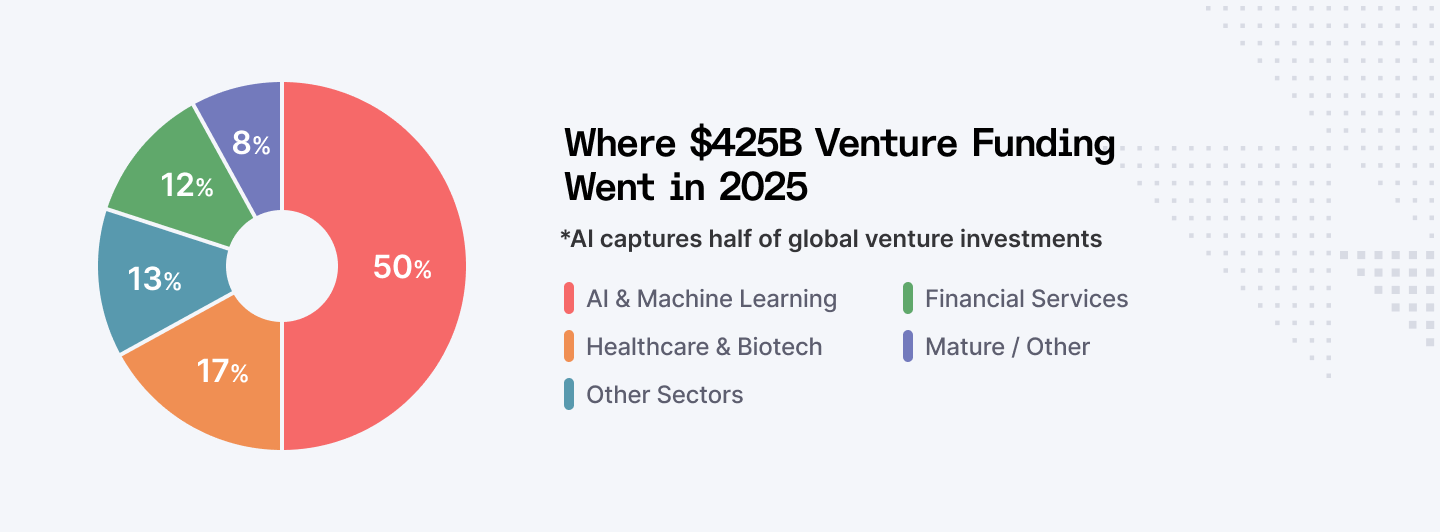
AI consumed exactly half of all global VC funding in 2025 ($211B of $425B). Everything else—including healthcare, fintech, and aerospace—split the remainder.
The AI Vacuum
50% of all global venture funding went to AI in 2025. That's $211 billion of $425 billion. OpenAI alone raised $40 billion—the largest private funding round ever. Five companies captured $84 billion (20% of all global VC funding). What happened to healthcare? To fintech? To consumer software? Starved. Squeezed. Competing for table scraps.
Venture funding for non-AI startups dropped 35% year-over-year. Founders of "traditional" tech companies report the same story: VCs open the conversation with "Where's your AI angle?" No compelling angle? The meeting ends.
The Concentration Crisis
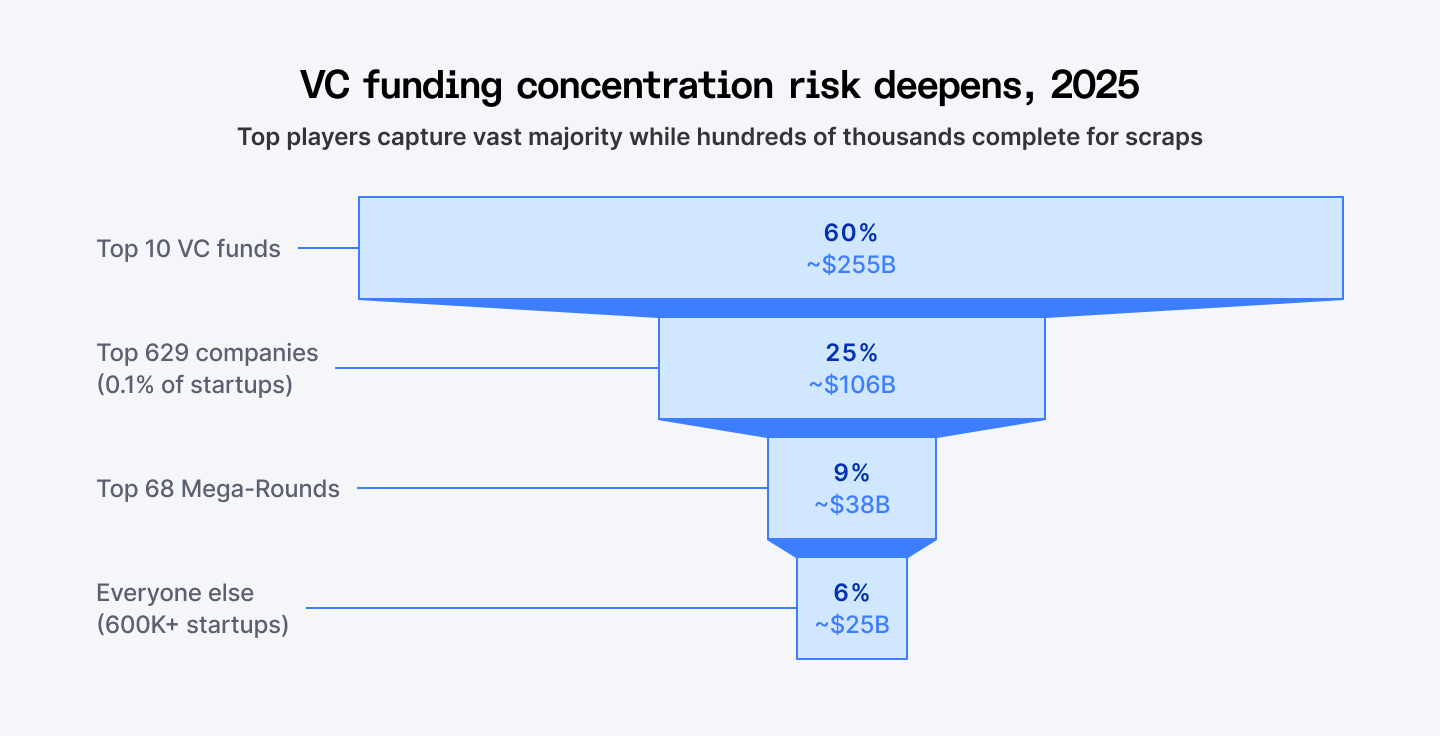
Capital concentration at all-time highs. 60% of 2025 VC funding went to just 629 companies. Everyone else—600,000+ startups—split 7% of capital.
Only 12 first-time venture funds closed in 2025, compared with 47 three years earlier—a 74% collapse. Why? Because mega-funds above $1 billion captured 62% of all LP commitments in 2025.
Translation: Institutional capital is consolidating. Emerging managers are getting locked out. Niche funds are starving.
For founders, the tightening is real:
- Fewer funds to pitch (options narrower)
- Higher deployment targets (mega-funds need bigger checks)
- More selective underwriting (VCs can afford to be picky)
- Shorter follow-on windows (if you don't hit metrics by Series B, you're stuck)
The Seed Round Trap
According to PitchBook and NVCA analysis, Series A will be the hardest raise of 2026. Which means that Seed rounds are getting bigger. Sounds great. You raise $5 million instead of $2 million. Celebrate, right?
Wrong.
That $5 million comes with a catch: your valuation jumped to $30 million. That's the problem.
Now VCs expect your company to grow 5x before Series A. Not 2x. Not 3x. Five times.
That means Series A becomes impossible for most founders. You need $20 million at a $150 million valuation. Few companies hit that growth. Maybe Cursor and Harvey can. Most can't.
Result? You're stuck. Too big for seed investors. Too small for Series A investors.
Where the $425B Actually Went
- AI & Machine Learning: $211 billion. Foundation models (OpenAI, Anthropic). AI tooling (Cursor, Databricks). Applied AI infrastructure.
- Healthcare & Biotech: $71.7 billion. One of the few sectors holding its own. Enterprise biotech pulling the most.
- Financial Services: $52 billion. Fintech + crypto recovery.
- Aerospace & Robotics: $34 billion. Fervo Energy, Boom Supersonic, autonomous vehicles.
- Everything else: $56 billion. Consumer social, hardware, travel, logistics, productivity tools.
Notice what's missing? Most software. Most services. Most companies that don't have an AI label.
⭢ Learn how the biggest AI acquisitions are reshaping markets and shifting power across the industry.
Founder Playbook for 2026
If you're raising capital this year, here's the strategy:
1. Build real metrics
Hype is dead. Seed investments that promised unicorn outcomes are marked down 40-60% in Series A. Investors want revenue. Retention. Unit economics. Proof of adoption. Plan for the down round you'll face in Year 2.
2. Know which fund you're pitching
Tiger Global backs mature companies with traction. Sequoia bets on founders + category. A16z does mega-rounds and ecosystem play. Smaller firms like Glasswing are hungry for differentiated AI application stories. Pitch the right fund or waste everyone's time.
3. Assume less follow-on capital
You can probably raise. You're raising into a world where follow-ons are selective and where pivot capital is thin. Be disciplined with cash. Hit metrics. Approach profitability sooner than you'd like.
4. If you're not in AI, build the counternarrative
Maybe deep tech founders now have less competition. Maybe fintech can build without VC hype distorting metrics. That's an angle worth exploring.
Reality check: Before you pitch mega-funds, run the numbers on your growth targets. Use Index.dev's hiring cost calculator to see what speed of execution actually costs. Your Series A will demand proof you can hit those targets. Which you can—with the right team.
Building Teams in the Mega-Fund Era
Here's what mega-fund portfolio companies need: execution. Valuations are high. Investor expectations are high. Timelines are compressed.
That company needs engineers who've been through venture scale-ups before. Developers who understand remote work. Operators who handle ambiguity.
Finding those through traditional recruiting? Nearly impossible in 2026.
The best developers are busy. Their current companies just raised huge rounds. They're selective. They know their market value. This is where Index.dev solves the hiring problem.
You're not hiring a developer. You're hiring someone who's been through this before. Someone vetted. Remote-ready. Available fast.
Index.dev's vetting process accepts only 5% of applicants. We don't hire based on resumes. We hire based on what they can actually build.
2026 Venture Capital Outlook: Five Things to Watch
- IPO momentum accelerates. Strong late-stage exits in 2025 created pent-up supply. Expect 2-3x more venture IPOs in 2026.
- Venture secondaries go mainstream. Only 2% of unicorn market value trades on secondaries today. As confidence returns, expect 5-10%.
- Selectivity gets brutal. Down rounds aren't coming back, but flat rounds are becoming normal. Series A rounds with 30-40% fewer dollars at the same valuation are standard.
- Vertical AI dominates. Thin wrappers on foundation models are dead. Investors hunt for AI applied to specific problems—legal, sales, recruitment, healthcare.
- Defense tech gets tailwinds. A16z's $1.176 billion American Dynamism commitment signals geopolitical tailwinds. Expect this category to pull $50B+ by the end of 2026.
The Reality Check
Venture capital in 2026 is just different. Capital is abundant if you're building the right thing (AI, deep tech, infrastructure, defense). It's scarce if you're not.
Mega-funds control the flow. Emerging managers fight for survival. Founders need discipline, real metrics, and teams that can execute.
The entrepreneurs winning in this environment share one trait:
Ruthlessness about capital allocation and hiring.
They raise what they need, not what's available. They hire senior developers who've been through this before, not junior talent they'll train. They build companies that mega-funds are betting on. Not the other way around.
➡︎ VC-backed companies scale fast—and hiring mistakes are expensive. Index.dev helps you hire vetted senior developers in 48 hours, so execution keeps up with investor expectations.
➡︎ Want to explore more real-world AI performance insights and tools? Dive into our expert reviews — from Kombai for frontend development and ChatGPT vs Claude comparison, to top Chinese LLMs, vibe coding tools, and AI tools that strengthen developer workflow like deep research, and code documentation. Stay ahead of what’s shaping developer productivity in 2026.