For years, we talked about American dominance like it was a given. OpenAI drops GPT-4, Google releases Gemini, and everyone else scrambles to catch up. That story is over.
Right now, in 2026, we're watching something unprecedented. Three different visions of AI are colliding, and each one challenges everything we thought we knew about how this technology should be built.
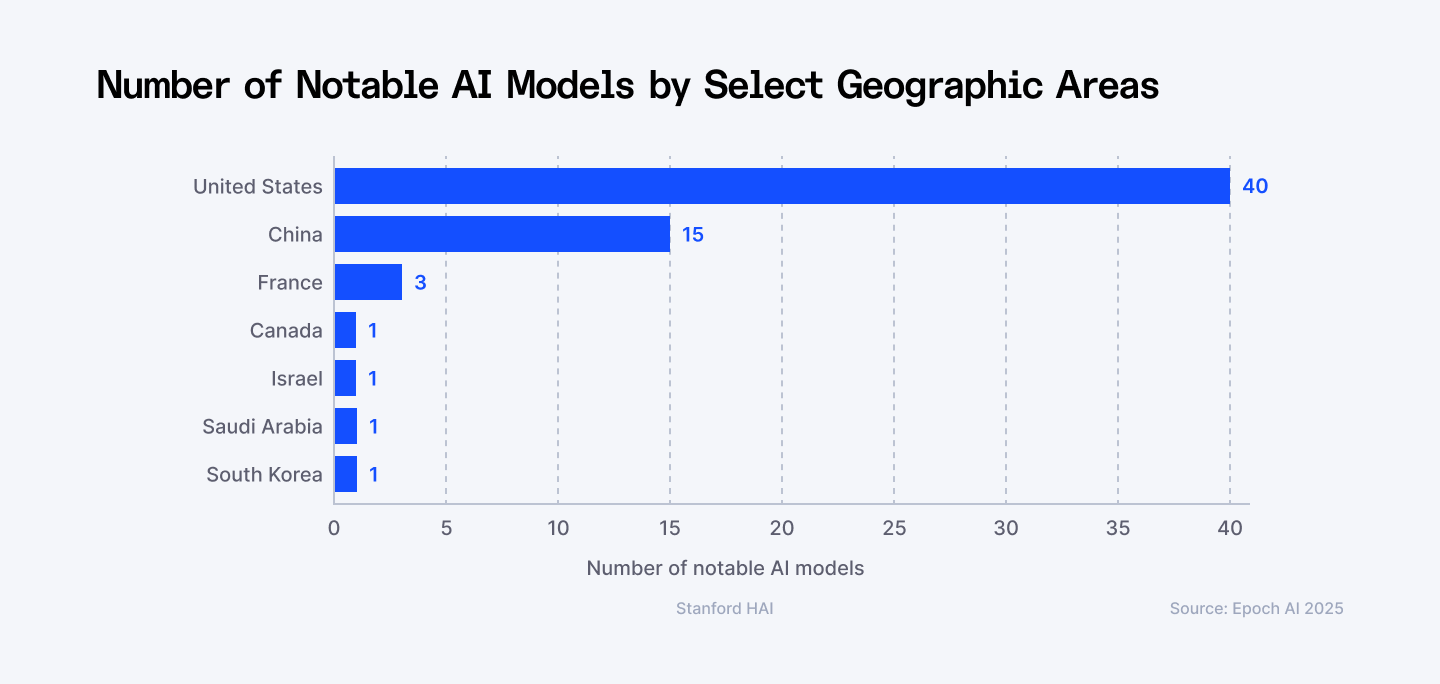
The numbers tell part of the story. The US cranked out 40 notable models last year. China produced 15. Europe made three. On paper, it looks like a runaway American victory. Except it's not.
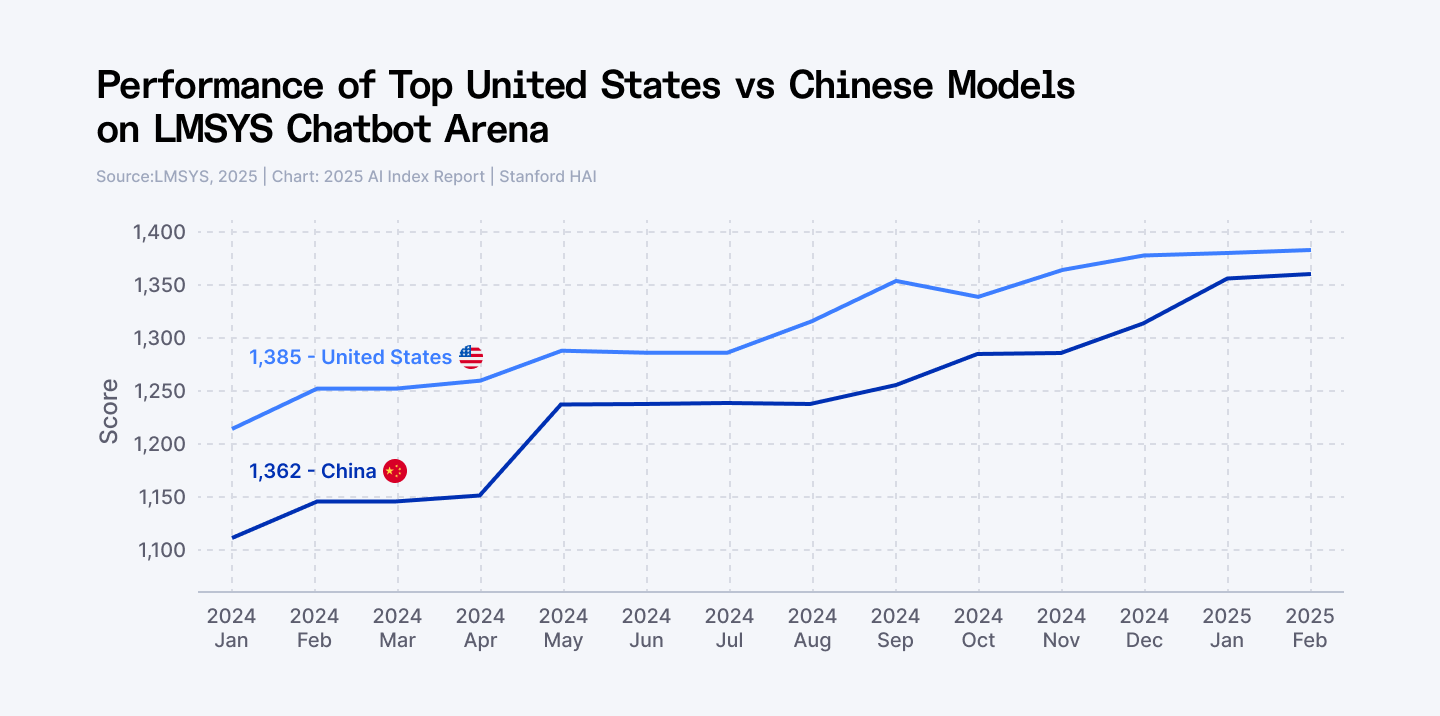
Stanford's latest AI Index reveals something striking: Chinese models have reached near parity with US models on critical benchmarks. On MMLU tests (measuring knowledge and problem-solving) and HumanEval (code generation), the gap has essentially vanished. China isn't just catching up. They're doing it differently, faster, and often cheaper.
Europe's playing an entirely different game. Three models don't sound like much until you realize they're building the regulatory architecture that will define AI for decades. They're not trying to win on speed. They're trying to win on trust.
This isn't about who builds the biggest model anymore. It's about competing philosophies. The US believes in commercial velocity and breakthrough research. China believes in efficiency and scale at lower costs. Europe believes in governance and human-centric design.
And here's what makes this fascinating: each approach is forcing the others to evolve.
The real question isn't who's winning. It's what kind of AI future each vision creates, and whether any single approach can survive without borrowing from the others.
Building AI products? Index.dev delivers pre-vetted developers expert in Gemini, Qwen, Mistral. Scale teams remotely, cut costs 40%, launch faster.
The Race Is Tighter than Ever
The AI race is about strategy, philosophy, investment, and compute. The US leads in scale and capital. China leads in efficiency and rapid iteration. Europe leads in ethics and regulation. And all of this competition accelerates innovation in ways that are reshaping technology and society.
Here are eight statistics that reveal what's really happening in the global AI race.
1. China's Best Model Just Beat America's Best From a Year Ago
Alibaba's Qwen3 235B outperforms the top US model from late 2024. The US and China still dominate the generalist model space, but smaller, specialized models are becoming the real battleground. Massive general-purpose models cost a fortune to train and run. For most actual business problems, you don't need them. Companies worldwide are figuring this out, and it's democratizing who can compete.
Europe's Mistral is proving you don't need Silicon Valley money to build something formidable. You need focus and smart engineering.
2. Quantity vs. Quality: The Gap Is Vanishing
In 2024, the US produced 40 notable AI models, China 15, Europe three. Chinese models closed a double-digit performance gap to near parity in just one year. On MMLU and HumanEval benchmarks, the difference between US and Chinese models has essentially disappeared.
Meanwhile, China continues to lead in publications and patents. And model development is going global. The Middle East, Latin America, Southeast Asia are all entering the arena. This isn't a two-horse race anymore. It's not even a three-horse race.
3. Global Optimism Masks Deep Regional Divides
Here's where things get interesting. In China, 83% of people see AI as beneficial. In Indonesia, 80%. Thailand, 77%. Compare that to the US at 39%. Canada at 40%. The Netherlands at 36%. The countries building AI the fastest trust it the least. That asymmetry matters. It shapes regulation, adoption, and ultimately who wins the commercial race.
The good news? Skepticism is softening. Germany, France, Canada, the UK, and the US have all seen optimism grow significantly since 2022. But we're still miles apart on fundamental questions about what AI should be used for and who should control it.
4. Chinese Models Are Quietly Invading the US Market
Despite political tensions and export restrictions, open-source Chinese AI is gaining traction in the US. From 1.2% market share in late 2024 to nearly 30% in August 2025, these models are winning on flexibility, cost, and accessibility. Businesses save hundreds of thousands annually by swapping proprietary models for Chinese alternatives. Even Nvidia, Perplexity, and Stanford are using Qwen in some capacity. Open models are practical, adaptable, and often all most companies need, proving that innovation isn’t always about secrecy or hype.
5. Top Models Are Concentrated in Few Hands, but New Players Are Emerging
The US produced the most notable models in 2024. OpenAI led with seven, Google with six. Alibaba came in third with four. France's Mistral tied for eighth with three.
But production volume doesn't equal market impact. DeepSeek's R1 model sparked a market frenzy in January by matching OpenAI's performance at a fraction of the cost. We're seeing competitive models emerge from more countries, more companies, more approaches. Monopoly is becoming harder to maintain.
6. China Dominates AI Publications and Patents
Patents are the currency of AI influence, and China is outpacing the US in sheer volume. Europe trails behind in both patents and publications, but smaller nations like Luxembourg punch above their weight per capita.
Patents are the indicators of where innovation is concentrated and who's building the foundation for future breakthroughs.
7. Compute Power Remains a US Advantage
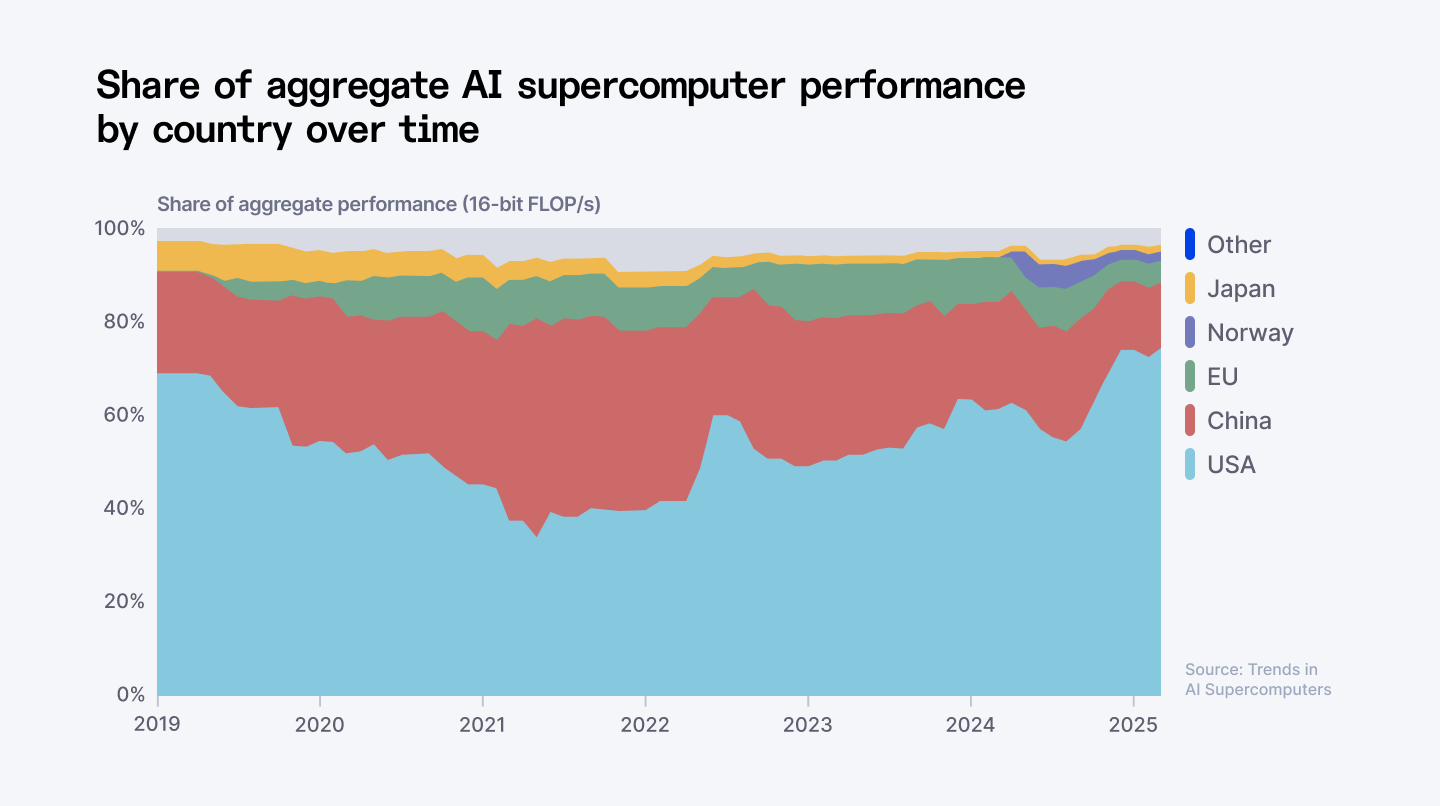
The US has nine times China's AI computing capacity. Seventeen times Europe's. This creates a self-reinforcing cycle. Compute advantage drives breakthroughs. Breakthroughs attract investment. Investment builds more compute. By 2030, the leading AI supercomputer will need the equivalent of nine nuclear reactors to run. The bottleneck isn't chips or capital anymore. It's electricity and grid capacity.
8. Private Investment Shapes the Battlefield
The US is now the uncontested magnet for AI funding, attracting $109 billion this year, 81% of the global total. China’s private investment has plummeted from $16 billion in 2018 to $5 billion today, while the EU pulls in $8 billion. Private capital is the fuel for AI dominance, and the US has effectively cornered the market. Countries with less funding may innovate differently, but they face hard limits on scale and speed.
USA, Europe, or China: Who's Winning?
1. United States: Still the Leader
America's AI dominance is the result of a specific ecosystem that no other region has managed to replicate: massive capital, top-tier talent concentration, and a culture that treats failure as R&D.
But dominance doesn't mean invincibility.
The Big Three Models
Here’s a snapshot of the top-performing US models based on Arena scores, which use a chess-like Elo system to compare real user performance across AI models:
| Model | Company | Arena Elo | Standout Benchmark | Best Use Case |
| Gemini 3 Pro | 1490 | 31.1% ARC-AGI-2 (IQ test) | Multimodal supremacy: text, images, code in one seamless hit. | |
| Claude 4.5 Sonnet | Anthropic | ~1470s | 77.2% SWE-bench Verified | Coding. Fixes real GitHub issues flawlessly, 0% error on Replit edits. |
| GPT-5 (o3 variants) | OpenAI | 1431-1447 | Near parity MMLU/HumanEval | Reasoning for math and refactors. 65-74.9% SWE-bench, but 40% cheaper for scale. |
OpenAI’s GPT-5 is the standout technical achievement. Its o3 architecture has redefined AI reasoning. Unlike prior models that relied heavily on pattern recognition, GPT-5 seems to reason step by step, approaching problems like a human mathematician. Its performance on benchmarks such as MMLU and HumanEval places it at the frontier of advanced reasoning.
Claude 4 Sonnet, from Anthropic, went in the opposite direction: trustworthiness. Built with constitutional AI training, it focuses on following instructions precisely while avoiding harmful outputs. On professional coding tasks, it achieves a 64.9% success rate on SWE-bench benchmarks, a level where it’s production-ready.
Google’s Gemini 2.5 Pro dominates in multimodal applications. Combining text, images, and code seamlessly, it leverages Google’s decades of ML research, massive datasets, and compute infrastructure. It’s practical AI ready to tackle complex real-world workflows.
Numbers Tell the Story
In 2024, US-based institutions produced 40 notable AI models, far outpacing China’s 15 and Europe’s three. They also lead not only in supercomputing power, private investment, and talent concentration. According to the 2025 AI Index Report (Stanford HAI), the US holds nine times China’s AI compute capacity and 17 times Europe’s, creating a self-reinforcing cycle: more compute drives better models, which attract more talent and investment.
The Talent Magnet
The US is concentrating AI researchers. Stanford, MIT, Berkeley, CMU create a pipeline that feeds directly into OpenAI, Anthropic, Google, and Microsoft. The academic-to-industry path is frictionless in ways that Europe and China struggle to replicate.
That $109 billion in private investment buys people. The top 100 AI researchers globally can name their price in the US market. Stock options, equity stakes, resources to pursue moonshots, that's the American advantage.
The Cracks in the Foundation
American AI leadership faces three challenges that benchmark scores don't capture.
First, trust. Only 39% of Americans view AI as beneficial. The country building the most powerful AI systems trusts them the least. That creates regulatory pressure and social backlash that could constrain development.
Second, cost. Training runs for frontier models now exceed $1 billion. Inference costs are falling, but not fast enough. Chinese open-source models are winning developer adoption because they're good enough and cheaper.
Third, concentration. When OpenAI, Google, and Anthropic control the talent, the compute, and the distribution, innovation happens at their pace, on their terms. Breakthrough ideas from outside this ecosystem struggle to get resources.
The Big Picture
The US still sets the pace, but it’s not invincible. Speed-focused Chinese models are closing gaps on key benchmarks, and Europe’s regulated, privacy-first approach is beginning to shape global standards. Yet in terms of breadth, depth, and real-world application, the US remains the world’s AI leader.
Before you choose: A practical comparison of Gemini and ChatGPT to see which one performs better for real-world coding.
2. China: Rewriting the Rules
China didn't try to outspend America. It out-strategized it. The focus isn’t on raw scale or flashy benchmarks, it’s on efficiency, speed, and accessibility. Chinese AI models perform close to American giants while using far less compute, updating faster, and costing a fraction of the price.
Top Chinese LLMs
| Model | Company | Arena Elo | Parameters | Real-World Edge |
| DeepSeek-V3 | DeepSeek | 1419 | 671B (MoE) | 10x cheaper inference than GPT-4 level. Reasoning matches o1. |
| GLM-4.5 | Zhipu AI | 1410 | 355B | Outperforms Claude 4 Opus on agentic tasks. |
| Qwen3-Coder | Alibaba | 1382 | 480B (MoE) | Open-source. Apache 2.0 free; the most downloaded model in 2025. |
| Baichuan3 | Baichuan | ~1370s | 130B | Handles 10M+ token context windows with ease. |
Qwen3-Coder is the breakout model of the year. Alibaba leveraged its cloud infrastructure expertise to build a 480-billion-parameter open-source model that’s competitive with premium alternatives. With an Arena score of 1382, it is practical, usable, and completely accessible under Apache 2.0 licensing.
DeepSeek-V3 is another standout. Performing near GPT-4 levels while using roughly ten times less compute for inference, it shows how Chinese engineering prioritizes scale efficiency.
The pace of iteration is just as striking. While US firms spend months refining models, Chinese companies often release weekly updates based on user feedback and new research. This rapid cycle creates a dynamic ecosystem where models are continuously evolving and improving.
The Open Source Weapon
China is also dominating the open-source AI space. Unlike closed systems such as ChatGPT or Google Gemini, Chinese models like Qwen and DeepSeek-R1 are open-weight, freely downloadable, and widely adaptable. On Hugging Face, these models are the most downloaded globally, reflecting both their performance and developer-friendly licensing. Qwen’s multiple parameter sizes mean companies can balance power and cost without legal hurdles, something that has contributed to its rapid adoption outside China. Even Nvidia, Perplexity, and Stanford are using Qwen in some capacity.
This strategy also gives Chinese models a global footprint. Open-source AI enables usage across borders, bypassing some of the geopolitical restrictions imposed on proprietary models. By making their models accessible, Chinese companies are building communities, driving innovation, and positioning themselves as global AI players.
Speed as Strategy
Chinese companies iterate differently. American labs spend months perfecting a model before release. Chinese companies ship fast and update weekly based on user feedback and new research.
DeepSeek-R1 launched in January and immediately sparked global attention. The company claimed it matched OpenAI's o1 reasoning model at a fraction of the cost. Whether that's precisely true misses the point. The fact that it was plausible enough to trigger a market reaction shows how quickly China closed the capability gap.
This velocity creates a dynamic environment where models improve in real-time. It's closer to how modern software development works than how traditional AI labs operate. Ship, learn, iterate. The model is never finished, it's just at its current best state.
Patents and Publications
China leads the world in AI patents and publications. This is about controlling the foundational research that determines what's possible tomorrow.
American companies lead in commercialization. Chinese institutions lead in research output. Those two advantages operate on different timelines. Commercialization wins quarters. Research output wins decades.
The US restricted China's access to cutting-edge GPUs from Nvidia and AMD. The goal was to slow China's ability to train advanced models. Instead, it forced Chinese companies to optimize. DeepSeek-V3 exists partly because Chinese engineers couldn't rely on throwing more compute at every problem.
This created a generation of AI engineers who think efficiency-first. As compute costs rise globally and power becomes the binding constraint, that mindset might become the dominant one. Constraint breeds innovation.
The Cracks in the Foundation
China's AI strategy has vulnerabilities. Private investment collapsed from $16 billion in 2018 to $5 billion in 2025. Capital controls, regulatory uncertainty, and geopolitical risk are driving money elsewhere.
Chinese models perform incredibly well on benchmarks, but they're optimized for those benchmarks. Real-world deployment at scale is where American models still have an edge, particularly for English-language applications.
The Takeaway
China demonstrated that the American approach to AI, massive capital plus maximum compute plus closed models, isn't the only viable path. You can build competitive models with less. You can win developers with open licensing. You can iterate faster by shipping imperfect versions. You can compete globally even when geopolitical tensions constrain your hardware supply.
The question isn't whether Chinese models are "as good" as American ones. The question is whether they're good enough for most use cases at less cost. For a growing number of developers and companies, the answer is yes.
Don’t miss: Beyond DeepSeek, these Chinese AI models are shaping the next wave of LLM competition.
Europe: Playing the Long Game
European AI isn't about dominating leaderboards. It's about building models that align with European values: privacy, transparency, human rights. While America and China sprint toward more powerful models, Europe is building something harder to quantify and impossible to ignore: the rules everyone else will play by. It's a long game, and it's working.
Key European Models
| Model/Initiative | Organization | Arena Elo | Country | Real-World Edge |
| Mistral Medium 3.1 | Mistral AI | ~1320s | France | Privacy fortress. Tops EU enterprise charts; 40% cheaper than Claude for compliant coding. |
| Falcon 180B | TII (UAE collab) | 1150s | Europe-linked | Open-source scale. Efficient for edge devices; powers non-English apps where big models bloat. |
| BLOOM | BigScience | N/A | Multi-EU | Multilingual pioneer. 176B params from 1,000+ researchers; blueprint for collaborative AI beyond borders. |
Mistral Medium is Europe's flagship and the perfect example of Europe’s pragmatic approach. With an Arena score of 1310, it’s not chasing absolute supremacy. It’s designed to be trustworthy, compliant, and secure. For companies constrained by data privacy laws, Mistral offers a fully European solution, keeping sensitive data on the continent.
BLOOM showcases European collaboration at its finest. Built by a pan-European consortium, this multilingual, open-access model represents something few other regions can match: a genuinely cooperative, cross-border research effort. BLOOM proves that AI innovation can be both technically capable and socially responsible, reflecting European principles of openness, collaboration, and inclusion.
The EU AI Act demonstrates Europe’s broader influence. While global attention focused on benchmarks and model size, Europe was creating a legal framework that dictates how AI should be used. The Act classifies AI applications by risk level. Unacceptable risk applications are banned. High-risk applications face strict requirements: human oversight, transparency, accuracy standards, cybersecurity measures. Everything else operates under lighter-touch rules. This matters globally because of the Brussels Effect. When Europe sets high regulatory standards, multinational companies comply everywhere rather than building separate systems for different markets. Europe's 450 million consumers create enough economic gravity to pull global behavior into alignment.
American and Chinese companies complained the Act would stifle innovation. Instead, it created clarity. Developers now know what's permissible and what's not. That predictability accelerates deployment for compliant use cases.
The Investment
Europe attracted $8 billion in private AI investment in 2025. That's second globally, ahead of China's $5 billion. But it's a distant second. The US pulled in $109 billion.
This constraint shapes European strategy. Build smaller, more efficient models. Focus on specific use cases rather than general intelligence. Partner with universities to access subsidized compute. Target enterprises that value compliance over cutting-edge capabilities.
The Trust Advantage
Here's where Europe might have an edge: trust. Only 36% of people in the Netherlands see AI as beneficial. In Germany, it's slightly higher. European skepticism about AI is rooted in data privacy concerns and historical wariness of unchecked technological power.
The AI Act directly addresses those concerns. If trust becomes the deciding factor in AI adoption, Europe's privacy-first approach could win even if its models aren't the most powerful.
European companies operating in healthcare, finance, and government need AI they can audit and explain. American models are often black boxes. Chinese models raise data sovereignty concerns. European models, particularly Mistral, offer transparency and regulatory compliance by design.
For use cases where explainability matters more than raw capability, that's a genuine competitive advantage.
The Collaboration Model
Europe's fragmented market is usually seen as a weakness. 27 countries, multiple languages, different regulatory traditions. But it also enables a different kind of innovation.
BLOOM emerged from over 1,000 researchers collaborating across borders. That kind of coordinated effort is harder in the US, where competition between labs is fierce, or China, where state control centralizes research.
The European model, funded by public research grants, built through academic collaboration, released as open source, doesn't scale to AGI. But it scales to specialized applications where domain expertise matters more than parameter count.
The Takeaway
Europe is building the framework for responsible AI at scale. The AI Act will shape how AI is deployed globally for the next decade. Mistral proves privacy-first models can compete commercially. BLOOM demonstrates collaborative research can produce frontier results. These aren't the victories that dominate headlines. But they're victories that compound over time.
If the AI future is one where regulation, transparency, and trust matter as much as performance, Europe positioned itself brilliantly. If the future is winner-take-all based purely on capability, Europe bet wrong.
Explore this: A side-by-side look at LATAM, CEE, and Southeast Asia to see where AI talent delivers the best balance of cost, quality, and speed.
The Battle for Visual and Multimodal AI
Text models get all the attention. But the real battle is happening in pixels. Image generation, video synthesis, multimodal understanding, this is where AI stops being a chatbot and starts reshaping creative industries worth trillions of dollars.
1. Image Generation
United States
The US continues to lead in image generation quality and innovation. OpenAI’s GPT Image 1.5 is the latest flagship effort, delivering faster generations, richer visuals, and advanced editing tools. It’s designed more like a creative studio, the sort of tool that artists and marketers actually adopt in professional workflows. Microsoft, too, has jumped into this arena with MAI‑Image‑1, optimized for photorealism and nuanced composition. This model is built with a clear eye toward enterprise integration, especially through Copilot and Bing Image Creator.
China
Chinese players are not standing still. ByteDance’s Seedream 4.0 has emerged as a serious competitor, offering ultra‑fast rendering at high resolution and strong visual consistency, thanks to multi‑reference image support. It’s positioning itself as a professional‑grade alternative to Western tools, with speed and affordability on its side.
Europe
Europe’s presence in pure image generation isn’t as dominant on the leaderboard, but creative, ethical, and regulated use cases remain its strength. European labs contribute open models and research frameworks that influence global development and are often built with data compliance and localization in mind, a growing enterprise requirement.
2. Video Generation
United States
American models like Google’s Veo 3 have set a high bar with sophisticated video generation that includes synchronized audio and physics‑aware motion. Runway’s Gen‑4.5, although a later‑stage independent model, has also taken the spotlight, dethroning some big names in benchmarks with improved scene consistency, natural motion, and synchronised audio generation.
China
China’s video generation scene is vibrant and practical. Kuaishou’s Kling AI has iterated rapidly, with video models that generate synchronized audio and visuals in a single pass. ByteDance’s Seedance also deserves mention for strong motion consistency and multi‑scene handling.
Europe
Europe again contributes mainly through open platforms and tooling that empower creators, often integrating video generation with ethical considerations like content provenance and user consent. These contributions matter for regulated industries and creative communities that prize traceability and responsible use.
3. Multimodal Integration
The most exciting frontier is the ability to understand and generate across text, vision, and audio simultaneously.
United States
US models like Google’s Nano Banana combine multimodal reasoning with image capabilities, making them versatile for real creative workflows.
The US is also driving innovation especially in audio‑visual synchronization, cinematic realism, and multimodal storytelling, areas that will define film, advertising, and virtual production in the next wave.
China
Chinese efforts often prioritize practical multimodal integration across text, image, and video in open ways, enabling developers to build solutions without steep licensing costs. Platforms like Qwen and related multimodal offshoots provide fertile ground for experimentation.
China is also pushing into interactive and real‑time world generation with open‑sourced real‑time models that reconstruct navigable 3D environments, devices that will matter for gaming and virtual experiences.
Europe
Europe has no competitive multimodal models. This is the clearest indicator of Europe's disadvantage in visual AI. The AI Act's emphasis on transparency and data rights makes training multimodal models legally complex.
What’s happening today is co‑evolution. US models push quality and vision. Chinese models democratize access and scale. European contributions shape how AI should behave in society. All of this accelerates progress in ways that benefit creators, businesses, and users globally, if we continue to apply these tools thoughtfully.
Worth a look: A clear snapshot of global AI readiness and how regions compare going into 2026.
US vs China vs Europe: Benchmark Comparison
The AI race is about different approaches to what “best” means. The US pushes performance, China democratizes capability and cost, and Europe champions responsibility and compliance.
Metric | USA | China | Europe | Winner & Insight |
| Top Chatbot Arena Score | ~1456 (Gemini 2.5 Pro / Gemini 3 Pro) | ~1380 (DeepSeek‑V3) | ~1310 (Mistral Medium) | 🇺🇸 USA: Still leads on top‑tier conversational performance. Google’s Gemini models consistently top human‑evaluated head‑to‑head comparisons. |
| Coding Ability (SWE‑bench Verified) | ~74‑77% (GPT‑5 / Claude 4.1) | ~70‑73% (DeepSeek V3) | ~<60% (Mistral variants) | 🇺🇸 USA: Strong coding performance with models like Claude Opus 4.1 and GPT‑5 performing best on real GitHub‑based coding challenges. |
| Best Reasoning (MMLU / Math) | ~88‑95% (GPT‑5, Gemini) | ~87‑90% (estimated DeepSeek R1) | ~80‑85% (Mistral) | 🇺🇸 USA: Slight edge in deep math & reasoning on major benchmarks — the leaders push frontier academic scores. |
| Cost per 1M tokens | ~$10‑30 | $2‑8 (DeepSeek / Qwen variants) | $10‑20 | 🇨🇳 China: Far more efficient cost‑to‑performance ratios, especially for high‑volume business use. |
| Inference Speed | Medium | Fast (Flash & Efficient variants) | Medium | 🇨🇳 China: Lightweight, fast inference models like Flash‑style designs prioritize low latency. |
| Privacy & Data Compliance | Medium | Low | High | 🇪🇺 Europe: Strong regulatory frameworks make European models better for enterprise and regulated sectors. |
| Multimodal Capabilities | Leading (Gemini 3 Pro & Google offerings) | Strong (Qwen multimodal variants) | Emerging (open research models) | 🇺🇸 USA: Best at integrating text, images, audio, and video seamlessly. |
| Open‑Source Adoption | Medium (some models available) | High (Qwen family, DeepSeek) | High (BLOOM & collaborative projects) | 🇨🇳 / 🇪🇺 Tie: China leads globally in adoption due to open models; Europe’s open‑research foundations accelerate ethical use. |
| Enterprise Integration / Ecosystem | Highest | Medium | Medium‑High | 🇺🇸 USA: Deep integrations with cloud providers and developer ecosystems give US models a real advantage in production use. |
Key Takeaways from the Table
- The US Still Owns the "First Mile":
- If you are trying to solve a problem that has never been solved before—scientific discovery, high-level strategy, or complex agentic workflows—American models are still your best bet. They have the "reasoning depth" that others are still chasing.
- If you are trying to solve a problem that has never been solved before—scientific discovery, high-level strategy, or complex agentic workflows—American models are still your best bet. They have the "reasoning depth" that others are still chasing.
- China Owns the "Last Mile":
- If you have a working product and you need to scale it to 100 million users, Chinese models like DeepSeek or Qwen are the clear winners. They are the "workhorses" of the 2025-26 economy.
- If you have a working product and you need to scale it to 100 million users, Chinese models like DeepSeek or Qwen are the clear winners. They are the "workhorses" of the 2025-26 economy.
- Europe Owns the "Safe Mile":
- For the public sector, healthcare, and highly regulated industries, the "best" model is the one that doesn't get you sued. Europe's Mistral has become the gold standard for "Sovereign AI" that stays on your hardware and follows your laws.
- For the public sector, healthcare, and highly regulated industries, the "best" model is the one that doesn't get you sued. Europe's Mistral has become the gold standard for "Sovereign AI" that stays on your hardware and follows your laws.
Read next: See which countries are leading AI growth in 2026 and which ones are falling behind.
The Final Verdict
We’ve reached the end of the beginning.
The illusion that one region could monopolize intelligence has shattered. Instead, we have a tri-polar world where the "winner" depends entirely on what you value most.
The United States leads in breakthrough performance, China dominates cost-efficient scaling, and Europe is setting the rules for ethical, privacy-conscious AI. Each approach shapes the ecosystem differently, creating a world where the “best” AI depends on context, use case, and governance.
The U.S. remains ahead in sheer firepower.
American companies like OpenAI, Google, and Anthropic have produced the majority of leading models, backed by hundreds of billions in investment, massive compute infrastructure, and half a million AI specialists. GPT‑5, Gemini 3 Pro, and Claude 4 exemplify frontier capabilities in reasoning, coding, and multimodal integration. Yet dominance is not guaranteed.
China is proving that efficiency and iteration can rival raw power.
With billions invested and aggressive annual R&D funding, Chinese firms like Alibaba, DeepSeek, and Zhipu AI are producing competitive models with less cost and compute. Open-source adoption gives them a global footprint, even as hardware limitations persist. Inference speed, affordability, and accessibility are China’s hidden weapons.
Europe, meanwhile, plays the long game.
Limited by compute and data, the EU is winning through governance and trust. Initiatives like Mistral and BLOOM, combined with the AI Act, are creating standards that may influence AI globally. The continent is shaping the rules of responsible AI and proving that ethics and compliance can be strategic advantages.
Beyond these three, the world is waking up.
Africa, Latin America, and Asia are starting to build models tailored to local languages, cultures, and needs, reclaiming digital sovereignty. The Middle East is investing heavily, aiming to secure a seat at the AI table. This decentralization challenges the notion of a two- or three-country monopoly and highlights that the future of AI is global, diverse, and contested.
The choices made now will determine who controls knowledge, sets norms, and shapes societies for decades. The window to steer AI toward an inclusive, accountable, and responsible future is narrow but still open. The defining question of our era is not who builds the models, it’s who governs them wisely.
➡︎ Building with AI? Index.dev connects you with developers who've shipped production AI systems using models from OpenAI, Anthropic, Alibaba, and Mistral. Whether you need efficiency-focused implementations inspired by Chinese architectures or privacy-first solutions aligned with European standards, we match you with talent that knows the trade-offs. Get AI developers who understand the models that matter for your use case.
➡︎ Want to go deeper into where AI is really headed? Explore more Index.dev insights on AI literacy and what it means in 2026, how AI is reshaping application and cloud development, and which industries are closest to a real AI tipping point. You can also dig into practical perspectives on why forward-deployed engineers matter, plus hands-on model comparisons that break down DeepSeek versus ChatGPT, how it stacks up against Claude, and which open-source Chinese LLMs are gaining serious traction.