That feeling when you describe what you want your app to do—and the code just appears. No endless debugging sessions, no syntax errors, just pure development. This isn't some developer's fever dream; it's the reality of Vibe Coding in 2025. Coined by AI researcher Andrej Karpathy earlier this year, Vibe Coding marks a fundamental shift in software development.
Hire top 5% vetted AI developers in 48 hours. Start your 30-day free trial with Index.dev today.
Introduction to Vibe Coding
Vibe Coding is a paradigm shift. It emerged from a collective frustration with tedious debugging and repetitive boilerplate code. But the transition hasn’t been seamless. The transition's been messy, gradual, and frankly, it still has plenty of skeptics. While companies like OpenAI and Anthropic developed the core technology, it wasn’t until Karpathy demonstrated its full potential that everything clicked.
As you read on, you will discover why many consider this method a game changer for both outsourcing teams and in-house developers alike.
Quick Fact: Recent surveys indicate that nearly 44% of developers had already adopted AI coding tools by 2023, and projects using Vibe Coding can see productivity gains of up to 55% faster completion times.
What Is Vibe Coding?
At its core, Vibe Coding lets developers focus on the big picture—what they want to build—rather than getting bogged down in syntactical details. Think of it as communicating the essence or 'vibe' of what you want, while AI handles the technical implementation. Rather than coding from scratch, you articulate your requirements in plain language. The AI then processes your instructions to generate, refine, and even debug an entire codebase or modify existing code—all while you monitor and guide the process. It's like the difference between micromanaging every detail versus telling your team what outcome you need and letting them handle the fine-prints.
Key Characteristics
- Natural Language Prompts: You describe what you need using everyday language.
- AI-Powered Generation: Advanced algorithms convert these descriptions into code.
- Iterative Refinement: The developer-AI relationship becomes conversational, with each refining the other's work. Modern tools understand not just what you're asking for now, but how it relates to your broader project.
- Human-AI Collaboration: You remain at the helm, steering the AI’s creative power to build functional MVPs in hours rather than weeks.
This paradigm means that we've moved from fighting with our tools to collaborating with them to dramatically accelerate prototyping and deployment. That's the essence of the shift.
For more insights into how this method is transforming the industry, reputable sources like UX Collective have shared detailed analyses.
Learn More: AI Application Development Cost | Key Estimation and Optimization Strategies
The Technology Behind Vibe Coding
The Vibe Coding movement didn't appear overnight. It's built on several technological pillars that have matured simultaneously:
Advanced Language Models
The engine room of Vibe Coding is powered by increasingly sophisticated large language models (LLMs). These aren't just the GPT-3.5 models from a few years back; we're talking about specialized code-generation models trained specifically on programming tasks.
Tools like GitHub Copilot and Amazon CodeWhisperer laid the groundwork, but today's systems go much further. Modern LLMs understand not just syntax but software architecture patterns, can reason about algorithm complexity, and even anticipate potential security vulnerabilities in their generated code.
Specialized Development Environments
Remember trying to use early AI coding tools within traditional IDEs? That awkward integration is gone. Today's environments are built around the Vibe Coding workflow from the ground up.
Platforms like Cursor AI have reimagined the development environment for this new paradigm. Their Composer tool lets developers seamlessly flow between natural language descriptions and code, with AI handling the translation. Voice-to-code interfaces using systems like Superwhisper mean you can literally talk through your solution and watch it materialize.
Perhaps the bigger challenge remains integration with existing codebases. Most teams adopt a hybrid approach where critical legacy components remain human-maintained while new features leverage Vibe Coding's strengths.
The Rise of Prompt Engineering
Behind every great Vibe Coding implementation stands a skilled prompt engineer. This emerging discipline focuses on crafting effective instructions that guide AI to produce precisely the code you need.
There's real skill here—telling an AI to "make me a website" yields vastly different results than a carefully structured prompt that specifies architecture preferences, design patterns, and edge cases to consider. The best prompt engineers combine deep technical knowledge with an intuitive understanding of how AI models interpret instructions.
You can read more on the different tools and platforms for Vibe Coding here.
How It Works in Practice
Let's walk through a typical Vibe Coding workflow:
- Conceptualization: You define what you want to build in natural language, perhaps with sketches or reference materials.
- AI Generation: The system interprets your description and produces an initial codebase.
- Iterative Refinement: You review the output, provide feedback ("make the authentication more secure" or "optimize this database query"), and the AI refines its solution.
- Testing & Validation: Automated testing tools verify the code's functionality and performance.
- Human Review: Developers examine critical sections, particularly around security or core business logic.
- Deployment: The validated code moves into production through modern CI/CD pipelines.
Each iteration takes minutes, not days. This rapid feedback loop means developers can explore multiple approaches quickly and converge on optimal solutions faster than ever before.
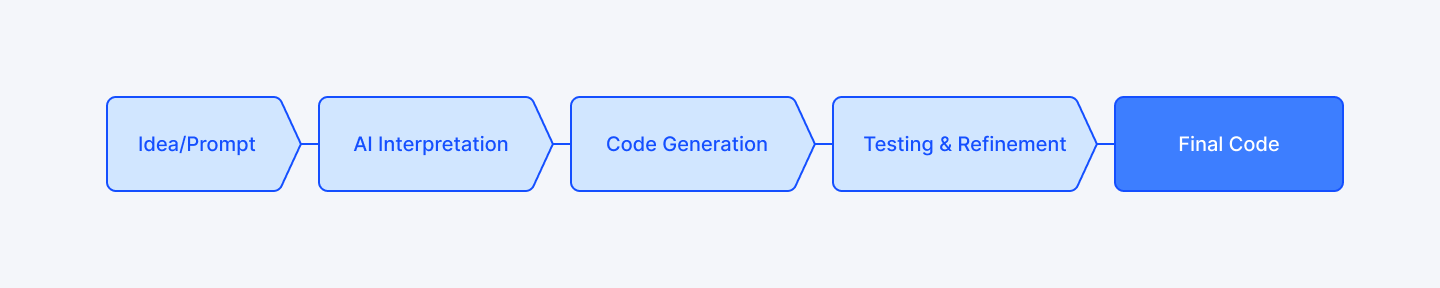
This diagram highlights how each step collaborates to produce reliable software rapidly.
The iterative cycle—prompt generation, code output, debugging, and improvement—is what makes Vibe Coding not only fast but also highly adaptable to agile development practices.
Benefits in 2025 Market Dynamics
Startups and MVPs
For cash-strapped startups, Vibe Coding has been nothing short of revolutionary. Teams can now build functional MVPs with a fraction of the resources previously required. One YC-backed founder shared that they went from concept to working prototype in three days—a process that would have taken weeks with traditional development.
Enterprise Adoption
It's not just startups embracing this approach. Fortune 500 companies are incorporating Vibe Coding into their development processes, though typically alongside more traditional methods. Financial institutions use it for rapid prototyping while maintaining human oversight for critical systems. Healthcare companies leverage it to accelerate development of non-critical applications while maintaining compliance with regulatory requirements.
The pattern is clear: Vibe Coding excels at accelerating development cycles and reducing barriers to entry, while traditional approaches still dominate where absolute reliability and security are paramount.
Best Practices for Adopting Vibe Coding
To successfully integrate Vibe Coding into your development process, you should consider these best practices:
Establish Robust Prompt Engineering
- Craft Clear Prompts: Ensure that every natural language instruction is detailed and precise. This minimizes ambiguity and improves code quality.
- Iterative Feedback: Look at the output critically and push back when needed. The best results come from developers who aren't afraid to tell the AI, 'That's not what I meant' or 'This approach won't scale.' Each round of feedback improves the output substantially.
Implement Thorough Testing Protocols
- Automated Testing Suites: Don't skip testing just because AI wrote the code. If anything, automated tests become even more crucial—think unit tests, integration checks, and security scans that catch what the AI missed.
- Code Review Processes: Never fully trust the AI without a human once-over. Even the best systems occasionally produce elegant-looking code that's completely wrong, especially for security-critical components.
Continuous Learning
- Train Your Team: Invest in training sessions so that your developers understand how to leverage AI effectively without losing their core coding skills.
- Stay Updated: The landscape of Vibe Coding is evolving rapidly. We recommend keeping abreast of the latest research and tool updates through trusted industry sources.
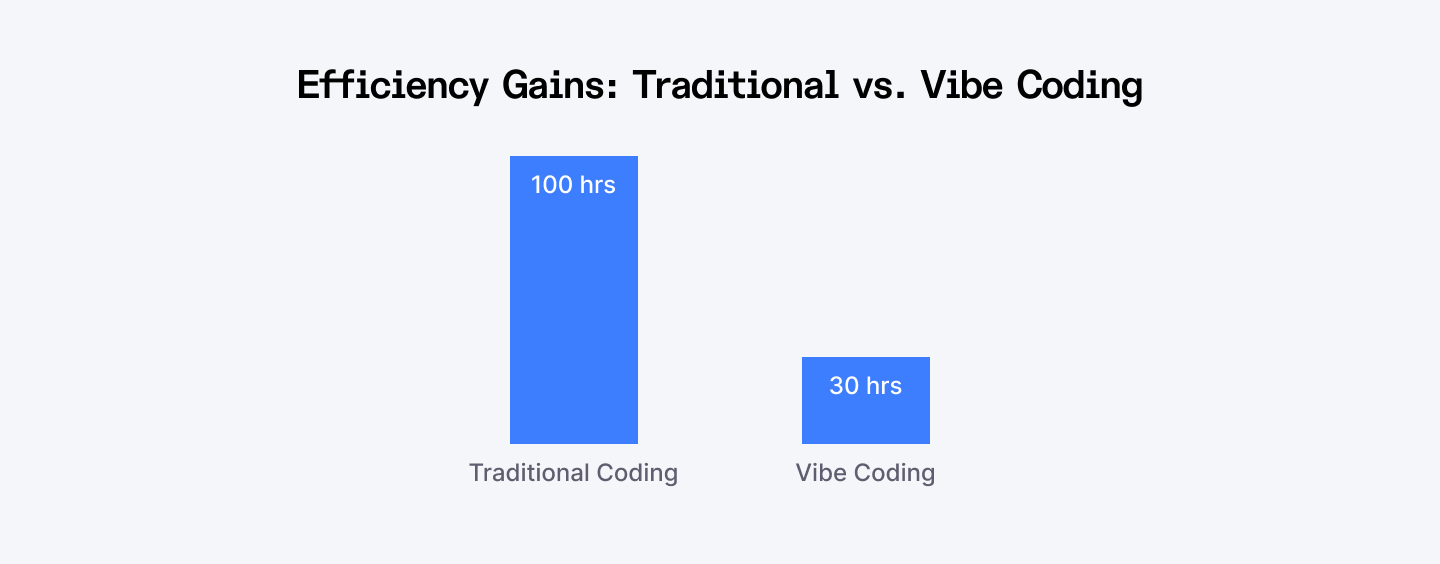
This figure shows ‘Efficiency Gains: Traditional vs. Vibe Coding’ comparing traditional coding timelines with Vibe Coding to vividly illustrate the time and cost savings achieved when using AI-assisted methods.
Integration with Agile and DevOps Methodologies
The iterative nature of Vibe Coding fits perfectly within Agile frameworks. The quick back-and-forth between developer and AI means you can rapidly prototype, get feedback, iterate, and deploy—exactly what agile methodologies call for. Hook this into your DevOps pipeline, and suddenly you're pushing updates faster than ever, without sacrificing reliability. Teams using this approach report slashing sprint completion times by 30-40% while maintaining quality metrics.
Challenges and Limitations
While the benefits are compelling, Vibe Coding does come with challenges:
Ethical Considerations
- Transparency & Accountability: Transparency in AI-generated code and accountability for errors are critical issues that need careful attention. We must ensure that the human element in programming isn’t lost.
- Impact on Employment: AI tools are game-changers—reshaping what it means to be a developer, and not everyone's thrilled about it. Some veteran coders are watching junior tasks they cut their teeth on get automated away and wondering if their jobs are next. It's not just paranoia—the landscape is shifting. But skilled developers are irreplaceable. We need to invest in upskilling our people—keeping their expertise sharp while embracing these new capabilities.
Technical Debt and Code Quality
- Debugging Complexity: AI-generated code may sometimes be murky, leaving you with unexpected bugs and logic errors that are difficult to trace.
- Maintenance Issues: Rapid code generation can lead to technical debt, making future modifications and scalability challenging.
- Security Vulnerabilities: Without thorough human oversight, there’s a risk that AI might introduce insecure practices into the codebase.
Over-Reliance on AI
- Skill Atrophy: Overdependence on AI may reduce your team’s hands-on coding skills, which are essential for understanding and maintaining complex systems.
- Quality Assurance: Without rigorous testing and review, there is potential for inconsistent quality, leading to systems that work in the short term but falter under scale.
Industry experts have noted these challenges, urging companies to implement robust review and testing protocols alongside Vibe Coding practices. For instance, detailed discussions in Business Insider emphasize the need for iterative feedback loops and continuous learning.
Future Trends and Predictions
Looking ahead, we can expect several key developments:
Specialized Domain Applications
General-purpose code generation is just the beginning. Development platforms will increasingly integrate AI tools directly into the coding environment, making Vibe Coding an everyday practice.
We're already seeing specialized tools emerge for specific domains like game development, embedded systems, and data science. These domain-specific variants incorporate best practices and patterns unique to their fields, producing more targeted and optimized solutions.
Evolving Developer Roles
Nobody's throwing away their programming books yet, but the daily work of developers is shifting. Rather than spending hours typing out every function and class, many developers now spend their time defining the problem space, critiquing AI-generated solutions, and focusing on the pieces that actually matter to users.
This bumps developers up the value chain. Instead of being code monkeys, they're becoming more like architects and product designers who happen to know how code works. The boring parts get automated while the interesting challenges get more attention.
Coding bootcamps are scrambling to figure out what to teach. Some still push traditional coding fundamentals, while others are pivoting hard toward "AI collaboration" courses. The jury's still out on which approach will win, but students are voting with their wallets for programs that teach both.
Hybrid Approaches
Smart teams aren't going all-in on AI or sticking purely with traditional methods. They're getting pragmatic about it—using Vibe Coding to knock out prototypes, UI components, and standard features, while keeping human hands on mission-critical systems and security infrastructure.
It's not ideological; it's about using the right tool for the job. Much like how we still write some performance-critical code in C++ despite having higher-level languages, we're developing instincts about when to let the AI take the wheel versus when to grab it ourselves.
Getting Started with Vibe Coding
Ready to dive in? Here's a practical roadmap:
- Start with existing tools: GitHub Copilot, Replit's Ghostwriter, and Cursor provide accessible entry points.
- Develop prompt engineering skills: Learn to communicate effectively with AI systems—this is perhaps the most valuable skill in the Vibe Coding era.
- Build a test-driven workflow: Robust testing becomes even more critical when working with AI-generated code.
- Join communities: Connect with others exploring these techniques; platforms like GitHub, StackOverflow, and Index.dev host active communities sharing best practices.
To help you visualize the process, here’s flowchart outlining the key steps of Vibe Coding:

This diagram captures the cyclical, interactive nature of Vibe Coding—a process where you continuously refine the output until it meets your high standards.
Explore More: 15 Best AI Tools to Transform Your Developer Workflow in 2025
Final Thoughts
Despite the technological advances, the most successful Vibe Coding implementations maintain a strong human presence. The technology augments human creativity rather than replacing it. As one seasoned developer put it: "The AI handles the typing; we handle the thinking."
At the end of the day, Vibe Coding is changing how we build software by letting us speak naturally about what we want to create instead of getting lost in implementation details. It's making development faster and opening doors for people who have ideas but couldn't code before. There are still plenty of kinks to work out with code quality and ethical questions, but the trajectory looks promising as AI systems keep getting better.
By rolling with this change instead of fighting it, your team can use AI for the grunt work while focusing your human creativity and insight on the problems that actually matter. Platforms like Index.dev are showing what's possible when you embrace this approach thoughtfully. With the right guardrails and practices, Vibe Coding becomes another powerful tool in your development toolkit - not a replacement for human ingenuity, but an amplifier for it.
For AI Companies:
Hire senior AI developers from Index.dev—vetted, matched in 48 hours, and risk-free for 30 days!
For AI Developers:
Join Index.dev and work on cutting-edge AI-powered projects with top global companies.