Startup hiring today feels like a ghost story on repeat.
Candidates vanish. Hiring managers disappear. Job descriptions sound like riddles. And somewhere between “urgent” interviews and unpaid take-home tasks, everyone forgets this was supposed to be about people, not process.
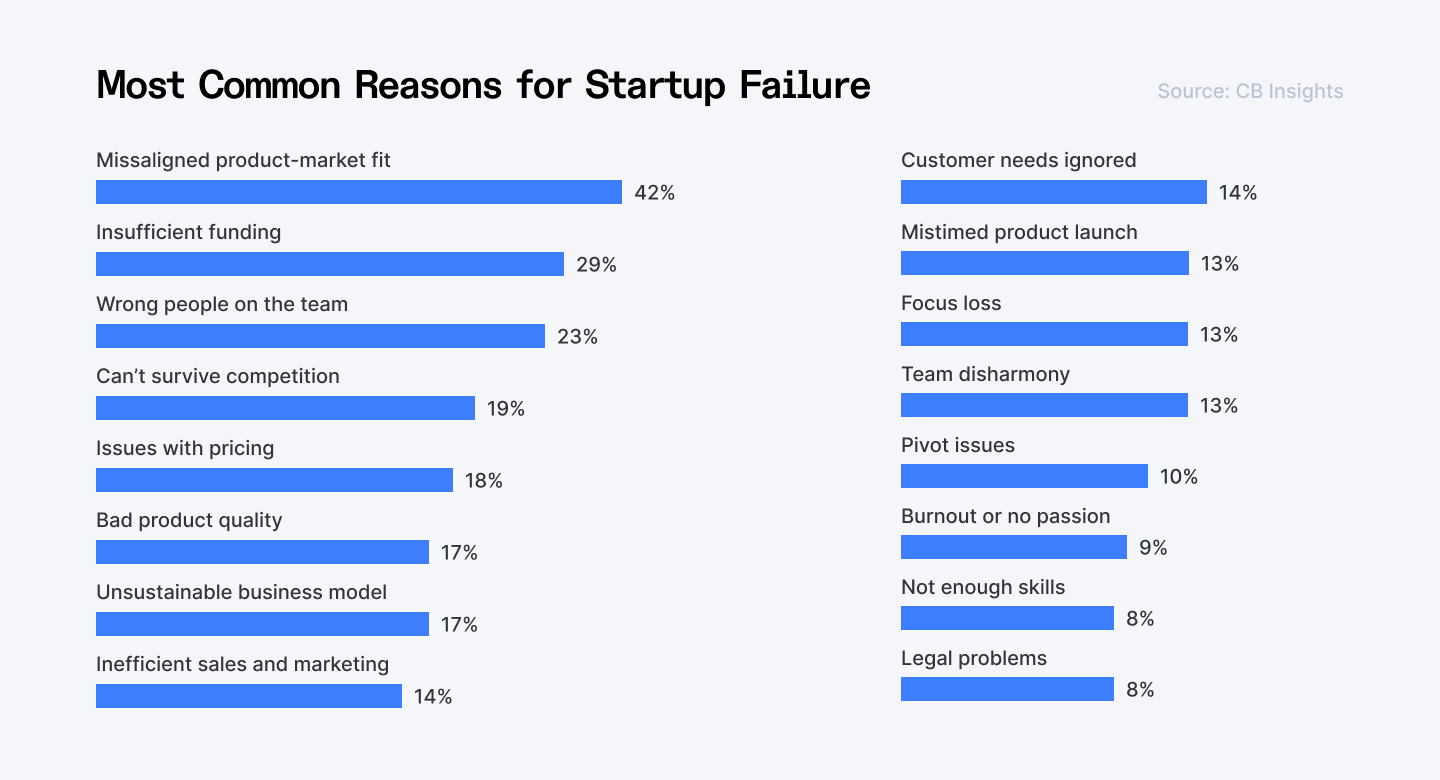
As Jaimit Doshi put it:
“The hiring process is so broken, it feels haunted. Everyone’s seeing ghosts and no one seems to care.”
He’s right.
After watching hundreds of startups scale through Index.dev, I’ve seen the same story unfold: founders chasing speed, recruiters chasing coverage, managers chasing optionality, while candidates are left chasing clarity.
It’s not a talent problem. It’s a system problem. One built on misalignment, over-engineering, and a fundamental lack of respect for people’s time.
But it doesn’t have to stay that way.
Let’s unpack the biggest hiring red flags haunting startups, and how to fix them before you scare off great talent.
Looking to hire developers faster and smarter? Index.dev helps startups build fair, efficient hiring processes and connect with top global tech talent.
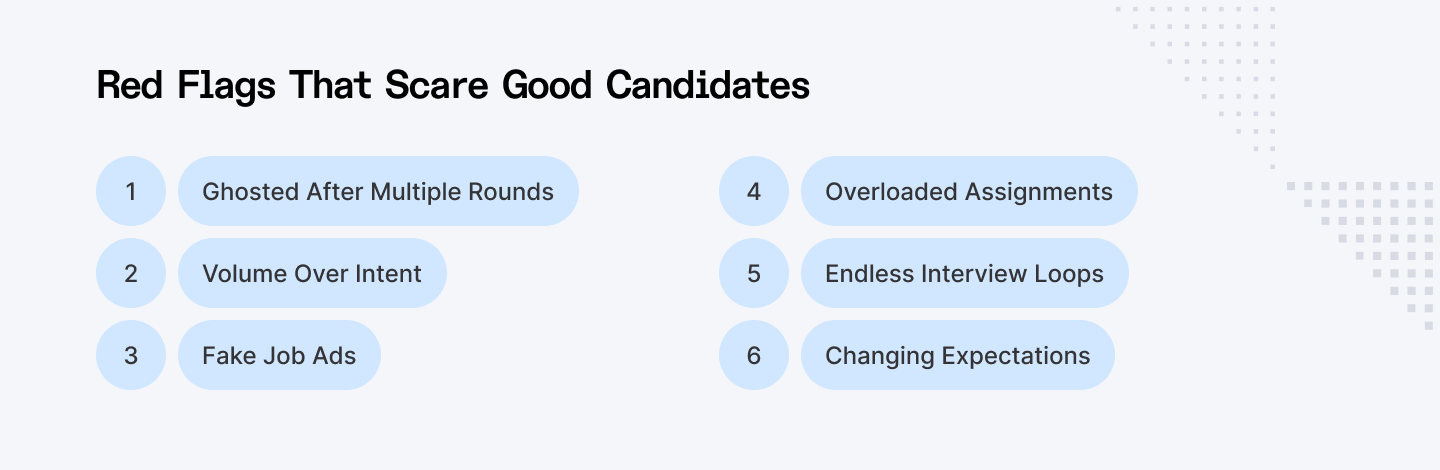
Red Flags That Scare Good Candidates
We talk to thousands of developers and engineers across the world. The patterns are painfully consistent. Smart, capable people walk away from promising startups, not because of the job, but because of how they were treated during hiring.
Here are the patterns they keep pointing out:
1. Ghosting After Multiple Rounds
Candidates invest evenings, weekends, and emotional energy preparing for interviews or assignments, and then? Silence. No feedback. No closure.
According to surveys:
- 61% of job seekers say they’ve been ghosted after at least one interview.
For candidates, this isn’t just rude. It’s discouraging. It kills motivation. It erodes trust in your brand. They don’t just remember the silence, they tell others about it.
And when good people stop applying, your hiring problem doesn’t just continue. It compounds.
Quick fix: Always close the loop. A short, honest “no” beats silence every time. It takes two minutes, costs nothing, and says everything about your culture.
2. When Volume Replaces Intent
AI has its place. But it also floods hiring systems with thousands of applications in seconds.
- 38% of job seekers admit they mass-apply, sometimes to hundreds of roles with a single click.
Recruiters, in turn, drown in volume. Overwhelmed, they lean on filters, bots, and automated replies. And that’s where hiring starts to lose its human touch. Candidates feel like numbers, not humans.
When your inbox turns into a numbers game, so does your reputation.
At Index.dev, one of our tech recruiters, Kate Poleacovski, put it best:
“Respect shows in the small things. If you value someone’s time, they’ll value your company.”
Automation isn’t the enemy. Indifference is. Use AI to streamline, not to disconnect.
Quick fix: Don’t measure success by the number of résumés received, measure it by the quality of conversations started.
3. Job Ads That Don’t Exist
Everyone's hiring. No one's being hired.
If you’ve ever applied for a role that seemed real, only to realize it wasn’t, you’re not alone.
Studies suggest up to one-third of all posted jobs are what the industry calls ghost openings: listings meant to attract resumes, not fill positions.
The reasons are surprisingly deliberate:
- 66% post to appear like they’re growing.
- 63% want to reassure current teams help is coming.
- 62% aim to signal that employees are replaceable.
- 59% use fake roles to build a candidate database.
That’s not hiring, that’s optics.
It wastes time, damages credibility, and erodes trust long before the first interview.
Candidates talk. Word spreads. And once your brand is labeled as misleading, it’s nearly impossible to win back confidence.
Quick fix: If a role isn’t real, don’t post it. Authenticity scales better than vanity metrics ever will.
4. Overloaded Test Assignments
Somewhere along the way, “assessment” turned into unpaid labor.
We’ve seen startups ask candidates to:
- Build full e-commerce platforms
- Design complete API architectures
- Create product roadmaps and GTM plans
- Develop working app prototypes
These aren’t assignments. They’re free consulting projects disguised as evaluation.
Too many startups forget that candidates already have full-time jobs. Asking them to spend nights or weekends on heavy take-homes is not diligence, it’s exploitation. And worse, many of these submissions never even get reviewed.
Research shows that work samples have limited predictive power when stretched beyond practical scope. The more you ask, the less reliable the signal.
Quick fix: Keep it short. Limit take-homes to 2–3 hours. Pay for anything heavier, even a small token shows integrity. Or, better yet, replace them with live problem-solving sessions that test how candidates think, not how long they can grind.
5. Endless Interview Loops
Six rounds. Same questions. Different faces. By the end, candidates are exhausted.
This is one of the biggest reasons good talent walks away.
- Only 24% of candidates say they’re happy with the hiring process.
- More than half drop out if the first interview isn’t scheduled within a week.
- And 52% of companies drag the process across 4–6 weeks.
Even Google, known for its rigor, studied its own hiring data and found that four interviews are enough to make a confident decision with 86% accuracy. Anything beyond that adds no value.
Every extra round signals indecision. And indecision is expensive.
Quick fix: Cap it at three structured rounds. Align on evaluation criteria early. Communicate timelines clearly. When you move fast and thoughtfully, candidates take you seriously.
6. The “We’ll Know It When We See It” Trap
It starts small.
- JD: “Mid-level Frontend Developer, React experience preferred.”
- Round 1: “Oh, we might need some backend support.”
- Round 2: “Actually, DevOps skills would help.”
- Final Round: “We’re thinking of shifting this to a Tech Lead role.”
That’s not evolution, that’s confusion.
When the role keeps changing mid-process, what you’re really showing is a lack of internal alignment. You’re hiring reactively, not strategically. Someone leaves, funding arrives, or a deadline looms, and you post a job without clearly defining the problem that role should solve.
A developer from the Index.dev network summed it up perfectly:
“By the end, I was interviewing for three different positions. They clearly had no idea what they were hiring for.”
This chaos hurts everyone. Candidates lose trust. Recruiters lose credibility. And companies lose talent, 20% of professionals reject offers after a bad hiring experience.
Quick fix: Get aligned before you go live. Define the problem, the outcomes, and the level. Hiring isn’t a guessing game, it’s a reflection of how well your team thinks and leads.
Next up: 11 mistakes to avoid when hiring remote software developers.
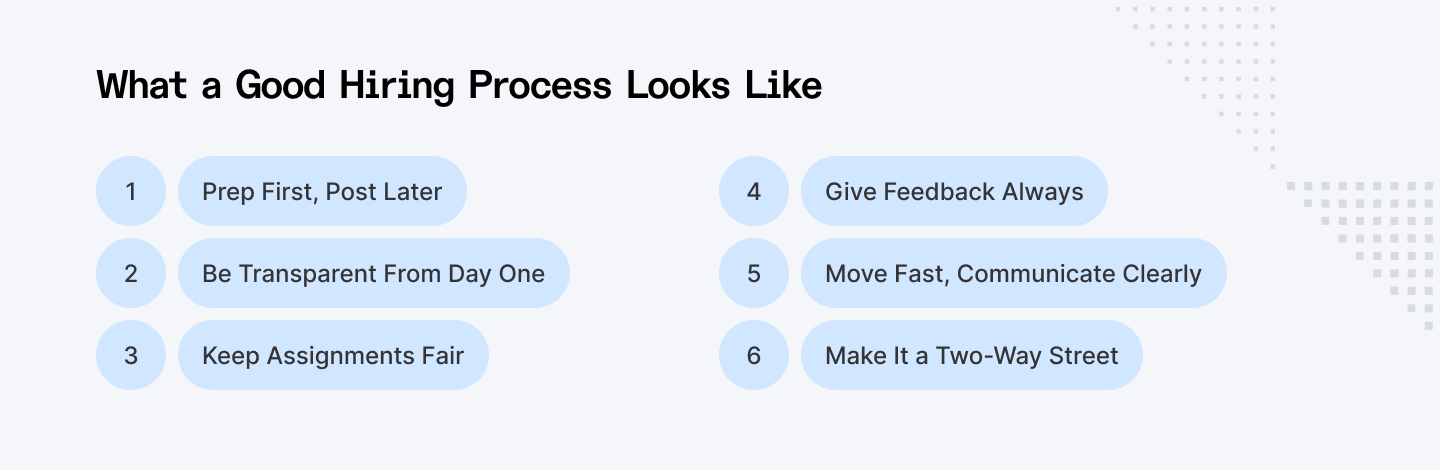
What a Good Hiring Process Looks Like
Startups move fast. But fast doesn’t mean sloppy. Here’s the framework we see consistently succeed when hiring remote tech talent:
1. Prep First, Post Later
Don’t post a role because funding arrived or someone quit.
Define the problem the role solves. Lock the title, salary band, responsibilities, outcomes, and reporting lines before you reach out.
Clarity upfront saves time, frustration, and poor hires later.
2. Be Transparent From Day One
Candidates are evaluating you as much as you’re evaluating them.
Share the salary range, outline the interview structure, and clarify who’s involved and how long it will take.
Transparency signals respect and builds trust before the first conversation even starts.
3. Keep Assignments Fair
Assignments should test problem-solving, not free consulting.
- Keep tasks short and realistic (2–3 hours max).
- Pay for anything heavier, even a token amount counts.
- Or use live sessions: pair programming, one-hour access to your codebase, or collaborative problem-solving.
Fair assignments protect your brand and give candidates a meaningful glimpse of the work they’ll actually do.
4. Give Feedback, Always
Every touchpoint matters.
Respond within 48 hours, yes, even to a “no.” Silence erodes trust; clear feedback reinforces your reputation.
5. Move Fast, Communicate Clearly
Close loops quickly. Limit to three focused rounds. Avoid repetitive loops.
Speed shows respect. Clarity shows leadership. Together, they show you value the candidate’s time.
6. Make It a Two-Way Street
Hiring is a partnership, not a favor. Candidates are choosing you too.
- Use tools like Lever or Greenhouse to track status and make feedback visible.
- Let automation support the process, but never replace human care.
The companies that get hiring right aren’t just filling roles. They’re building trust, credibility, and teams that last.
Read next: How to hire developers: the know-all guide.
The Cost of Getting It Wrong
Strong hiring processes are business-critical. Research from Glassdoor shows companies with well-structured hiring are 3.5x more likely to make quality hires. Meanwhile, 77% of job seekers report being ghosted after interviews. This is a direct link between broken processes and missed opportunities.
But here's what most founders don't realize: bad hiring experiences spread like wildfire in developer communities. Recent research shows 58% of candidates share negative experiences online: on LinkedIn, Discord, Reddit, Slack, or at meetups. In tight-knit tech circles, the ripple effect is even bigger. Every ignored email, every last-minute cancellation, every meaningless assignment leaves a mark.
"I've had developers come to us completely burnt out from startup hiring processes," says Anastasia Dontova, Index.dev’s Technical Sourcer. "One senior engineer spent 20 hours on take-home assignments in a single month, for five different companies. Zero offers. Zero feedback. He was ready to give up on startups entirely."

That engineer? Within six months at one of our clients, he was promoted to Tech Lead. Imagine losing talent like that. Not just the individual, but the network, colleagues, and referrals they influence.
For Candidates: Stop Enabling Bad Behavior
Developers have power in this market. Use it.
You can't complain about bad hiring while simultaneously accepting it.
Walk away from processes that disrespect your time or energy. Red flags include:
- No salary range in the job posting
- Assignments without clear scope, timeline, or compensation
- Multiple interview rounds asking identical questions
- Interviewers who haven’t read your resume
- Technical interviews unrelated to the actual job
- Companies that can’t explain what you’d be working on
Ask hard questions: about development processes, team health, technical debt, and growth plans. If a company gets defensive about basic transparency, that tells you everything you need to know.
Your time and energy are finite. Respect them. There are better opportunities waiting. Don’t settle for ghosted emails and wasted weekends.
Also explore: AI talent retention strategies → keeping your best AI developers.
Final Thought
As Jaimit Doshi perfectly put it:
"How you hire is how you lead. And how you treat someone before they join is how they'll remember you long after they don't."
Good hiring isn’t complicated. It’s basic human decency applied systematically to business processes.
Respect people’s time.
Be transparent about expectations.
Give feedback.
Make decisions quickly.
Treat candidates like potential partners, not disposable resources.
Do this consistently, and you’ll hire better people faster while building a reputation that attracts even more talent. Ignore it, and watch great candidates choose your competitors while you wonder why you can’t find “good people.”
The market has shifted. Developers have options. Being decent isn’t optional, it’s a competitive advantage.
At Index.dev, we’ve seen this play out hundreds of times. Companies that treat candidates as partners, not resources, consistently win the best talent.
➡︎ Index.dev has facilitated 500+ remote matches between startups and top developers worldwide. We help you build smarter, fairer hiring processes and connect with skilled talent that shares your vision and drives your growth.
➡︎ Want to dive deeper into hiring and retaining top tech talent? Explore guides on the best tools to hire AI developers for startups, tech hiring reports from Index.dev’s clients, AI tech stacks for startups, how to use AI to hire developers, and what’s next in the tech job market. Browse our complete collection of expert insights and practical strategies for building high-performing tech teams.