The question echoes through every tech conference, Slack channel, and LinkedIn thread:
Is AI coming for developer jobs?
Here's the short answer: No. AI isn't replacing developer jobs. Rather, it's changing what developers do.
But the story is more nuanced than that.
Here's what the data actually shows: According to the 2025 Stack Overflow Developer Survey, 84% of developers use AI tools now. Yet the software engineering job market is projected to grow by 17% through 2033—adding roughly 327,900 new roles. This isn't a contradiction. This is exactly what happens when productivity tools reshape an industry.
What's actually happening is a restructuring.
The auto industry automated assembly lines. Did that kill manufacturing jobs? No. It killed certain manufacturing jobs—specifically, the repetitive ones—while creating demand for entirely different roles. Mechanics, engineers, technicians. Different people doing different work.
Development is experiencing the same transformation. Some roles are shrinking. Others are exploding. Your value depends on which side you end up on.
Want to thrive in the AI-driven developer market? Join Index.dev to access projects where your system design and judgment skills are valued.
Stop Confusing Code Generation With Job Elimination
The Reality
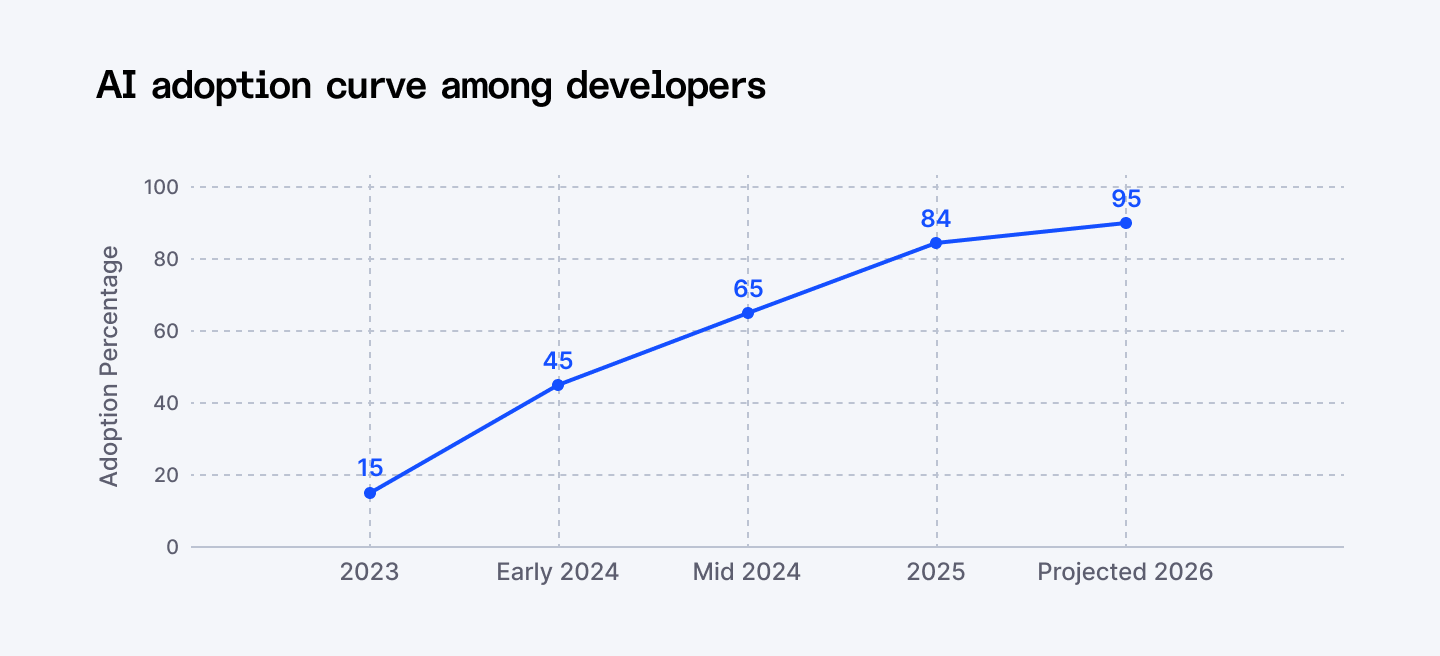
AI Adoption Curve: Developer AI tool usage growing from 15% (2023) to 84% (2025)
Here's what AI actually does: it completes routine tasks 55% faster. Boilerplate. Standard tests. Utility functions. API scaffolding.
Leadership sees that and thinks: "Fewer developers needed." But this was never the work that defined developers. It was the work that buried them.
The Apprenticeship Pipeline (And Why It's Broken Now)
Historically, junior developers paid dues. You wrote boring stuff. You learned how code actually worked. You moved up. This apprenticeship model created a pipeline: interns → juniors → mid-level → senior.
AI didn't eliminate that pipeline because it's too valuable. It eliminated the grunt work that made the pipeline painful.
The problem: nobody planned for what comes after.
The Hidden Crisis: No Learning Grounds Left
When you remove the learning ground, you create a talent crisis further up.
Consider the numbers:
- Graduates now account for just 7% of new hires at major tech companies (down 25% from 2023)
- Entry-level computer science graduate unemployment is 6-7%—worse than senior roles
That's not a replacement. That's a disruption. Companies haven't figured out how to onboard juniors when the juniors have nothing routine to do.
What This Means: A Painful Transition Period
The market will adapt. It always does. But the transition period is real, and it's painful for early-career developers.
Where Developer Jobs Are Growing
Job shrinkage isn't universal. It's concentrated.
Financial technology companies are hiring heavily in AI-driven trading platforms. Manufacturing automation is adopting smart systems. Information services is building data analytics infrastructure. These sectors need engineers who solve actual problems, not generate components.
The Pattern: Complexity Over Velocity
Notice the pattern: complexity and ownership. Not code velocity.
The roles they're hiring for:
- Full-stack engineers who own entire systems
- Backend developers managing infrastructure
- DevOps specialists handling deployment pipelines
- AI/ML engineers building production systems
- Cybersecurity specialists protecting data
- Cloud architects designing scalable platforms
The Data: Where Growth Is Actually Happening
According to Reddit and developer job boards:
- Machine Learning Engineer roles: +39.62% year-over-year
- Data Engineers: +9.35%
- DevOps Specialists: +2.92%
- Frontend Engineers: -9.89%
The math is simple: AI excels at frontend code generation and repetitive patterns. It struggles with ML model optimization, infrastructure decisions, and system architecture.
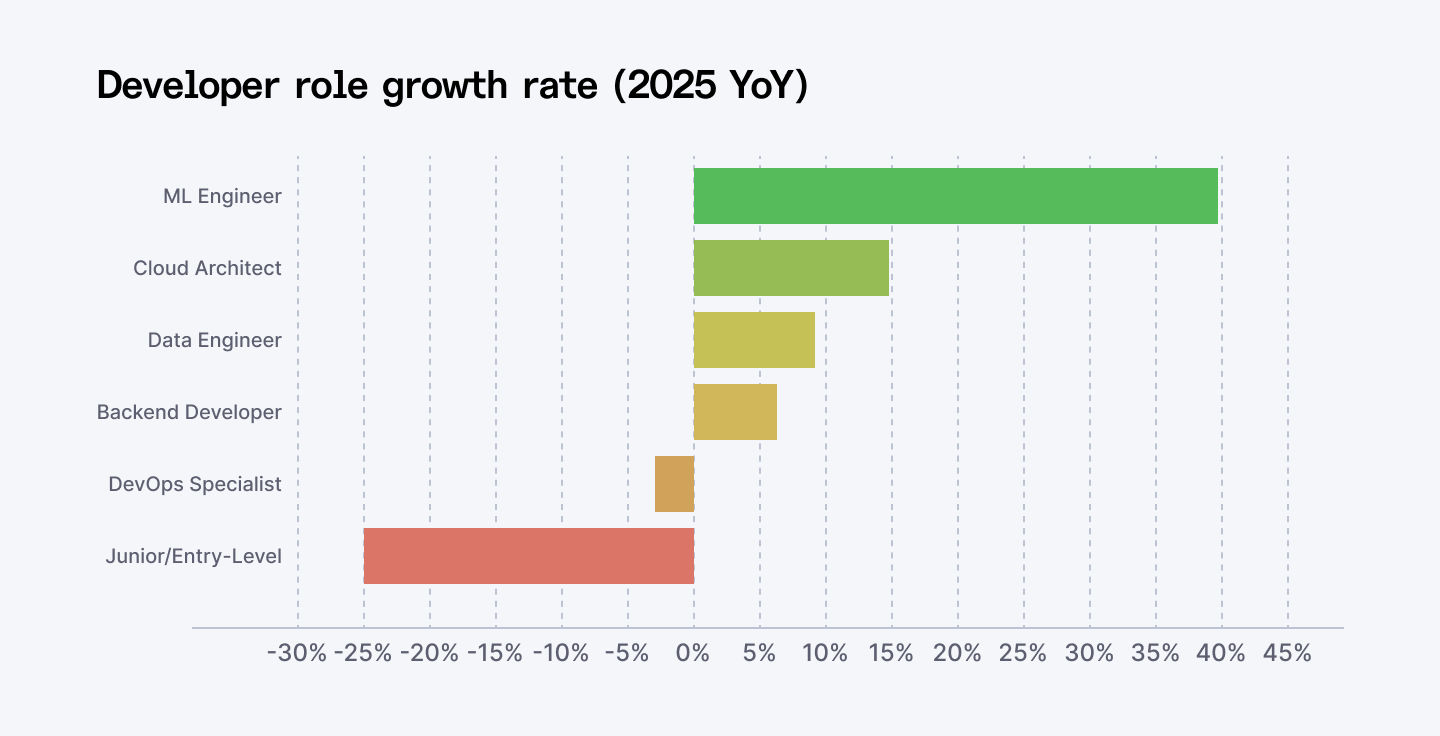
Which developer roles are growing vs. shrinking? Year-over-year growth rates by role
The Emerging Categories (And Where They're Headed)
Three years ago, "Prompt Engineer" wasn't a real role. Now companies are hiring for it.
Same with:
- MLOps specialists
- RAG (Retrieval-Augmented Generation) developers
- AI Governance specialists
- AI Infrastructure engineers
New AI-related job postings grew 38% between 2020 and 2024. Companies are posting for "GenAI Engineer" and "MLOps Specialist" roles at 2-3× higher rates than five years ago.
These aren't lateral moves. They're new markets opening.
Explore the tech skills that can boost your career and lead to six-figure salaries in today’s market.
The Real Cost: Code Review Burnout Is Climbing
AI didn't create more time. It created a new job: babysitter.
Before AI, senior developers reviewed junior code as mentorship. Now they review AI code at scale.
The Burnout Is Real (And The Data Proves It)
Studies show experienced developers now spend 19% more time on code review than before Copilot arrived.
Here's what that looks like in practice: One enterprise deployed AI to 300 engineers. 93% wanted to keep using it. But their code shipment volume increased 28%, with 30-40% of that code being AI-generated.
The math is brutal: Meaning more code to review. And it's code written by something that doesn't understand context, domain knowledge, or long-term implications.
The result? Code review burnout is real and climbing.
Why Senior Developers Are The Bottleneck
Developers cite review fatigue as a top contributor to burnout—especially context switching.
Here’s why—switching from your own work to review someone else's costs 20-30% of your focus per switch. Now multiply that by 40% more code.
A senior developer with Copilot doesn't become a code-writing machine. S(he) becomes a code-validation machine.
This is the hidden cost nobody talks about when they celebrate AI productivity gains. The gains are real. But they're unevenly distributed. And they come with a hidden tax on senior engineering teams.
How The Winners Hire
Companies that understand the code review bottleneck hire differently. They invest in:
- More senior engineers (not juniors)
- Architecture reviews and documentation
- Testing infrastructure that scales
- Code review processes that protect quality
Companies that miss it? Flat headcount. Crashing code quality. And burned-out teams.
The winners are hiring more, not less. They're just shifting the mix.
They're moving dollars from junior training budgets to senior hiring budgets. From velocity to quality. From scaling humans to building systems that scale.
That's why the job market looks contradictory: fewer junior roles, more senior roles. It's not replacement. It's a rebalancing.
See which programming languages are dominating 2025 and where your skills can make the biggest difference.
The Entry-Level Crisis Is Real (But Not What You Think)
Let's be direct: junior developer hiring is down. The traditional apprenticeship is broken. Entry-level positions now require the skill level that used to be mid-level expectations.
The Numbers Don't Lie
Only 7% of new hires at major tech companies are recent graduates, down from 9.3% in 2023. Internships have declined 11% year-over-year. Tech internship postings specifically dropped 30% since 2023.
The economic logic is cut-throat: AI can handle the tasks junior developers used to do. Why train someone for six months when the tool handles it immediately?
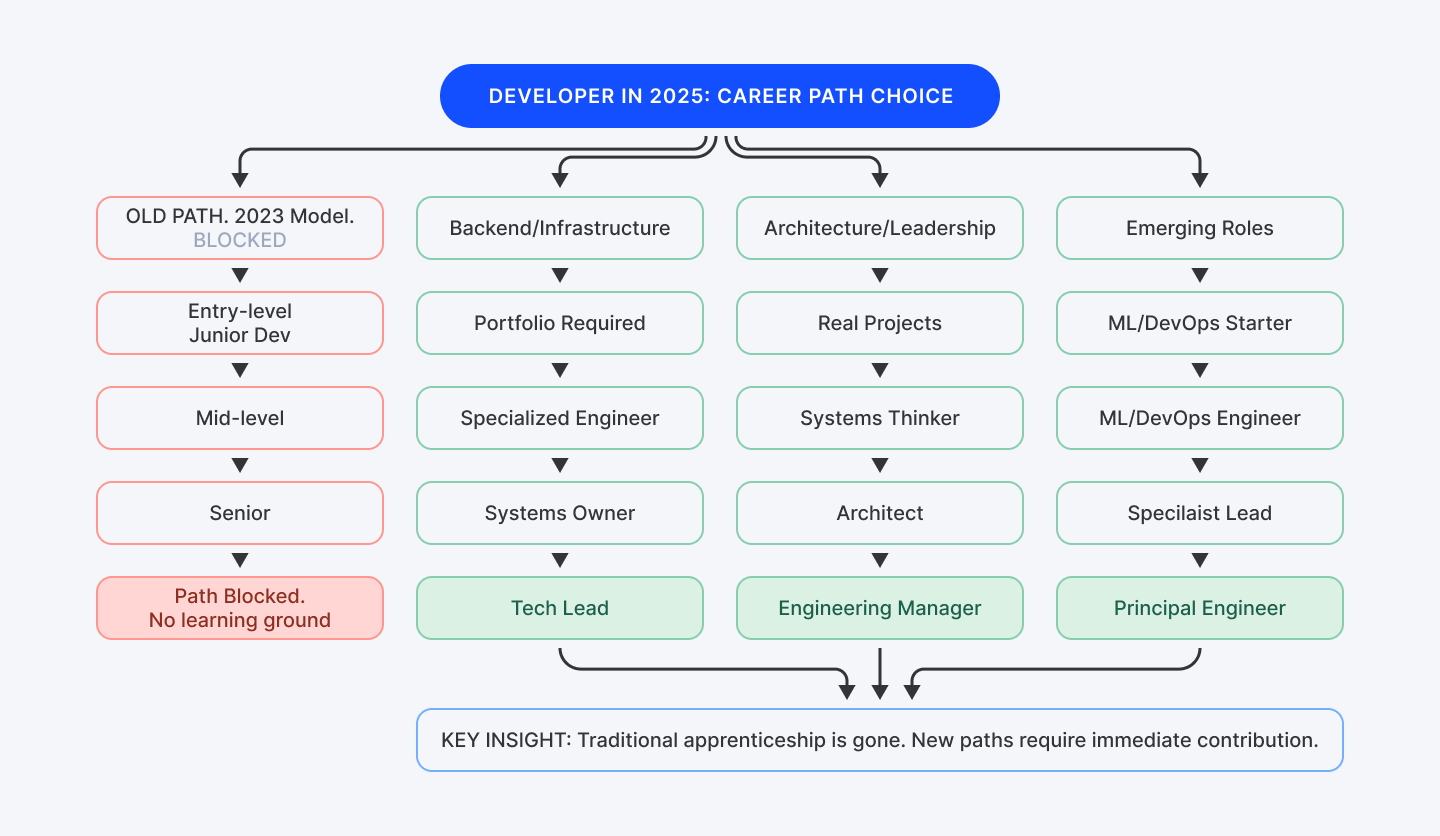
Developer Career Paths in 2025 - showing old blocked paths vs new alternative routes.
Market Favors Insiders
Here's the part nobody wants to say out loud: the market favors insiders now.
If you have five years of experience, AI is a force multiplier. You're more valuable. Your salary goes up. You work faster.
If you're trying to break in, the path got steeper. The traditional entry ramp—get hired, write simple code, move up—is gone.
But Here's The Path That Works Now
That doesn't mean junior developers can't find work. It means the path is different.
The new entry strategy:
You need a portfolio first. Real projects. Not tutorials. Not LeetCode. Actual work you built.
Startups and smaller companies still hire juniors. But they need juniors who can contribute immediately. No training wheels. The bar got higher upfront because the learning ground disappeared.
If you are a junior developer in 2025, then you need to:
- Understand what AI can and can't do (and when it's lying)
- Review AI code critically (not just accept it)
- Design systems that work at scale (AI doesn't think about that)
- Debug when AI gets stuck in a loop (which is always)
- Communicate clearly (because AI relies on it)
Open-source contributions help. Freelance projects help. Internships help. They prove you can ship code and understand what AI does wrong.
The Skills That Changed (And The Ones That Didn't)
You're not a typist anymore.
The 2025 Stack Overflow survey revealed something important: 66% of developers are frustrated with "AI solutions that are almost right but not quite."
Translation: you now need to know when a machine is wrong. That requires understanding how systems actually work—something that can't be automated away.
What Developers Need Now (The Non-Negotiables)
These are the skills that separated great developers in 2025. In 2026, they're mandatory:
- System design thinking – Why does this architecture exist?
- Debugging skills – Why did the AI choose this approach?
- Architectural judgment – Is this the right solution?
- Testing mentality – What will break?
- Communication – Can you explain complex ideas simply?
These aren't new skills. They're just mandatory now. Five years ago you could be a decent developer without strong system design. Now you can't.
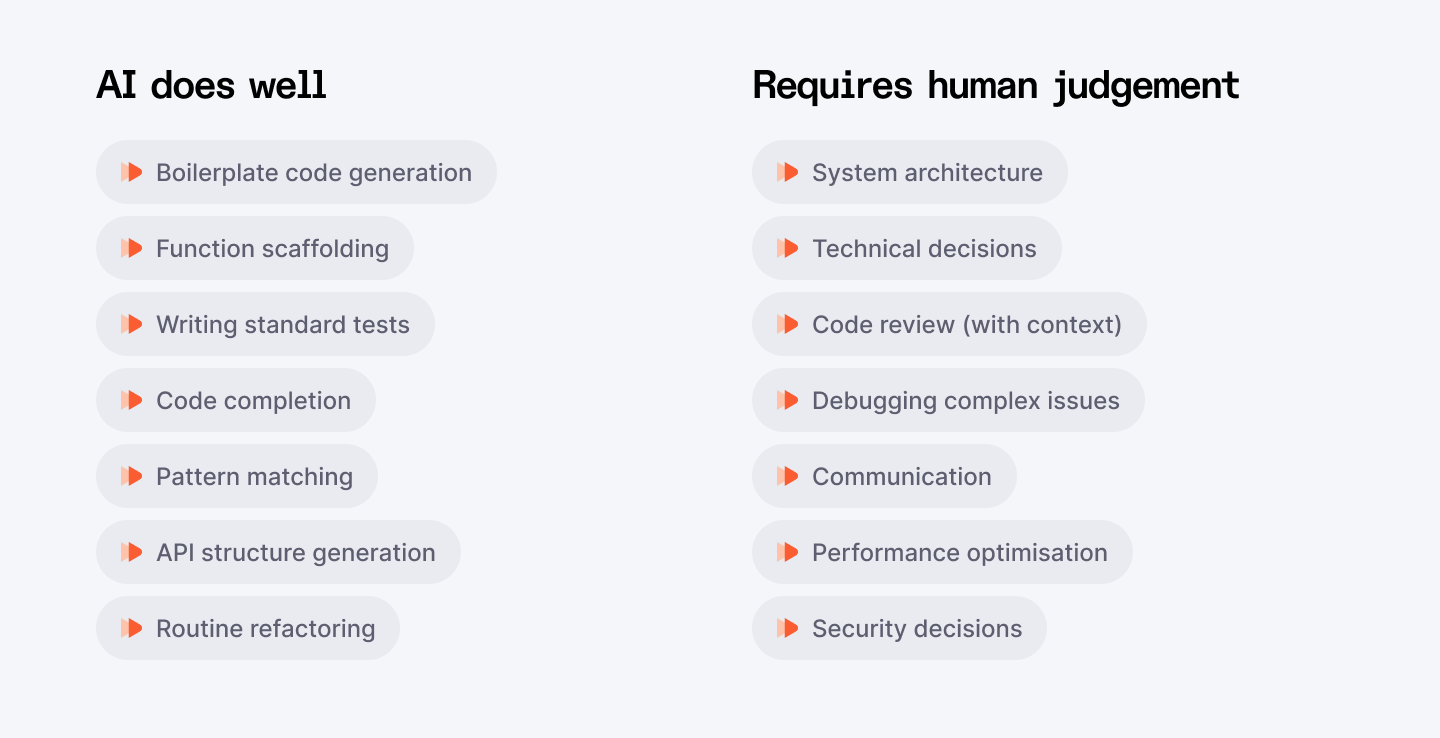
Skills breakdown: AI excels at routine tasks while human judgment drives strategic decisions
What Stayed The Same (Still Matters)
Python, SQL, and cloud skills remain in highest demand. But the differentiator increasingly is problem-solving and communication.
AI didn't change what matters. It just made the shortcuts disappear.
The developers who thrived in 2024 by "knowing the frameworks" are now struggling. The ones who understood why systems work the way they do are thriving.
This is actually good news. It means you can't just copy-paste your way to success anymore. But it also means your depth matters more than ever.
So Here's The Reality In 2026: You're Either Building Or Maintaining
Let's summarize what actually happened:
The job market didn't collapse. It restructured.
AI eliminated the grunt work. That sounds like bad news for developers. But it also eliminated the worst part of being a junior—writing boilerplate for six months before you get to do real work.
The new reality is clearer.
Senior developers are now either code validators or architects. If you choose validation (code review), you'll be in demand but burned out. If you choose architecture (systems thinking), you'll be in demand and valued.
Junior developers can't just "learn by doing grunt work" anymore. So they need a different path. They need real projects. They need to understand when AI is wrong. They need to design systems, not just implement them.
Hiring managers who understand this are winning. They're shifting their budgets. They're hiring for depth, not velocity. They're building teams that scale because they're building systems, not just more code.
Where Do You Fit In This Picture?
If you're a senior developer or engineering leader
Your value went up. AI became your tool. Salary premium for engineers with AI-centric skills: nearly 18%.
Your code review process just became your competitive advantage. The teams winning in 2025 aren't the ones shipping the fastest. They're the ones shipping code that actually works—and staying sane while they do it.
Your move: Invest in code review infrastructure.
If you're a mid-level developer trying to level up
You're in the best position. AI made your depth valuable.There's opportunity here if you shift focus from coding to architecture.
Learn system design. Understand infrastructure. Move from "write code fast" to "decide what code to write."
The companies that understand this are paying premium salaries for engineers who can architect solutions and mentor others.
Your move: Build systems, not features.
If you're a junior developer trying to break in
The path is steeper. The traditional apprenticeship is gone. But the opportunities are still there—they're just different.
Your move: Build a portfolio. Contribute to open source. Freelance. Prove you can ship code and understand what AI does wrong.
Discover the developer skills AI can’t replicate.
AI Didn't Replace Developers. It Clarified What Developers Actually Do
The ones who write clean code fast? AI does that now.
The ones who understand systems deeply? The ones who see around corners? The ones who know when a machine is wrong? Those developers are more valuable than ever.
That's the 2025 job market. That's where hiring is exploding. That's where the premium salaries are.
The question isn't whether AI will replace your job. The question is: which side of the restructuring are you on?
Don't Get Caught In The Middle
The mistake everyone makes: assuming AI does your job.
It doesn't. It does a task in your job. A task that was never the interesting part anyway.
Think about your actual job. Yes, you write code. But you also decide whether to write that code. Anticipating what will break. Mentoring someone stuck on a problem. Pushing back on a requirement because you see where it'll fail. Simplifying something overcomplicated.
Copilot can write a utility function in seconds. It can't decide if you need it. It can't evaluate whether that's the right approach or if it'll actually scale. It can't see the risks coming.
That requires judgment. Understanding your system deeply. Knowing what you don't know. Seeing problems before they happen. Communicating tradeoffs clearly.
And here's the thing: that's not a limitation of current AI. It's fundamental. You can't compete with AI on speed. You never could.
But that's never been the point.
There's a skill AI absolutely cannot replicate: knowing what's right when there's no single right answer. That's judgment. And that's where developers are worth money.
➡︎ Ready to prove AI can't replace your judgment? Index.dev matches developers who've mastered the skills AI can't replicate—system design, architecture, and debugging complex problems—with companies paying premium salaries for depth over velocity. Apply today!
➡︎ Looking to hire developers who thrive alongside AI? Index.dev connects you with top engineers ready to architect, innovate, and scale your projects.
➡︎ Want to explore how AI is transforming developer roles and hiring? Check out guides like AI in cloud development, developer productivity statistics with AI coding tools, 5 industries on the edge of AI transformation, and reviews of top AI tools like Claude vs ChatGPT, v0 vs Bolt, and Mistral AI.